Alchimie

Le fou
(lui-même)
allume mon briquet
avec la tête
d’une allumette illustré
avec le schématique
du feu
designee
en d’or
mir(acle)
alchimie


The fool
(himself)
lights my Bic
with the head
of a match illustrated
with the schematic
of Fire
designated
in gold
mir (Acle)

sleeping
alchemy

by Bonnie McClellan

ecoutez ce poem ici…listen to this poem below:


IPM 2MXI…Where have all the poems gone?

“We’re all trying: poets to give you, the reader, the gift of an image that cannot be offered in any better way, that cracks you a bit and frees something; you, readers, are giving us the gift of your searching, your curiosity, your attention…”

That’s what I wrote on the 31st. of January when I inaugurated International Poetry Month 2011 and now, on the 2nd of March I say, with joy, it happened…the exchange of gifts between poets and readers.

Now what?

International Poetry Month 2011 is closed. The marauding hordes have left the library ablaze, the flood has washed away the ashes, the caravan carrying the last copy of the precious poetry collection has vanished in the desert; at least that’s what it feels like to me as I hit the delete key and erase the written versions of the poems.

What remains is the oral tradition; I have made audio files of each poem available where the poem used to be posted.  Anyone who is on my e-mail list has a ‘fragment’ of each work. Perhaps, like the poems of Sappho, this is all that will remain.

I would like to extend my profound thanks to the following guest poets for their contributions:

Anonymous 2oth Cent. Poet

Cesare Bedognè

Gilles-Marie Chenot

Chris Fillebrown

Brad Frederiksen

Giacomo Gusmeroli

Michelle Lee Houghton

Christian Stokbro Karlsen

Tom McClellan

Angel Raiter

Adina Richman

Liliane Richman

Jere Schaefer

Octavio Solis

Edin Suljic

Some of these poets have blogs or websites where intriguing writing and images may be encountered. I encourage anyone suffering from poetry withdrawal to visit these sites by clicking on any of the names that appear in bold. Others are tantalizingly unavailable, if you want to see more of their work you’ll have to hope that they come back next year. Of course my work that is or has been posted throughout the rest of the year is still here.

Thanks as well to everyone who has stopped by to read and comment on the poems either here or at podbean*. It has been a real joy to present so much fine poetry again this year. Now I have to start thinking about next year and get back to writing.

A presto!

*podbean ate my audio! All mp3’s can now be found posted with the poem.

Making Ragu á l’americana

First of all, I have to say that I know the recipe for traditional Italian Ragu. This is kind of like it but not it because that would require going to the butcher to get the precise mixture of meat ground there. Instead, this is the Ragu that I make almost every weekend with ground pork sausage that I buy at the store and what I have in the house…it’s still really good! It also does that wonderful trick of making up 3 meals worth of sauce for our family of 2 grown-ups and a little girl.
Start with mirpoix (onion, celery, carrot) either diced very small or minced fine.
The total volume of minced vegetables should be equal to the volume of meat. I use about 1 pound (500grams) of PORK sausage, this is a good quantity for 2.5 people to get 3 meals worth of sauce. It doese’t have to be Italian sausage or skinny but don’t use Jimmy Dean (which is delicious, but not for this). If in doubt, just buy high quality ground pork; but not lean, it needs some fat in it.

Saute the veggies in 1-2 tbs. of olive oil (you can use half olive oil and half butter if you want). After about 10 min over med-low heat they’ll start to caramelize a bit (if you’re lucky).
While this is cooking mince garlic (2 cloves or less) and crush some clove or get the powdered clove from the cupboard. If you’re one who’s tempted to have a heavy hand with spices, now is the time to back off by half. One of the fine qualities of good Italian food is clear, simple flavours. You can, if you like that kind of thing, crush a single juniper berry and add it to the 1/8 tsp (or less) of clove. Don’t add these yet, just have them ready. You may also chose not add any of these spices/garlic, esp. if you’re using a gourmet sausage like the kind one can find at Whole Foods.

Now comes the part where you add the wine (red or white or even a desert wine or a marsala). I’ve also used cognac. Just be aware that what you use to de-glaze the pot will effect the flavour, sweet wine, dry wine, red or white shades the tone of the finished Ragu.
This is going to cook a long time. The flavours will concentrate. If you don’t do the alcohol kind of thing, you can de-glaze with water and it’ll be okay. For the quantity I mentioned above I use 2-3 tablespoons…enough to get the good stuff off the bottom without making soup.

Now, let the wine cook down and the veggies dry out a bit in the pan. If you have sausage with a casing on it, use this time to remove the sausage ‘skin’. when the veggies have absorbed the wine and are about to start caramelizing again turn down the fire to low. Then, add garlic and spices along with the meat. Take a wooden spoon and start breaking up the sausage right away, don’t let it brown on cook up into clumps. You want it to be the consistency of…well, dog food. You can also add 1 or 2 (but not more) twists of black pepper from a pepper grinder. Do not, under any circumstances, add salt.
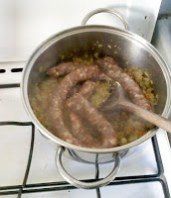
Once the meat is no longer pink but not brown. Turn off the fire under the pot (or move to a cold burner if you have an electric stove). Let the flavours sink into the meat while you decide about the tomatoes.
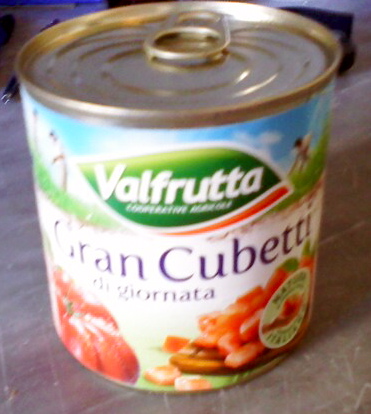
Tomatoes depend on the season. If the tomatoes you’re finding at the store have a blast of acid tang but otherwise no discernible ‘tomato’ flavour, skip them and use a good brand of canned tomato. If, on the other hand, they are big and beautiful or small and sweet, chop up about 1-1/2 cups of them being careful to conserve all of the juice. Right now it’s winter, good tom’s are hard to find so I’ve opted for pre-diced, canned tomatoes. You can also use canned if you’re just not feeling like doing all that chopping.

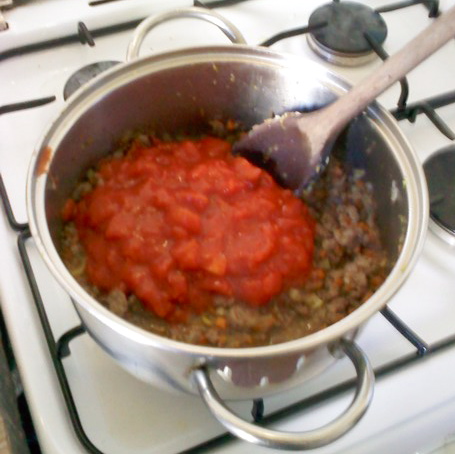
Okay, now that you’ve happily resolved the tomato issue, move the pot to the smallest burner on your stove, with it’s very lowest fire (or setting). Splorp in the tomatoes!

Okay, here comes the easy part :). Making sure that the meat is broken up as small as possible, stir in the tomatoes and slid a lid half way onto the pot and sit down to drink a glass of wine. Ragu is slow food, it needs to cook over this low fire for at least 3 hours for edible and preferably 4 for irresistable. If you started in the morning thinking you’d have it for lunch and suddenly find that it’s not going to happen, relax, you can have it for dinner. Never start a ragu later than 2 or 3 in the afternoon…unless you want it for breakfast. Remember this is 2-3 meals you’re going to put 2/3 of it in the freezer and have a care-free, ready in 20 min. meal twice next week.

Now, just to be sure, when I say a low fire on a small burner, this is what I mean. You’ll need to stir it about every half hour (unless you smell it burning). If it seems to be getting to dry, add in a dash of wine and cover it completely with a tight lid.
Brief warning, don’t cook it even 10 min. more than 4 hours, the meat will turn to saw-dust, trust me, I tried it once.
Okay, boil the pasta in well salted water (1 scant Tbs. of sea salt for every 2 quarts of water) 100 grams of pasta per person for adults. Use something that has ridges or crevices to grip the sauce or spagetti (any fresh egg-pasta is also good including filled ones such as cheese ravioli or tortolini).
Now, and only now, taste the sauce to see if it needs salt. When the pasta is almost done take the lid off the ragu and add about 1-2 tablespoons of the starchy pasta water to the sauce, turn up the heat. Drain the pasta put it in the serving bowl, add butter (yes butter, not olive oil) 1 tbs. to the pasta and one to the sauce. Turn off the fire.  If you want to eat Italian-style pasta con ragu, ladle out about 1/3 cup of sauce for each 100 grams of pasta…. Italians do not drown the pasta in sauce, if the pasta is good, it is nice to be able to taste both. In Italian they call this kind of dish pastasciutta, pasta is the main ingredient to which the sauce is added as an accent.

If you want american-style spaghetti then put the whole pot of sauce over a pound of cooked spaghetti.

Stir the sauce through the pasta and then dish it up! Tastes great with a dusting of freshly grated parmesan.

Divide the leftover sauce into two containers (about 1 cup of sauce per container) and let cool before putting in the freezer. You can also use this sauce for the meat-sauce part of Lasagna but that’s a whole day project!

Hope that you enjoy making it as much as eating it.
Train of Thought

Okay, I don’t like to dwell on the past; but, I have WWI on my mind of late. I have a whole backlog of charming ‘life in Italy’ posts that I’ve been meaning to write as soon as poetry month is under control. The one about how my daughter is afraid of the recorded voice of “the train lady” that emanates from the train station below our house or her first experience with the Feliniesque small circus. Then there’s the possible post that has a photo recipe of how to make real Ragu like an Italian.
But, instead, I’m still thinking about WWI. I started writing a poem about Georges Méliès, one of the first film-makers, the father of special effects and author of the first political film: L’affair Dreyfus (1899). I knew nothing about Méliès until, in the course of my work as a translator and language coach I was working with Dr. Barbara Grespi. Now, Barbara is one of those insanely intelligent (she’s written books on cinema history), sophisticated, and stunningly beautiful Italian women who makes someone like me feel like, well, a putz.
Anyway, I must not be too much of a putz, because she was asking me to work with her on an English language presentation about tarot iconography in the films of Georges Méliès. We were SKYPE’ing and I said George who? She said, “He’s famous for the film of the Moon with the rocket in it’s eye.” Sure enough, I wiki-ed and then Youtube-ed and came up with familiar images.
In the process I also got a bit of information stuck in my head like a piece of spinach between a canine and a bicuspid. Méliès made tons of films but then went bankrupt and sold his film business. Then he started making and selling toys at Gare du Montparnasse (a big train station in Paris). Five hundred of his films were confiscated by the French army in WWI in order to recycle the celluloid into heels for soldier’s boots.
Finally, last week I started writing the poem that had been poking and shifting in the back of my head for over a year. I wrote 10 lines of blank verse and then I sat still and started again. It all came in rhyming couplets (which I rarely use and then never one after the other) and it turned into the first eight lines of this sonnet that looked at me and then spat at my feet, asking: “why are you writing about a toy maker and a special effects man when the ground is full of the blood and bones of the people who died wearing those boots?”
It suddenly felt as if those dead stood up and cried in me, all at once. And the poem doesn’t do them justice, there was Siegfried Sassoon for that. I know that it’s not worth crying over anymore, those who died in the confused slaughterhouse of WWI would be dead now even if there hadn’t been a war; it’s too late. Still, I can’t quite shake the sensation of hopeless frustration at being unable to either stem or adequately memorialize such loss.

Gare du Montparnasse: Sonnet for Georges Méliès by Bonnie McClellan

This poem has disappeared from the site, if you’re wondering why, click HERE.

To listen to a reading of this poem, click on the play arrow: 

To read the backstory for this poem, click HERE.

The Poetry Evangelist: by Bonnie McClellan

This poem has disappeared from the site, if you’re wondering why, click HERE.

per ascoltare la poesia in italiano, fare clic sul lettore qui sotto:


To listen to or download a podcast of this poem in English, click HERE. To listen to the Italian translation, use the audio player above.

To read more poetry by Bonnie McClellan, click HERE.

I’m in love…with dictionaries!

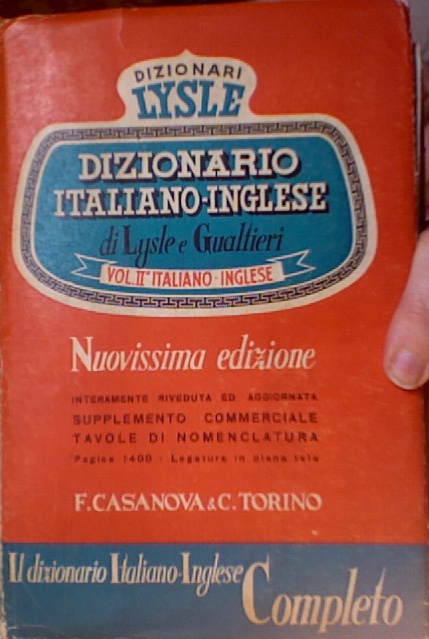
 I’m in love with this dictionary…really, it’s a two volume set that my sweetheart bought me for christmas. He picked it up at the second-hand store because he liked the font. I have a very fancy Italian-English dictionary, brand new 3″thick…”Oxford / Paravia” complete with online reference resource included.

The dictionary in the picture was published in 1951 as the revised edition of a revision that had started in the 1940’s and then stopped because of the war. The editing house, F. Casanova & C, explain this in the introduction and then go on to talk about how they’ve not only finished the revision but added hundreds of new entries that:

“…bring to you the very latest words and modes of speaking, the result of the rapid changes that both languages have undergone in the course of the conflict.”

On the other side of the frontispiece is the name of the publishing house beneath which is an emblem, stamped by hand in red ink, a lion rampant standing on a globe.

 So, you might think, well Nuovissima in 1951 has to be out of date by now, but it’s really not that way. Today I was looking up the verb “dole” as in “to dole out”. In the fancy new dictionary they offered the following: dare, distribuire in piccole quantità (to give, to distribute in small quantities). Pretty straight forward but I was translating a poem. I was looking for something more subtle. I went to find Volume One of Dizionario Lysle e Gualtieri. They told me that this word was not used much in English anymore, that today people said “distribute” but they gave me a new verb: scompartire (to divide into parts). I glanced up at the noun form, gold! parte, porzione, elemosina, pietanza, spazio lasciato senza aratura, piccolo pezzo di pane (part, portion, alms, pittance, a space left unploughed, a small piece of bread) Now, the next to last one I’ve never heard…but I found the word that fit into the poem, “elemosina”.  I made the noun form work by finessing the line a bit.
Although I have to give credit to Oxford/Paravia in that they went on to give an entry for “on the dole” (a phrase current in England since 1920 and yet not to be found in Lysle even in 1951); for the noun form of “dole” they only offered two synonymous Italian words for “pain”.
All this to say that old dictionaries are a treasure trove for both the translator and the word hound and that the latest up-to date version doesn’t always tell the whole story…

IPM 2MXI – Una Selva Oscura

Dante’s Divine Comedy took him thirteen years to write. I’m not a Dante scholar so I don’t know, but I think he probably revised, crossed things out, rewrote and re-composed over the course of those 13 years and the poem still sings, still makes me blush, and cracks my heart with fear. Dante’s work is, in part, my answer to Charles Bukowski’s so you want to be a writer as it was my answer to two young Latvian poets that I met while living in the hills outside of Florence who asked me: You’re a poet, tell us, it all has to come out in a burst of passion that burns onto the page, yes? Well looking at Dante, and Shakespeare, and William Carlos Williams…no, in part.

The other part of the answer is yes: this is how poetry is: blood and fire, especially when you’re a young poet. Some poets write like this for a lifetime. I am not such a poet, nor am I bound to become a titan of World Literature. I’m about 13 years younger than Dante was when he died, incidentally – just as he finished up Paradiso. I may yet have a Divine Comedy somewhere in me but I doubt it.

I can say that in my life, words have become dense and encrusted with associations over the years. Sometimes I need a poetic structure to bear their weight, to keep them from collapsing in on themselves so that the song of each word can be heard. Other times they do fly out suddenly, as light as startled birds and I have to stop in a parking lot or in the middle of cooking dinner and pen them down, sometimes I don’t and I lose them. Sometimes I write down a bustling crowd of dense images and a year later begin the process of picking the poems out, finding that what I thought was one poem turns out to be three. It is work; but what joyous, intense, full work.

So I write, other poets write, each with their own motives and methods. You read and the poem sings to you, or it doesn’t. We’re all trying: poets to give you, the reader, the gift of an image that cannot be offered in any better way, that cracks you a bit and frees something; you readers are giving us the gift of your searching, your curiosity, your attention. This month we have a proliferation of gifts to offer, I hope that you will find something in the next 28 days that sings to you.

Buona lettura e grazie,

Bonnie M. McClellan

IPM 2MXI – Rhyme’s Reason: the lure of form

Since my tumble for the Romantic poets in high school, I had been writing in Free Verse, not the kind that gives poetry a bad name:

“a kind of free verse

without any special

constraints on it except

those imposed by

the notion – also

generally accepted – that

the strip the lines

make as they run

down the page (the

familiar strip with the

jagged

right-hand edge) not

be too wide”

John Hollander from Rhyme’s Reason: A Guide to English Verse

But the kind that any poet with half a wit will recognize as taking a bit of work: with internal rhyme, intentional rhythm, and subtle resonances within the meaning of words from line to line. I wouldn’t own any of it now, but that is more because of the subject matter: painfully romantic and introspective… impossibly beautiful loves, broken hearts left, battered and beating in lonely silence. Not that one shouldn’t write about those things; it’s just that one has to do so really well in order to overcome the built-in triteness waiting to clog up the poetry with a nasty mix of sugar and blood. I wasn’t that good.

I abandoned Byron and  found a new love: William Carlos Williams. I scrawled out his poem This is just to say on part of a paper grocery sack and stuck it to my boyfriend’s refrigerator knowing that he would understand it as the passionate expression of affection that it was. I flirted with Dylan Thomas, Rilke, and Neruda while maintaining an abiding respect for the acid bite of Dorothy Parker and the amazing craftsmanship of Edna St. Vincent Millay. When the same young man left both me and his refrigerator to go off to art school on the east coast it was her : “Not in a silver casket cool with pearls, that I gave him (along with my broken heart) as a parting gift.

I got older. I kept writing. I turned 30.

Somewhere in the late 90’s I got bored with my life (work, eat, watch TV, shop, do the same things with the same friends: repeat); so, I started taking ‘extension courses’ at Southern Methodist University. I signed up for: Introduction to Philosophy, Intermediate Conversational French, Organic Landscaping. The classes were at night, after work; there were no grades. It was another way to use the only reward that I got for working so hard at my job: money.

It seemed like a good investment. For $74.00 I got a few hours of interesting information and conversation two or three days a week for six weeks. Introduction to Philosophy was fascinating, exhilarating; Organic Landscaping helped me cure the bald patches in the lawn of my rental house and left it smelling of tropical islands and pancake syrup. I had though I might have been overreaching  with Intermediate Conversational French but found that none of the other students even knew the passé composé and I ended up both bored and feeling a bit sorry for the professor.

A new brochure for the next round of courses came out: Writing Poetry in Metered Verse. I was excited, I would learn how to construct a sonnet: then if I wanted to I could. I would meet other grown-ups who were interested in doing the same (an audience!). We were in 14, the professor was Martha Heimburg. She helped us work through the text:   John Hollander’s Rhyme’s Reason: A Guide to English Verse and shepherded us into the world of the Deep Ellum poetry slam (a profound disillusionment for me) and submitting our fledgling work to literary journals. More importantly for me, she introduced us to the work of Sharon Olds and Wallace Stevens. I looked at the poems of these writers not with adoration but with curiosity.

I wrote my first sonnet, my first roundel, my first shaped poem. I met with a firey-haired fellow student at the Inwood Bar and drank martini’s while writing exquisite corpse poetry on cocktail napkins. I sent envelopes full of poems off to prestigious and not so prestigious literary journals and in due time got them back with polite and not so polite rejection slips. I switched the poems out and tried again. I kept writing. They came back again. I took a class in book-making, compiled my own work into a small book, made 14 hand-bound copies which I gave away to friends and family. I fell out of love with poetry. I still liked it but who needed the heartache? Occasionally I rearranged the words from my magnetic poetry kit on the refrigerator.

Then, in the middle of the road of my life, I met HIM…I mean, I’d run across him before but I’d been too young to see how attractive he really was: charmingly fragile and filled with self-doubt, bitterly intelligent, and he’d built this huge, fabulous thing, designed it and tied the words to it…and it SANG, and then something inside of me broke and sang back; it hurt. And then it made me blush with the pleasure of reading language tied so intimately to form.

It changed me, unhinged the order of things, made me stop trying to force the language to ‘do what I wanted it to do’ and to start forming an intimate relationship with words and structures in which publication and attention were no longer a goad/goal. I was overcome with desire, a desire and a curiosity as real and as visceral as that one kindled by a lover’s first kiss…

New E.U. mandate replaces the Sun with an Energy Saver Bulb

This is my town, Gemonio, at 4:30 pm today. It’s been like this for the last several days. Not so cold, above freezing every night and up in the 40’s during the day, but grey. I hate to be a whiner but these grey days get to me…it feels like working in a fluorescent lit office building from which there’s no escape.
After a few days I begin to feel disconnected from everything as if my lovely apartment that is so full of windows has become an aquarium and I’m some exotic tropical fish floating around inside doing the laundry. Although there’s no change in the intensity of the light, the colour shifts: this morning the light was grey-green, now it’s changed to grey-blue verging towards grey-black.
As I was thinking about this day I read Bobbie’s Blog and thought…well, at least it’s not snowing. But now I don’t know, snow has a nice hard splang! to it; real cold that crunches under your feet and blows in the front door. I console myself with the brilliant red of pomegranates and the idea that it can’t last forever….can it?

p.s. I’m loving the beautiful scarf that my Mother sent me….take a LOOK at her blog full of beautiful stuff!