IPM 2013 : You Are Here

International Poetry Month 2013

INTERNATIONAL POETRY MONTH 2013 IS NOW OPEN FOR SUBMISSIONS from now until 15 Feburary 2013. KEEP READING BELOW FOR THIS YEAR’S THEME AND HOW TO SUBMIT:

Vedi sotto per le linee guida per la presentazione in italiano (tutto in verde)

Voir ci-dessous pour les directives de soumission en français (toute en blu)

The theme  for IPM 2013 will be Cultural Atlas:

How has your culture shaped your internal map? How does where you’re from affect how you see where and/or who you are? Which cultural points of connection/reference can be discovered in your poetry, even if obliquely?

Send submissions in any language (no more than 3 poems of any length) to:

bmcclellan.lapoeta@gmail.com

You will receive a receipt confirmation and a response within one week of your submission.

Poems will be published during February of 2012. For poems in other languages an English translation is welcome but not obligatory.

ITALIANO

INTERNAZIONALE MESE DELLA POESIA  2013 è ora aperto per contributi provenienti da ora fino al 15 febbraio 2013. Continua a leggere sotto per il tema di quest’anno e come inviare la vostra poesia:

Il tema di IPM 2013 sarà Atlante Culturale:

In che modo ha la tua cultura plasmato la tua mappa interna? Come le tue radici culturali o il tuo paese influenzano il modo di vedere dove e/o chi sei? Quali sono i punti culturali di collegamento / di riferimento può scoprire nella tua poesia, anche se obliquamente?

Inviare la poesia proposta (non più di 3 opere di qualsiasi lunghezza) al redazione a:

bmcclellan.lapoeta@gmail.com

Riceverete una conferma di ricevuto e una risposta entro una settimana dalla vostra presentazione.

Le opere saranno pubblicate nel mese di febbraio (2013) come l’anno scorso, ma voglio avere la poesia in gennaio se possibile (in qualsiasi lingua – traduzione in inglese gradito ma non obbligatorio).

FRANÇAIS

INTERNATIONAL Mois de la poésie 2013 est maintenant ouvert pour les soumissions à partir de maintenant jusqu’au 15 Février 2013. Continuer la lecture ci-dessous pour le thème de cette année et la façon de présenter votre poème:

Le thème de l’IPM 2012 sera l’Atlas Culturel:

Comment votre culture façonnée votre carte interne? Comment ça d’où vous venez affecter la façon dont vous voyez où et / ou qui vous êtes? Quels sont les points culturels de connexion / de référence peut être découvert dans votre poésie, même si obliquement?

Envoyer une proposition de poésie (pas plus de 3 œuvres de n’importe quelle longueur) à la rédaction:

bmcclellan.lapoeta @ gmail.com

Vous recevrez une confirmation et reçu une réponse dans une semaine après votre présentation.

Les œuvres seront publiés en Février (2013) que l’année dernière,
mais je veux avoir la poésie en Janvier si possible (dans n’importe quelle langue – traduction anglaise bienvenue mais pas obligatoire).

Cultural Atlas of a Displaced life: Empirical Logo(s) or Graphic Incision

Scan 2
second hand bed linens, paint, graphite and embroidery on paper. plastic bag and staples.

Cultural Atlas of a Displaced Life: Size(mic) Map of Texeuropa

copyright 2012 Bonnie McClellan - all rights reserved
Metaphorical scale map of Texas and Europe

Texas is large but the map is only metaphorically in scale. I spent 38 years in Texas and just 7 in Europe but European culture also holds the underpinnings of U.S. culture. In real terms, Texas is about equal to continental France, Belgium, Luxembourg and Switzerland all stuck together (but not nearly as densely populated).

As a Texan living in Italy, “Where are you from?” is a question I get asked a lot. It’s an easy answer; I grew up in Dallas and I have yet to meet an Italian who doesn’t know that it’s the city where either:

  1. JFK was shot, or
  2. the TV series Dallas was made.

This is where I fall on a map though few of them could tell you where the state is in the U.S. and I am often, when describing distances in Texas, constrained to superimpose a map of Europe over my internal map which results in comparisons like:

“Texas is about as big as France / Texas è più o meno la stessa grandezza della Francia.”

Or time/distance equations with multiple variables:

“It takes the same amount of time to drive from Dallas to the border with Mexico as it does to drive from Liguria to Calabria / Ci vuole lo stesso tempo di guidare da Dallas al confine con il Messico, come fa a guidare dalla Liguria alla Calabria.”

The interesting part to me is how often I need to superimpose these two maps to orient myself both internally – culturally and historically – and for others who don’t have and internal map of Texas for reference.

Cultural Atlas of a Displaced Life: El Pescador / Fingerprint:Ring

Cultural Atlas of a Displaced Life: Il Pescador / Fingerprint:Ring
El Pescador/Fingerprint: Ring – a multimedia collage from “Cultural Atlas of a Displaced Life: Embroidered Errors.”

This will make more sense if you take a look at the previous pages of the Cultural Atlas of a Displaced Life: Embellished Errors

The title El Pescador is from the Mexican lotteria card (that somehow emigrated from Texas to Italy tucked between the pages of a book) included in the mixed media collage on the left hand page. Behind it is another hand print in marble dust on tissue painted round with lampblack. The hand print reaches towards a neon-pink sticker with my mother’s handwriting, towards an unreachable past from a composite future represented by El Pescador – the fisherman – who must always be anchored within in order not to be lost. Ironically, although the image is taken from my Texas cultural roots, the landscape on the card looks surprisingly like that of Lago Maggiore with the Alps in the background, a landscape I’ve addressed in two poems: Monte Rosa or the Picturesque and the Sublime, and Lombard Spring / Rondeau á Lago Maggiore.

The left hand page is connected to the right by a coat of white paint that covers (on the center left) an image of a person who has just opened a box (Pandora’s?), and is holding instructions for what to do with the contents but looks doubtful – again from IKEA. Living in a different cultural context with a different language and only the cultural map from my ‘mother-culture’ to navigate by was a bewildering sensation that I explored in Testimonio.

I found myself searching for constants, strangely comforted by being near the Mediterranean sea whose waters – in some slow, circumnavigation through white clouds and shifting currents – must have once broken on the sands of the Gulf of Mexico. Fingerprint:Ring expresses that unity through another universal language: hardware (no, not the computer kind). A pencil drawing of a hose clamp, comfortingly the same in any country, neither metric nor standard, adjustable with a flat-head screwdriver, a slender coin, or the tip of a butter knife. At the top left of the page, my pale, smeary fingerprint, an intentional error, both unique and universal.

Cultural Atlas: White Skirt on the Train

In looking at experiences that are culturally specific to my life in Italy, there is the train…a marker, something utterly distinct from transport in Texas by car. I chose the light moving across the surface of a white linen skirt in an attempt to localize the sensory experience of being on the train to a specific focal point.

Cultural Atlas of a Displaced Life: Embellished Errors – (Pax Texana)

Pax Texana - copyright 2012 Bonnie McClellan all rights reserved

The inside cover of my Cultural Atlas is covered with Italian shelf-paper. I used it because when I tore up the front cover, I thought that the inside should be stabilized (another embellished error). This paper is still made in this country; a lovely, heavy, egg-cream ground with black, red, dark blue, or green patterns. When I had first moved to Italy, I lived in a rural valley outside Florence; I was trading work for a place to stay with an American-Italian couple. One of the first things Adele asked me to do was strip off the old paper from her kitchen shelves and re-cover them with new paper. It marked one of my first trips into the treasure-palace that is the Italian ‘whatnot’ store. While I was living there I was in the process of a separation that turned into a divorce and a cultural shift that involved re-evaluating the (then) 38 years of my life in Texas.

The poetry/story of this can be found in my Orphan Poetry series; however, later, I also made, from the empty tissue paper ‘books’ that remain after one has used up the thin sheets of gold leaf, a series of impressions of my left hand made with white marble-dust and gum arabic. In these two ‘books’ there is one page and one hand-print for each year of my life with the year written in pencil on the bottom-left and my age on the top-right. They overlap and stick, they are messy (as my life has been) and made of the dust of rocks that were once marine fossils, our common calcite frame.

PAX TEXANA - detail (copyright 2012 Bonnie McClellan, all rights reserved)

This attempt to make peace between my Texas past and my Italian present is included in the collage on the first page of the Cultural Atlas. The envelope from the gold leaf (delivered from Italy to Texas and then repatriated when I moved here) holds the book. Above the envelope is the word PAX – which speaks to the common Roman/Latin cultural roots between the two places – from the instructions for an IKEA shelving unit – representing a more recent, consumer empire that uses those common roots to try and make clients feel ‘at home’.

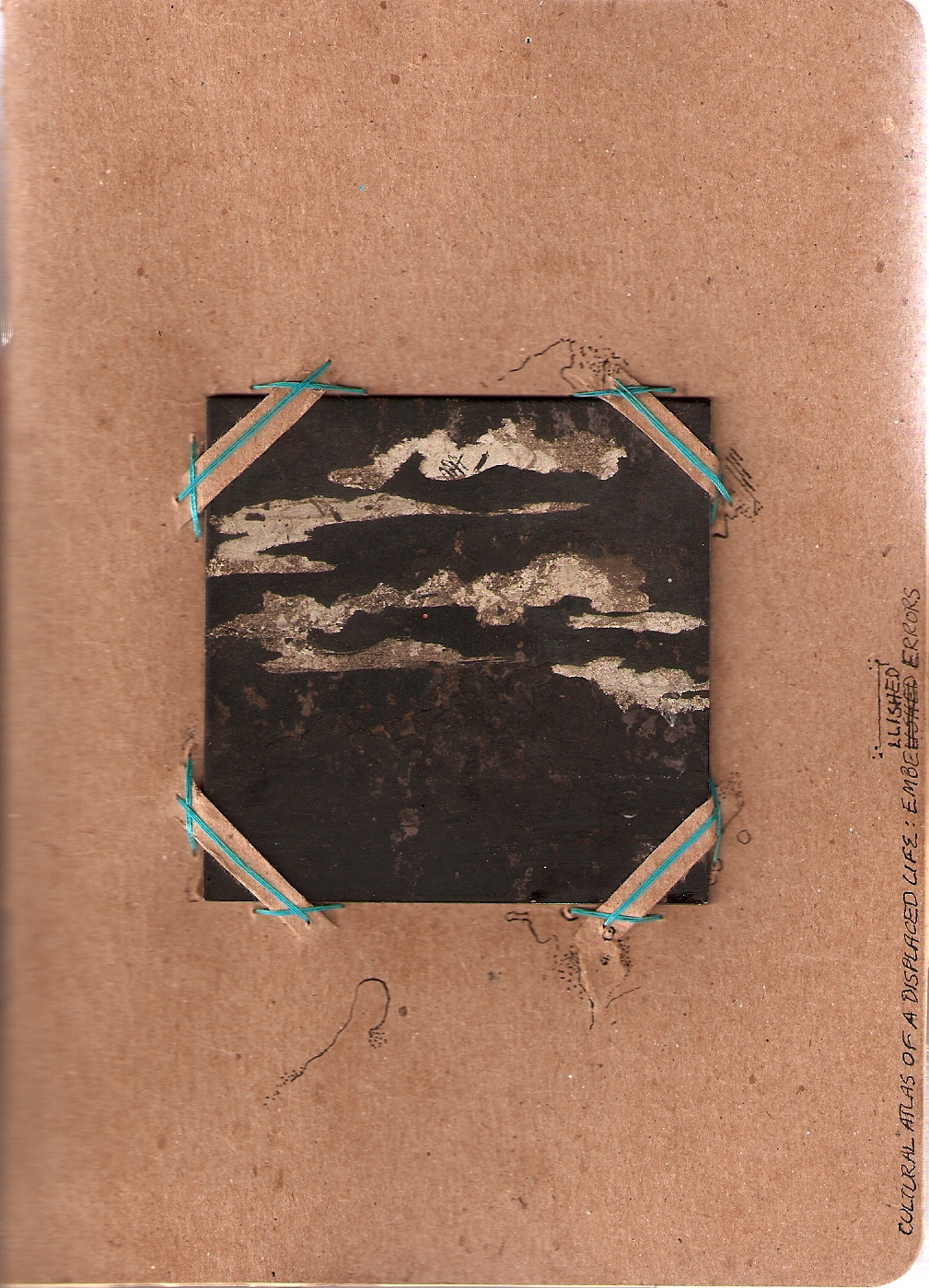
Cultural Atlas of a Displaced Life: Embellished Errors (cover)

copyright Bonnie McClellan-Broussard 2012 all rights reservedI’ve started working on my ‘Sketchbook Project 2013’. I tried once in 2010 (starting late) and couldn’t finish in time. Maybe I’ll make it this year. I chose the theme ‘Atlas’ because I’ve been considering Cultural Atlas as the theme for IPM 2013.

We all come into our adulthood with a series of images, advertising jingles, cartoons, and some language appropriate icons from pre-school coloring pages that helped us learn our alphabet, equivalent to “A is for apple and B is for Ball”.

How the houses were built where we grew up, what form the windows took, the layout and width of the streets and how much of the sky’s expanse could be seen, all form part of an internal cultural atlas that we carry with us. We may remain unaware of how deeply etched these ‘maps’ are until they are challenged by living in a different cultural context.

The image above is a small panel of black steel on which I drew with white gold leaf and rust converter. The image is of the sky, something I love watching change where I live in Northern Italy and also something I miss from my birthplace, Texas. I tore the soft, cardboard cover while trying to insert the rigid panel and then glued the torn bits back together and sewed over them with turquoise thread.  Thus, the subtitle of the book, “Embellished Errors” refers both to my way of making art – often so impatient to see the results of an experiment that paper is torn, fingerprints are left where glue and ink have smeared that are then ‘fixed’ by pointing out their presence and letting it become part of the work, sometimes even the focus – and the series of, sometimes painful, decisions that have made the beautiful and densely embellished ‘stuff’ of my life so far.

I hope that my readers will enjoy the upcoming ‘visual poetry’ and that poets interested in submitting poetry for International Poetry Month next January will keep this theme in mind.

REGULATOR A: love song to an analogue clock

REGULATOR: love song to an analogue clock

I have such a tick tock
pendulum clock on the kitchen wall.
Though it came with you, I’ve called it mine
(after all, it sat in my lap,
my fat, pregnant belly shielding it from the shock
of a stone paved road, gone to seed)
since it was brought from where you were
to count your. my. our. time.

Like my grandfather’s banjo clock
but older and cheaper,

MADE IN JAPAN
A
REGULATOR

with face of printed paper,
case-wood painted
to look like wood,
tiny gilded flowers faded.
A late addition atop it sits:
(India slender not China round)
a small, golden Buddha
from a town just north of BEE. Be. Being. Was.

I’ve grown so accustomed to the sound
I notice it only, when paying attention
(like now).
Reliable ghost of the town bells,
which ring the mass and the hour / half hour
(though my clock, by choice, does not).

I am like my grandfather these days
(awake at 5 by 9 asleep);
I don’t, like he,
get out a shortwave radio and
listen for Greenwich’s distant beep,
add six to arrive in Central Texas,
then wind and set my clock
on a given day each week.

I can hear the beep on the BBC’s
un-crackling web-cast
but I rather look past,

where my clock’s hands have stopped time
on its foxed paper face,
to the prescient clock on the town’s bell tower.

I open the round glass,
open the pendulum case,
remove the dark and heavy, little key,
turn ten times counter clockwise in its given notch,
remove the key and hear the
hollow clonk
as it touches the bottom of the case
in point.
Not closing it,
I raise my finger and catch
time’s arrow-tipped minute
hand and turn it clockwise until it twins
the tower time.
I try to keep my index fingertip
from touching the foxed paper of the stopped face
not wanting it to scar,
over time.

I close the glass
over paper
over scissor-like hands and

set the round, bronze
pendulum swinging
on its slender, stem of lacquered lath.
Check for a tick equidistant from the tock,
close the case and turn the lock.
Time springs
into action,
A REGULATOR.

copyright Bonnie M. Broussard, all rights reserved.

Seed Catalogue: by Bonnie McClellan

Russian Lavender
and spring rhizomes.

Meaty white
lily bulbs,
waiting,
to ease forth their sweet green tongues;
gasping into bloom
at the first pressure of March’s holy breath.

ENGRAVING (for Angel and Ronit): by Bonnie McClellan-Broussard

ENGRAVING

Grief must sometimes be taken in sips,
like coffee too scalding and bitter to swallow.

Each new grief holds within
an elder one in-nested.

The ‘no’ un-screamed arises:
is shattered, then compressed.

The terror of resignation
(winter’s hard companion)

reverberates down through
calcified strata all the way to

the first pearlescent grief:
a burst balloon, a lost gift.


INCISIONE

– il dolore a volte dev’essere preso in sorsi,
come cafè troppo bollente e amaro da ingoiare. –

Ogni nuovo dolore racchiude
un vecchio innesto.

Il non-urlatò ‘no’ sorge:
va in frantumi e si comprime.

Il terrore di rassegnazione
(dura compagna d’inverno)

riverbera verso in basso, attraverso
strati calcificati, fino all’arrivo

del primo dolore perlescente:
palloncino scoppiato, un dono perduto.

Angel Pfeifer Raiter, poeta : 11 dicembre 1979 – 3 febbraio 2012
Ronit Dovrat, pittore: 12 maggio 1955 – 15 dicembre 2011

Bonnie McClellan-Broussard
Copyright 2012 all rights reserved