SEKISHU: by Gilles-Marie Chenot

Caresse de soie torrentielle
Coup de foudre neuronal
Dans le silence abrupt
S’illumine la montagne endormie

Tonnerre de feu aquatique
Sur une terre dévastée
Et resplendissante

L’été étreint l’hiver torride
L’obscurité ensoleille la clarté

Une nuit meurt, un jour s’éveille

Equilibre

SEKISHU

Caress of floodly silk
Neuronal lightning strike
In the abrupt silence
The sleepy mountain lights up

Aquatic thunder of fire
On a devastated land
So bright

The summer embraces the torrid winter
Darkness sunlights clearness

A night is dying, a day awakes

Equilibrium

To read more work by Gilles-Marie Chenot (1963-2104), click HERE.
To find other poems by GMC on this blog click HERE.

Prologue to My Birth: by Stephanie Harper

This is neither a beginning
nor the prophecy of an ending
for beginnings & endings are lies
told to the once-living

it is not the exemplifying
of the aberrations the alchemists made
when they dethroned our Divine Queen
& transmuted her golden honey
into their iron pyrite philosophy
that left us to wither
inside our stunned husks

& so    this is the emptying
of our errant devotion
to the denial of bodily hunger

the sanctified unbelieving
in fairytales of heavenly salvation

& it is the vital refilling
of infants’ gaping mouths
with earthly fortitude

& here    now    is the weeping

for our birth-story    interred
with our long-dead mothers
who delivered us
& secured our velvety    aboriginal flesh
to their warm breasts—

the saline unleashing
to purify our Logos
our will to creation    our innate need
to manifest our god-selves

it is the recovering
of the Life that was severed from our psyches
when it was reduced to a Word
& uttered    bereft of melody—

the unrepressed singing
Artemis awake from her slumber
beneath her ruined Temple in Ephesus

at last    this is the extricating
of shame that made our tongues
untie us from our Mother’s holy earth
& swayed our ears to scorn her winged songs
even as she kept flying back to us
ever thick-limbed & fragrant
with nourishment from lavender blooms
solely that we should swell in our birthing cells
gorged on her royal jelly

This poem is my body
embryonic    translucent
distended with new hope

it is my luminous    black eyes
grown huge with their memory
of who I am

lavender-kiss_matthew-harper

To listen to a reading of this poem, click on the player below:

You can read more of Stephanie L. Harper’s poetry on her blog, HERE.

Stella Invades The Modern: by Edward M. Stanton

Visual vocabulary

What you see, is what you see…

Purity violation

Dazzling fluorescents

Overcoming boundaries, the essence of freedom…

Florid excitement

Narrative structure

Unlikely combination of mass and strength…

Scintillating movement

Dauntingly fundamental problems

Unified, forceful and immediate.

Rigorous diagrams

All-over compositions

Massive brutality of a catastrophe.

Emotionally turbulent

Baroque forms and irrational gestures to dominate.

Rhythmic geometry

Semi-industrial atmosphere

Drab color

Unparalleled intensity

Radically reduced compositions distilled and silenced the emotional and transcendental rhetoric that inspired what you see…is what you see.

Pure visual impact

Classical order or baroque theatrics.

Visual connections between seemingly disparate series.

Psychic automatism

A state unmediated by the unconscious mind.

Frankly speaking…
undisputed authenticity.


To listen to a reading of the poem by the poet, click on the player below:

Copyright Edward M. Stanton 2017

To hear a readings of other poems by Edward M. Stanton, click HERE.

Angst: by Liliane Richman

………………..Perhaps it was the snow
……………….blanketing all
………………refusing to melt
……………..papering pelting us blind
…………….with its swelling flakes
……………or lassitude
…………..a veil at the front door
………….wrinkled and stained
…………from filtering myriad horror

………..May be midlife crisis unrelenting
……….demanding doomsday income tax accounting
………wrenching flesh spitting

……..Or else a chrysalis
…….harbinger of tender life anew
…..in full evolution

….And what of it
lack of talent? spent imagination?
..should we never more tap words
.on the clavier?

Forget the rot
the self mutilated finger
your amputated leg
Oh! young Rimbaud
How is it you did not mourn the poetry
tracing of the pen writing
revising upon virgin paper?


To find more poetry by Liliane Richman on this blog, click HERE.

Liliane Richman’s recently published memoir, “The Bones of Time” can be found HERE.

Sonnet on Descartes’ Vinyard / Sonetto sul Vigneto di Cartesio: by Bonnie McClellan

SONETTO SUL VIGNETO DI CARTESIO

Paesaggio trascrive in polvere il fantasma del tempo
Tratto manomesso; friabile, reticolo evidente.
Maledizione di Jahweh, o di Minerva fatidico dono
Nudo frutto d’Eden, nel lavoro ridefinito.
Asse cartesiana della mente ben ordita
Contro il caos verdeggiante; la ruota della ragione.
EGO SUM dell’uomo tirato in campo ardente
Morbida, intransigente linea infinita.

Cosa abbiamo perso in questo mondo ben composto,
Arato dalla nostra razza divisa e consapevole?
Beatitudine incolta, dura, senza nome;
Primo bacio selvaggio tra Adamo ed Eva d’ossa fine;
Frusciante betulla sbiancata, mai scritta;
Panno primale della lingua, tessuto ma ancora spiegato.

*****     *****     *****

SONNET ON DESCARTES’ VINEYARD

Landscape writes out in dust the ghost of time
Well-fingered tract; friable, forceful grid.
Yahweh’s curse or Minerva’s fateful gift
Naked fruit of Eden, in labour, redefined.
Cartesian axle of the ordered mind
Brought against verdant chaos, reason’s wheel.
Man’s own I AM scratched out in burning field
Soft, intransigent infinity of line.

What have we lost in this well-structured world
Ploughed out by our sentient, divided kind?
A hard, unnamed, uncultivated bliss;
Adam and fine-boned Eve’s first savage kiss;
Clattering, chalky aspen undescribed;
Primal cloth of language, woven, yet unfurled.

Click on the player below to listen to the podcast:


Per ascoltare allo podcast in italiano, premete qui sotto:

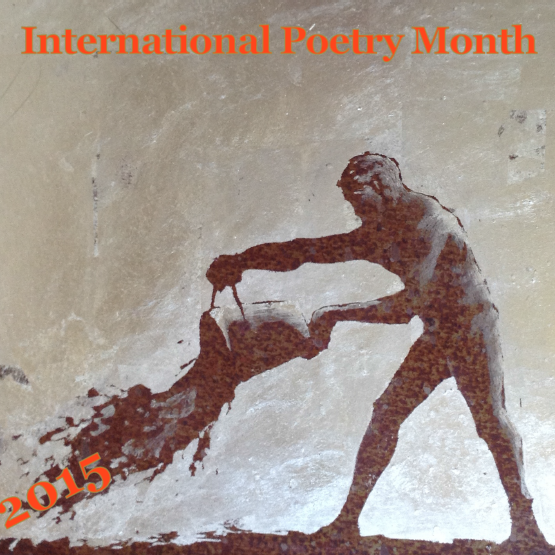
Water Under the Bridge: IPM 2015 is open for Submissions

IPM 2015 - Water Under The Bridge

Jump right in, the water is full of poetry…

Splash! Throw the poems out with the bath water and see what you can fish up; IPM 2015 is open for submissions. I’m late with posting the call for submissions because I’ve been immersed in reading Zola’s Au Bonheur des Dames a series of entrancing social and political observations of turn of the century Paris and the rise of the department store in the guise of a romance novel. His mesmerizing descriptions of the ‘new’ architecture captures the theme of this year’s IPM perfectly:

“The iron staircases developed bold curves, multiplying the landings; the iron bridges suspended in space, ran straight along, very high up; and all this iron formed, beneath the white light of the windows, an excessively light architecture, a complicated lace-work through which the daylight penetrated, the modern realisation of a dreamed-of palace, of a Babel-like heaping up of the storeys, enlarging the rooms, opening up glimpses on to other floors and into other rooms without end.”

It’s all water under the bridge

Poetry gives us the opportunity to offer our observations to present and future readers, be they from the perspective of one standing on the bridge watching events or of one standing below and taking on the current. I’m looking forward to a month of editing and I know that my IPM readers are standing on the bridge waiting for the flow of poems to begin.

Find the submission guidelines and info about IPM HERE.

Once more into the breach…IPM 2014 is open for submissions!

International Poetry Month 2014

once more into the breach…or fill the gap with poetry

I had been casting about for a theme for International Poetry Month 2014 for almost a year when my husband, Matthew Broussard, made a series of paintings on the theme of ambiguous and iconic gestures in December. As soon as I saw the painting “Leap” the phrase in the heading above came to mind.

After a year of listing to news packed with war and disaster, perhaps the unaltered quote from Shakespeare’s Henry V would be more apt – although a quick recap of the years news will tell us that the gap was filled with dead of every nationality: the building collapse in Dar es Salaam, the Fertilizer plant in West, Texas, the Boston Marathon bombing, the constant undercurrent of the financial and employment crisis in Europe, a devastating typhoon in the Philippines, drowning of migrants off of Lampedusa, the wars in South Sudan, Syria…does your heart feel like lead yet, are you about to click on a link to something else, anything else?

Poets are charged with throwing their works into the breach, paving the unseeable future with words that transform the painful, the splendid and the ordinary of where we are now and where we have been, into where we are going…making the leap, perhaps of faith or perhaps of desperation or even of joy. The future is there: blindingly dark, spattered with patches of dense brightness. We’re on the precipice, hanging above the clouds, now….LEAP

Biography of a Bipolar: by Tom McClellan

Reposted from IPM 2MXI in loving memory of Tom McClellan
(23 September 1941 – 3 August 2013)

Biography of a Bipolar

At first friends share the ecstasy that comes before the burn:

“That night he was going crazy everyone

was too drunk to care.”

But after years all learn:

“His conversation grew brilliant and alarming.

Students were frightened by his lecture on Hitler.”

“He wrote the most pitiful letter;

though I was not angry, he spoke of us fighting.”

“His religious notions, never stable, flowered

into oddity; his judgment went haywire.”

“He was barricaded in his room in his skivvies when the police came;

he was surprisingly polite.”

The poet obligingly provides snapshots from hell:

“I meditated Detachment and Urbanity but the old menacing

hilarity was growing in me.”

“What use is my sense of humor when the brain blinks

like a radio station rapidly distanced?”

“I lay there secured but for my skipping mind.”

After the delusions pass, he lacerates his soul with reason:

“Seven years ago Bloomington stood for Joyce’s hero and Indiana for

the evil, unexorcised aborigines, while I suspected myself

The Holy Ghost.  The glory and banality of it are corrupting.”

The poet’s wife learns to suffer a fool who falls in love

with students, madhouse nurses,

any woman but her:

“I don’t think he realizes the damage.”

New drugs offer old hopes of Panacea:

“To think of all that suffering for lack of a little salt in the brain!”

Theories suffer the usual changes:

“Recent research shows mania’s a summertime dis­ease,

perhaps an excess of light.”

(Robert Lowell)

This poem is excerpted from Mr. McClellan’s book: Reflections From Mirror City
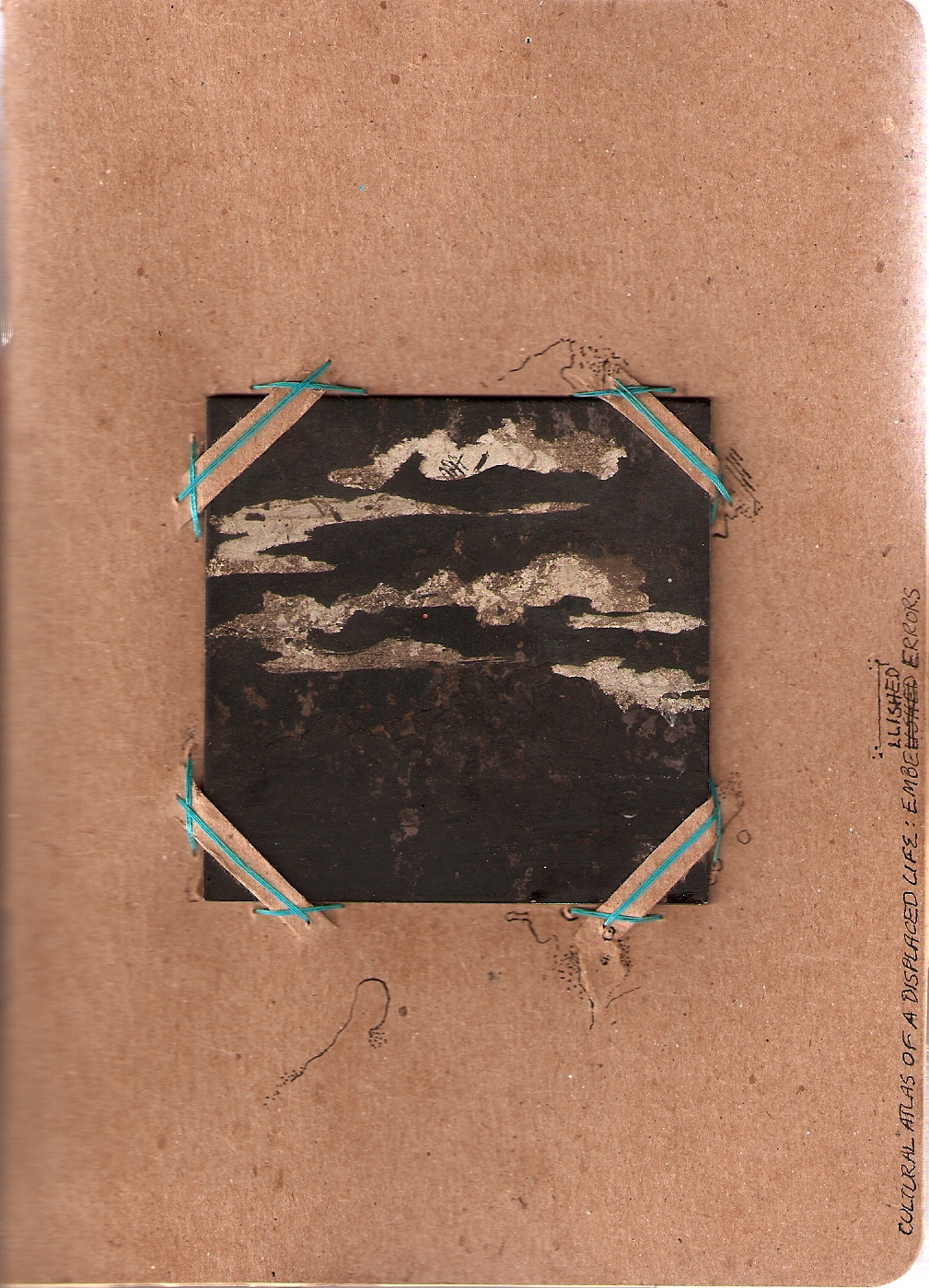


Mothers and Daughters: Terra Cotta

Peering into the narrow compact
Rectangle reflecting back:
The rumpled face of a woman
……….whose father is dying;
……….whose mother will die.

Under chin skin slags, begins
To give up the ghost of a woman
……….whose skin was once full
……….and firm as an egg.

Now, like a plastic bag full of slip,
When squeezed in the right places takes on
Then, temporary grace of a woman
……………who will also die;

Falling away into potsherds, unfired.
Falling away into sand, into clay.

by Bonnie McClellan

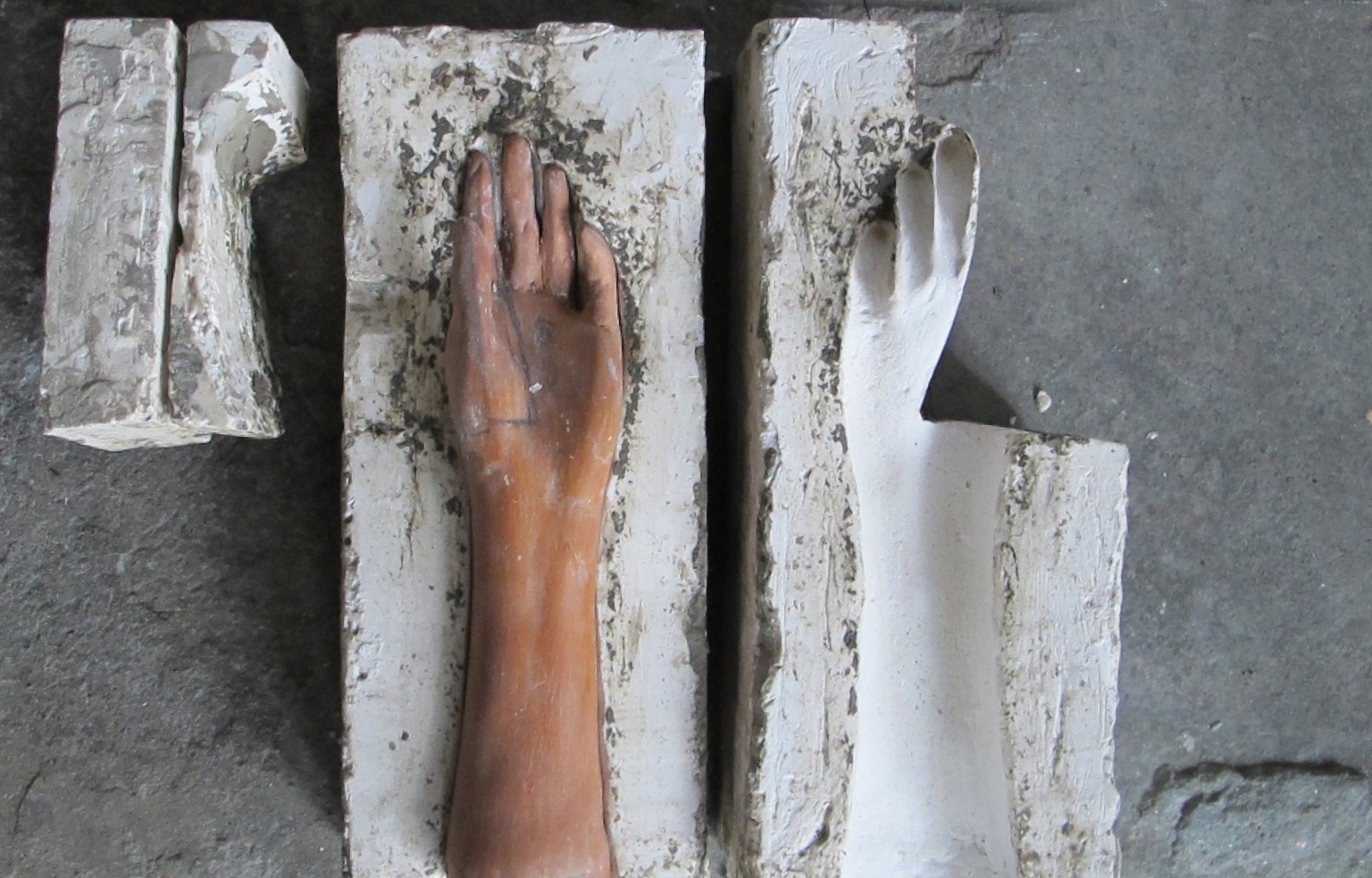
Tic - photo: Bonnie Broussard, sculpture: Matthew Broussard

Orphan Poetry or Paradise Lost: IV. The Vinegar Scripture

The Vinegar Scripture

I am blue in the face
words unexhaled;
sky’s edge, distant,
cracks and curls.
Ozone’s filthy fingers
ruck parched dusk.
I drink;
water and vinegar
think of Christ
Roman soldiers,
rough sponge,
cracked lip:
“E’-li, E’-li, la’-ma sa-bach’-tha-ni?”
After that
this same
amber thick, sour smell
slaps against our Savior’s sense.
Now he’s off –
Hard business for him to harrow hell;
Hard business for me,
just sitting still.

To listen to the poem, click on the player below.