This poem in its written form has disappeared. If you want to know why, click HERE.
To hear a reading of this poem, click on the player below:
to hear more poetry by Anonymous on this blog, click HERE.
reflection: spare crop / fleet mind
La versione scritta di questa poesia è scomparsa. Una versione audio può essere trovata qui sotto con i link a ulteriori informazioni sul poetessa:
Clicca qui sotto per ascoltare l’audio:
La versione scritta di questa poesia può essere ritrovata QUI.
Clicca QUI per trovare più poesia di Anna Mosca.
The english version of this poem has disappeared, an audio version in Italian can be found above and the written version of the poem in Italian can be found HERE.
English-language poetry by this poet can be found HERE.
Vous pouvez lire ce poésie en français ICI. Écoutez une lecture ci-dessous.
The written version of this poem is available in French at the above link. An audio version of the English translation is available below:
To read more work by GMC, click HERE.
To find other poems by GMC on this blog click HERE.

This poem in its written form has disappeared from this website. If you want to know why, click HERE.
This written version of this poem can be re-discovered on Mr. McClellan’s website HERE.
Copyright Tom McClellan 2012 ~ all rights reserved
To hear a reading of this poem, click on the player below:
To read more poetry and prose by Tom McClellan, visit his blog HERE.
This poem in its written form has disappeared. If you want to know why, click HERE.
To hear a reading of this poem, click on the player below:
You can rediscover the written version of this poem HERE.
Read more poetry by Anna Mosca in English HERE.
copyright 2013 Anna Mosca all rights reserved
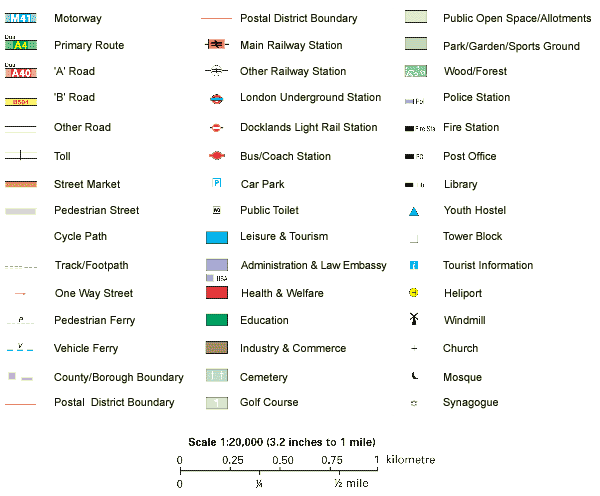
“Since a map is a reduced representation of the real world, map symbols are used to represent real objects. Without symbols, we wouldn’t have maps.” – Compass Dude
In my previous essay I talked about mapping the terrain, the “You Are Here” aspect of a Cultural Atlas. That, and a response to the post by Brad Frederiksen, got me thinking about another aspect of maps, the key. I have always loved those little boxes at the bottom of a map, the ones that tell you what those mysterious hieroglyphs printed across the terrain mean. Even their names are inviting, intimating the possibility of deciphering and understanding unknown territories both physical and cultural: The Map Key. The Map Legend. Without this key, the caption to the photo, a physical or cultural context, where are we? Who are we?
We all have our own cultural ‘legends’ which help us read and interpret the surrounding terrain. Often, one is unaware of what these symbols are until we are called upon to function in a situation or a place where our internal ‘key’ is not consonant with the one in which we’re operating. These legends and keys tell us not only: ‘you are here’ when they align (or don’t) with our external circumstances; but also ‘you are this’: these recognized symbols can place us in the centre or on the periphery of nations, professions, spiritual communities, families and historical epochs.
The language in which a poem is written can place it in the realm of ‘fully accessible’ only to people who understand our cultural or even personal keys and legends. Each reader in the center or on the periphery of a language group, a professional or family environment will give a new reading, using their own symbols and associations to navigate a poem – superimposing their Map Key upon the poet’s – or they may give up, the two keys too dissonant to be reconciled.
Starting at the end of this week (Feb. 1st), IPM will be presenting poems that map territories both broad and intimate, urban and rural, topographies of nations, family relationships and internal landscapes. I invite you all to come and read, bring your keys and re-map the territory of the coming 28 days of poetry…who know’s what you’ll discover about your own territory:
You Are Here?
You Are This?
“Being in a foreign country means walking a tightrope high above the ground without the net afforded a person by the country where he has his family, colleagues, and friends, and where he can easily say what he has to say in a language he has known from childhood.” – Milan Kundera from The Unbearable Lightness of Being

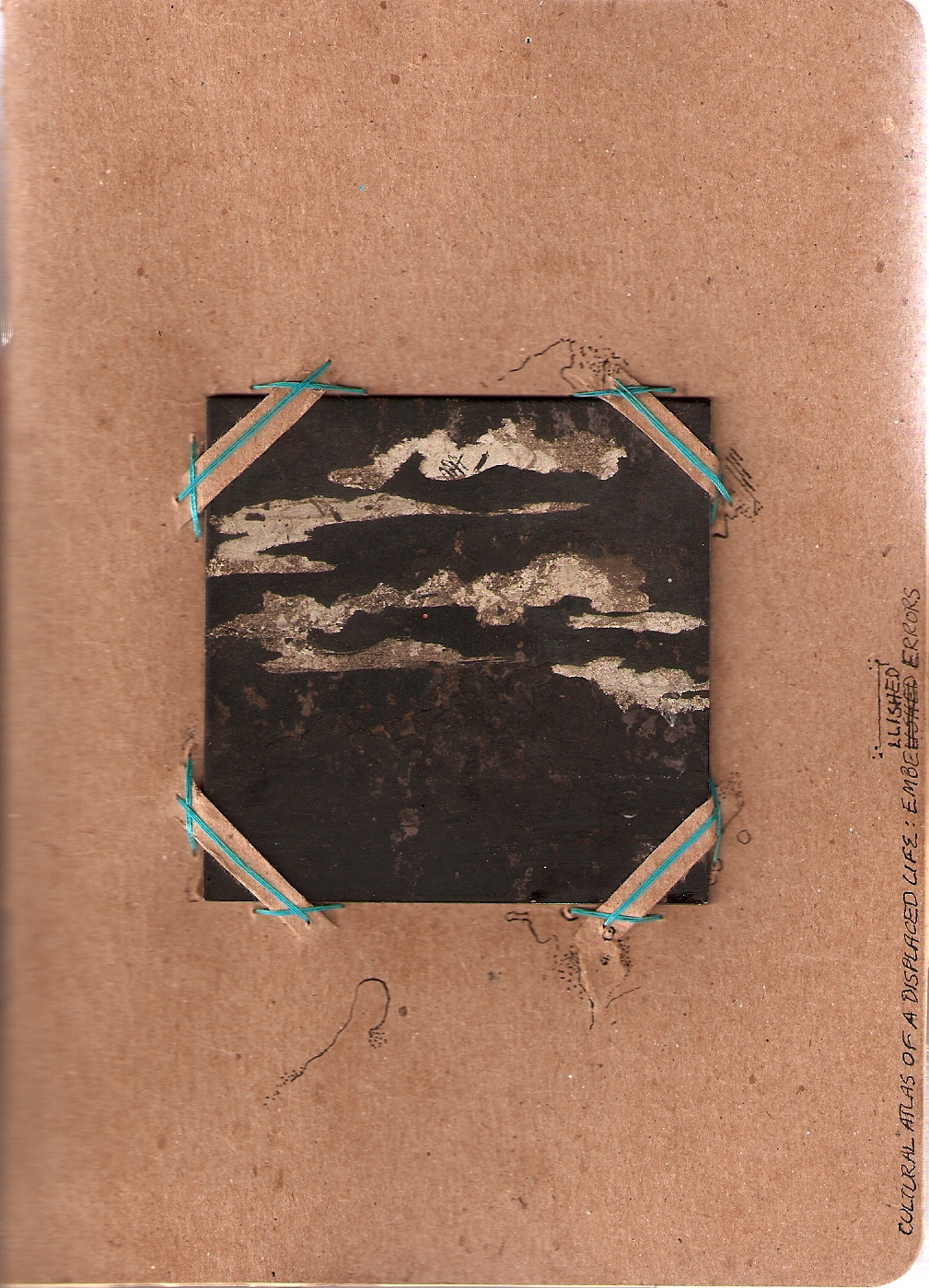
The time has come for the introductory essays for International Poetry Month 2013, a project I started 5 years ago in an effort to create a dynamic space for poetry around the world to be read and heard. Each year has had a theme and this year’s theme is ‘Cultural Atlas’. I admit, I stole this theme from The Sketchbook Project 2013. As I started working on my sketchbook I began to think of all of the ways this theme dovetailed nicely with what IPM is about: making cultures accessible to one another, sounding the similarities and marveling at the differences.
The photograph to your right is of an installation sculpture that my husband, Matthew Broussard, did for an exhibition called ‘Clicking the Territory’ in 2009 (the first year of IPM). It’s titled “You are Here” and is an image of the ‘clicky hand’ – that we all know and love from the virtual world – mown into the grass of Novara’s Vespolate airfield. So, you are here but where is here? Without google maps and panoramio how would you ever know how find or even be able to imagine the dirt runway and green grass of Vespolate if you’d never been there?
So, where am I? The ‘location’ box to the right of my screen says gemonio, varese italy; but I feel my internal, physical and cultural map of Texas bumping up against Gemonio’s every day. This is not a bad thing, it’s just noticeable. As a poet I appreciate the fact that it makes me think and inspires me. The interesting part is how often I need to superimpose these two maps to orient myself both internally – culturally and historically – and externally, for others who don’t have an internal map of Texas for reference.
As a Texan living in Italy, “Where are you from?” is a question I get asked a lot. It’s an easy answer; I grew up in Dallas and I have yet to meet an Italian who doesn’t know that it’s the city where either:
I fall into this nebulous terrain on an Italian’s mental map, though few of them could indicate Texas on a map of the U.S. I am often, when describing where I’m from, constrained to superimpose a map of Europe over my internal map which results in comparisons like:
“Texas is about as big as France / Texas è più o meno la stessa grandezza della Francia.”
Or, time/distance equations with multiple variables:
“It takes the same amount of time to drive from Dallas to the border with Mexico as it does to drive from Liguria to Calabria / Ci vuole lo stesso tempo di guidare da Dallas al confine con il Messico, come fa a guidare dalla Liguria alla Calabria.”
The same size(mic) translation is required for my family and friends in Texas when trying to contextualize media frenzy over Italian earthquakes.
In blog land we are all in an ever evolving here, no matter how far apart we are. Here is where we begin our IPM exploration.
Where is your here? If you’ve written a poem that touches on mapping your cultural territory (interior or exterior) I’m interested in reading. Check out the submission guidelines HERE.
Stay tuned! Up next: Cultural Atlas of the Periphery and the Center…




 Bonnie McClellan-Broussard