My sister’s voice
shattered across
an inconsistent, oscillating
field
stammering in and out
of being
then gone
but imprinted
on the field
not of you are here
but of you are this.
lack
My grandmother’s pearl
earrings oscillating
one black pearl one
the color of cream
thick with fat.
– she moves her head, lifting
her hands to speak
two palms holding up
a weightless field –
her lips move and issue
the sound of glass
sublimed
expansion
I am made up of stars that are not, or
the container of their memory:
fireworks cracking the saint’s day
of the insomniac night
I became not always the one who leaves
but the one who is (for her)
the fertile field/the constant star.
dispersion
How long until she knows
what it is to be the glass
flowing into flatness,
ceding the vertical,
breaking the light,
into water?
by Bonnie McClellan
a note on the title: Italians often refer to a place in which there is no reception for mobile devices as “un posto dove non c’è campo” – although the word campo translates as field (with the same degree of semantic density as field in English) it also implies range or depth of field.
If you haven’t read “The Ovile of Memo and Pepe: Part One” (click here).
Peppe and Mimmo
Inside, the room was clean and sparse. A bucket of water just inside the door held the meter-and-a-half-long wooden stick with which they stirred the cheese. The cheese was boiling in a black iron cauldron, with a mouth a meter wide, that hung over a wood fire burning so hot and clean that I do not recall even a breath of smoke in the tiny room. Some sausages hung from the rafters; on a table catty-corner from the fire a wood plank table held up two bottles of wine and several packs of cigarettes. In the far corner, opposite the fire, Mimmo and Peppe were busy at a shallow-sided, waist-high stone sink, squeezing whey from the cheese through plastic sieves. They looked up from their work, smiling, verbally poking at Matthew for having taken so long to bring his family down to the ovile, saying hello to me and saving all of the best sweet talk for Robin.
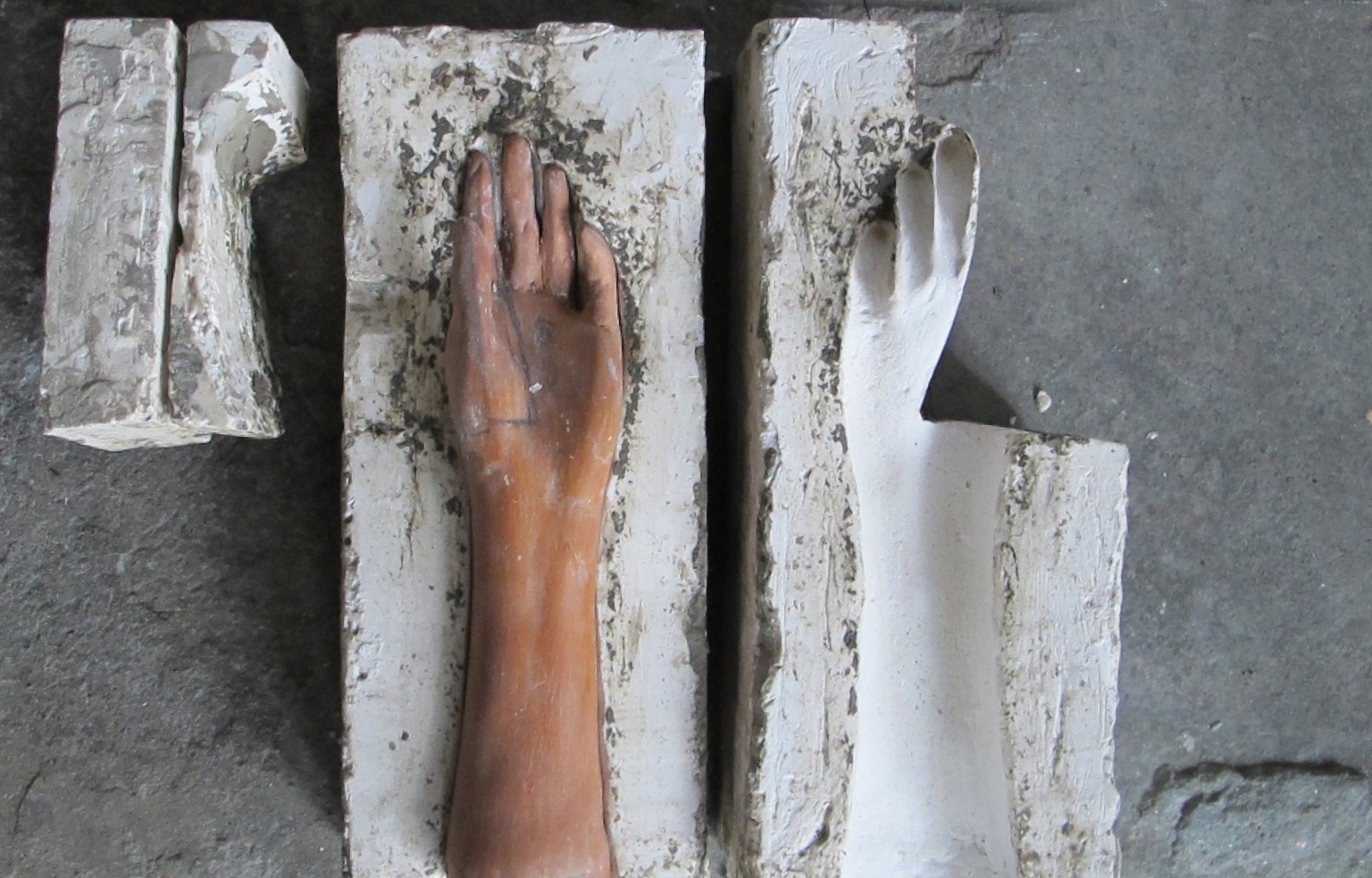
Now I’m going to cheat, this is a blog and not a novel so I can show you a picture of Mimmo and Peppe that I’ve posted above and ask you to look at their hands. They are amazing hands, impressively large and smooth, these hands make almost anything they hold look small. I’m also going to break another writer’s rule and slip into something more comfortable, the present tense:
They offer us some curds of the cheese they’re cooking; it tastes like fresh farmers cheese, bright and dry. Mimmo explains that this is the first cooking and that they will cook it again, making it into creamy, rich ricotta (literally: re-cotta/re-cooked). In the meantime they are busily pressing and compressing the cheese, the whey runs down the slanted work surface and into the drain feeding the rivulet of whey specked with curd that we encountered on the way in. Matthew pops another bit of crumbly bright cheese in my mouth and I understand why the dog outside is so happy to lap up the remnants.
Robin is squirming and agitated by the fire, the dark room and the two robust men with hands bigger than her head. She says alternately, “want to go OUTside.” and “want to see BABY goats!” She wants nothing to do with the fresh cheese. She’s squiggled down out of my arms and hoisted up onto her papa’s shoulders. Matthew asks for permission to go through the door next to where Mimmo and Peppe are working; this is the door that leads to the enclosed concrete part of the ovile where all the goats, too young to go out to pasture, are kept.
Inside the Ovile
Ducking through the door we see goats of all ages from ones that look grown to ones that are barely standing, only 24 hours old. Amongst the goats is a lone lamb with his tight white wool looking tidy in comparison to the splendor of speckles, spots and stripes that embellish the surrounding swirl of goats. Their legs and bellies thick with damp feces, the baby goats are still enchanting. Robin shimmies down from her father’s shoulders and her sneakers smack on the wet cement. The baby goats resist her attempts to pat them by dancing away on their delicate hooves in a wave, like startled ballerinas on point. We explain that they’re nervous, that she needs to walk slowly so she can get a little closer. She won’t get her hands on one this time but she’s happily talking to and about them, informing the world in general about which ones are what colors, and which ones are sleeping, or jumping. Then, like any toddler, her attention span is used up and she wants to go.
We come back into the cheese making room where Mimmo and Peppe have started the second cooking. Our shoes, everyone’s shoes, are slimed with goat shit so I am relieved to see that Mimmo meticulously rinses his hands and keeps the cheese stirring stick always up or resting in the bucket of clean water. Robin cannot be tempted to try the cheese and now wants to go outside, see pigs, see pretty, sad puppy. As we walk back down the path towards the pig pens Mimmo and Peppe’s brother, Gianni, is coming up the path with another man, he sees Robin and scoops her up on to his hip, like a veteran papa, and chucks her startled cheek with his broad knuckle and tells her what a lovely girl she is.
Robin balks at being picked up by Gianni but she doesn’t cry she just wriggles and chants her latest mantra, “mama gon pick you up!” Gianni gets the message and puts her down. He, the stranger and Matthew all walk back up to the cheese room and Matthew returns with a small, plastic basket full of hot and creamy fresh ricotta. He spoons bites into my mouth at happy intervals as we walk up and back down the path. Robin is balanced on my hip and we alternately shoot the breeze and point out things to her, rocks in the cliff face, flowers by the side of the road. The ricotta is magnificent.
In the spaces between the rains the sky runs and falls; gathers itself and plunges again towards the sea. Cumulonimbus titans strike their shins on the horizon line as they stumble through the Mediterranean, dead drunk and anxious to reach Ithaca. This is a place where mothers still name their sons Ulysses.
The houses are like barnacles on a rock; roof tiles buried in lichen and slathered with concrete where they meet at the crown in an uneasy sea-sick ridge. Below the rust-eaten white iron boundary of the balcony-rail I can see two flaps of a prickly pear struggling out from between two heavy arcs of terracotta.
The edge of the sky at dawn over the water is like Montale’s description, a singing strip of metal lath, a kite string straining against the rebounding vault of blue. His was the western sea, the Ligurian coast, a sunset light. Here the Ionian dawn makes eastern music…Jove’s mute mistress writes her name in the sand with a round hoof…IO.
Despite lying just above the Ionian Sea, named for Jove’s mythic mistress transformed into a cow, Caulonia Superiore is a place of goats. The goats, along with a few sheep, are kept in enclosures called ‘ovile’ just outside the town walls. There should be a better English translation for the Italian word, “ovile” (oh-VEE-layh) but there is not. “Fold” is inadequate, it’s too short in sound and too broad in meaning. “Goat fold” although accurate, is just plain ugly, clanking off the tongue like a broken carburetor. I mention this translation difficulty because I am about to tell the story of “The Ovile of Mimmo and Pepe” and I don’t want to leave readers scratching their heads as to what an “OH-vile” is until they reach the third paragraph. And so we begin…
View of the land below the Piazza della Carmine in Caulonia Superiore – the Ovile is on the far right towards the bottom…way down there.
THE STORY OF THE OVILE OF MIMMO AND PEPPE
This morning Matthew, Robin and I woke up early to go and visit the ovile of Mimmo and Peppe so that Robin could see the baby goats and we could all have a breakfast of fresh ricotta. The three of us piled into my big blue van and Matthew managed to squeeze, nudge, and coerce it through the slender streets of Caulonia Superiore until we found ourselves on the dirt road that meandered below the vaulting walls that are still (just barely) sustaining Piazza della Carmine above. Matthew parked the van atilt on the shoulder of the road, leaving room for another car to pass, maybe.
The ovile was what you would expect: a big fenced in plot of land for the grown sheep and goats in which every hint of something green had been eaten. Three rambunctious, gangly white puppies tumbled over one another, and a minor river of water, goat shit and urine ran across the road and under the front tires of my van. Adjacent to the large open pen was a roofed enclosure where the baby animals were kept separate and which was abutted by a cinder block shed where Peppe and Mimmo were working making the cheese.
As we walked up the path towards the porch that fronted the shed we passed by a fluffy white dog whose eyes were badly infected, the skin all around them pitted and inflamed. Robin wanted to pet it until she got a little closer and her good will towards animals banged flat up against something sad and ugly. She solved the struggle by resorting to reassuring herself with words, “Bobbie give sad puppy hug, now she happy puppy!” She looked obliquely at the dog while hugging her own round, pink arms. I found my self wondering when we should start teaching her to look at the ugly things straight on and with compassion instead of looking at the ground and calling them beautiful; then I remembered that I was still working on that one myself and our daughter was not yet two years old. Today would not be the day.
We passed by a small fenced in garden with olive and lemon trees. Across from this were a series of low-walled concrete pens one of which housed two large, pink pigs. Matthew held his hand down to their wiggly snouts saying, “See, it’s a pig. He has a wiggly nose.” Robin edged nervously against my leg saying, “Mama gonna pick you up. Don’t want pigs.” For the first time she was seeing the real animals and they were not wearing plaid shirts and blue jeans like the small, shiny, cartoon pigs in her picture book. They were twice as big as she, I would have been nervous too. I lifted her up. “Lets go see Mimmo and Peppe and the BABY goats,” I said.
As we neared the shed we saw another white dog, this one young and healthy, tied up near a large tree. He was lapping up the water and whey and bits of curd that came from a tube functioning as a drain that led from the cheese making shed out the door and on to the concrete sluice that angled down from the porch. As we reached the open door to the shed Matthew said the obligatory “con permesso” as we walked in.
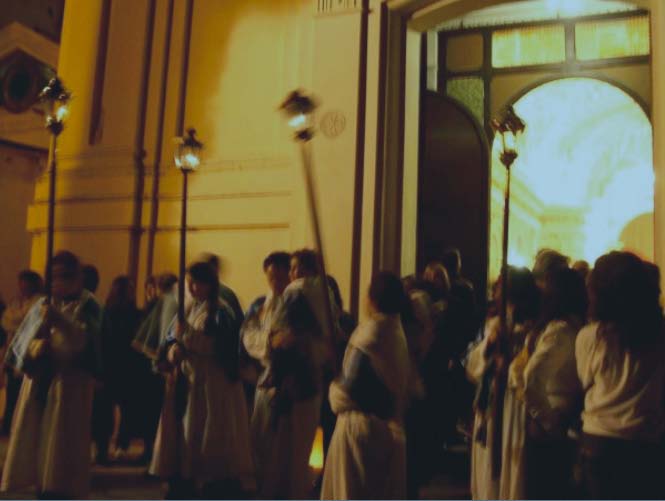
Unable to traverse the swallow’s path
Or tread roof tiles as the agile cat,
upon his brothers’ labouring backs
A polychrome Christ will make a rough pilgrimage of His own;
Pillar bound, to that church above from this one below.
Square-shouldered, tow-haired nine-year old will run and clap
His acolyte’s bell laughingly at black curls that lap
The tender nape of his fellow impenitent in Mary’s blue.
And so this honour guard will hew
four hundred years of progress’ path
Pelligrinago from first to last,
Across the stuck in stones.
AT 5:30 THIS AFTERNOON
Piazza della carmine is desirous of tumbling towards the sea.
Boys gyre round parked cars in this town the Greeks begot.
A truck full of music winds lamenting through the streets;
Calling forth ancient Eves to buy their compassionate widow’s tot
Of what, to Adam’s sweaty brow, this fallen earth bequeaths.
poem and photo copyright Bonnie McClellan 2011 all rights reserved
This poem is the third in a suite of poems written about 24 hours in Caulonia Superiore.
There was a rain storm yesterday and across the street
It rained rose petals from the climbers in the garden above.
The wet asphalt was drenched with these pink drops
licking the stern obscurity of letters not still white
S T O P.
******
I am immersed in a Japan that isn’t.
Google and FB know.
To the side has just appeared an ad for an opera singer
Japanese,
Whose voice “goes down like the smoothest of alcoholic beverages”
Which is not really how I like my opera.
Do they have a singer whose voice:
“scalds like strong, hot coffee first thing in the morning?”
“is as transcendent as a great orgasm?”
“who evokes an abyss of guilt and sadness comparable only to leaving your sobbing child as you walk away from the school?”
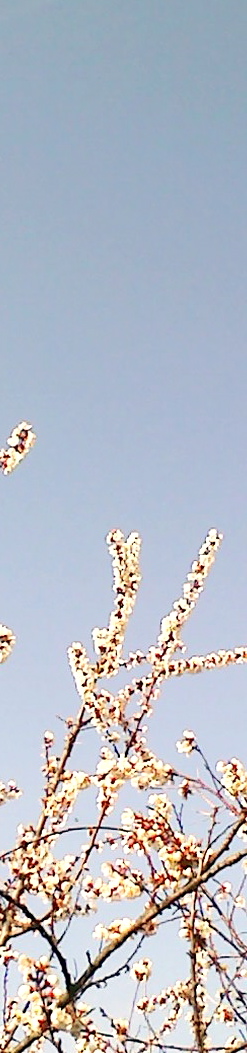
LOVELIEST of trees, the cherry now
Is hung with bloom along the bough,
And stands about the woodland ride
Wearing white for Eastertide.
Now, of my threescore years and ten,
Twenty will not come again,
And take from seventy springs a score,
It only leaves me fifty more.
And since to look at things in bloom
Fifty springs are little room,
About the woodlands I will go
To see the cherry hung with snow.
A. E. Housman (1859–1936)
Very seldom do I post something so well known, but I saw a cherry in resplendent bloom this morning and this poem by Housman (one of the few I’ve ever memorized) sang so loud I thought I’d see if you heard it…
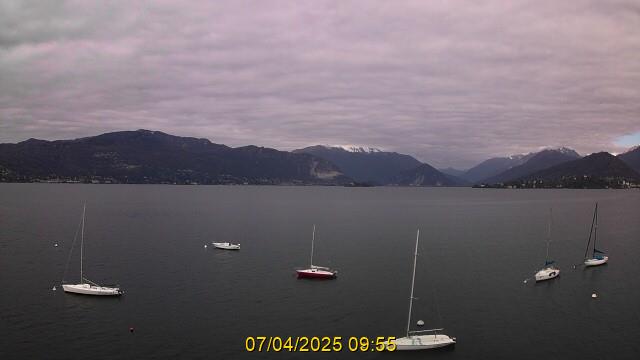
The Spring won’t come. A dun bird shifts
his leaden wing and preens the quick
unplanished sky. The rain holds back
above the glacier’s mirrored lac.
Sheet pinned to sheet clouds sullen drift,
Mountain’s iron foot shores the split,
Dis’ black horses elude the bit.
In white re-dressed the peak sounds back: The Spring won’t come!
Persephone irons out her shift,
Twists off her leaden ring and quick
folds up famine’s sheet; sighs, turns back
to Somnus’ smile ingrained with lack
of sleep pinned to sleep, beauty drifts,
the Spring won’t come.









 Bonnie McClellan-Broussard