Tip of the hat to Galileo…The Dialogue Concerning the Two Chief World Systems.
I’m standing in the kitchen with my sweetheart, we’re making dinner, the girl is circling our legs like a small, very talkative shark:
“So, you’re going to leave the poetry up.” he says.
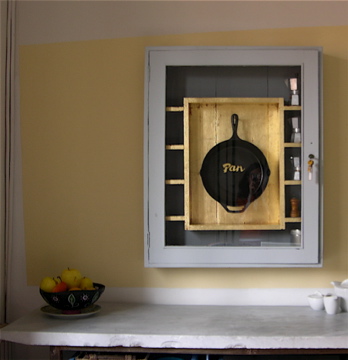
“No, I’m putting it up from the 1st of February until the 28th. On the first of March it all disappears,” I reply, shifting around the green beans and bacon in the bottom of the cast iron skillet.
“But your other poetry, you’re leaving that up?”
“Yeah, the stuff from the regular blog will stay. But the work from International Poetry Monthwill go. The poem posted on Feb. 1st will be available for the whole 28 days. The poem posted on the 28th will be up for 24 hours. I’m going to leave the audio recordings of the readings on the site.”
“So why take the blog posts down, to make it more of an EVENT?”
About now, our girl is at the height of her performance and frantically switching back and forth between being Captain Hook and a baby goat. I am now Wendydarling…Captain Hook wants to give me a kiss but only if I pretend I’m a crocodile eating his hand…no wait, now we’re supposed to bonk heads and say ‘maaaaa’. The stuff in the pan is starting to smell good but it does that right before it starts to burn. I struggle with managing the traffic in my mental train yard while I think about my response,
“Well, yeah. You know, we talk about how people post a zillion links on FB, there are 5 stories you mean to read on the news sites, not to mention the infinite list of things we’ve been meaning to google… and we think, ‘Oh yeah, when I have a minute I’ll check that out but right now (insert favorite and perfectly valid excuse here)….’
Our assumption is that the content will always be available. I want people to feel that they have something to lose if they don’t go and look now. It’s not just that; it’s also because I want this to be a microcosmic, super-fast-acting mirror of what history does to poetry.”
My sweetheart hands me a glass of wine, my daughter bangs her head into my leg with enough force to fell a small pine tree.
“In what sense?” he wonders (meanwhile scanning theBBC Homepageand clicking through the iTunes playlist; and he says he can’t multitask…)
My mental ‘poetry train’ is rambling through the landscape of old thoughts, essays I wrote about writing 5 years ago, the link about the history of books that a friend posted this morning, and the submissions that I’ve been organizing for this month:
“How many poets were writing at the same time as Sappho or ‘Homer’? Was she really the best? Time washes through, consumes everything and spits out the bones. We have the luxury of instantaneous access to information so that we think that we don’t need to remember anything…we google it and then forget it.”
“So, why leave up the podcasts…why not delete it all?”
“In the beginning there was the word. The roots of poetic form grew from the soil of the human voice; metre and rhyme began as mnemonic functions, which were only much later codified as written forms. The way in which the English speaking world views the work of western literature’s first poet (or poets) ‘Homer’ is not a result of his composing on the page but the culmination of the labour of Greek writers who transcribed the works, later translations into Latin, and much later translations into other European languages and then to English…who knows how much this work mutated before it was codified? Isn’t that beautiful to think about?”
I realize that now I’m sounding and feeling a hopelessly ‘wordnerdish’. How do I convey how important I think it is to listen…with attention or the joy I have playing with words in poetic form and reading the work of others who are doing the same? It’s like the fun Galileo had searching the sky, drawing diagrams, and rolling objects of different weights down an inclined plane; or like the pleasure of a child playing with sand and water on the beach, making dams of shells, digging channels, making order out of chaos, knowing that it will all be erased by the tide and not caring.
“So you’re going to explain this to people…write a curatorial statement beforehand right?”
“Umm, yeah…I guess that’s another ‘naptime project’.” my daughter tries to wriggle in between my legs and the stove.
He laughs, “Naptime Projects, sounds a good title.”
Starting on February 1st and ending on February 28th…a month long flash poetry event. One poem a day for 28 days and then they dissappear, maybe forever…
“I wonder if Dante would smile to know that,
reading his words aloud
(as they used to long ago),
a future poetess would blush to feel
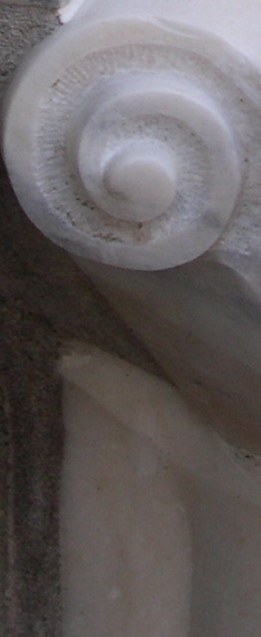
the smooth white marble of his tercets
trace their dust across the center of her tongue?”
How ironic (or bizarre) would Dante or Sappho find it to think of a 21st century reader/writer, reading, parsing, and borrowing from his or her work; women in pants, men in pants!…all speaking a strange, barbaric language and with access to technology that makes words instantly available to millions.
I am both a passionate reader and a passionate writer. I believe that writing serves two excellent functions: it works as a tool to help both the reader and the writer digest, formulate, and reconsider ideas; and, it works as a creative discipline that binds the ephemeral nature of experience to the architecture of words.What we are writing now is a bridge. Who knows how long it will last or who will cross it? Let’s find out.
The time has come to ask for submissions for International Poetry Month! I will post ten of my poems which are the nucleus of a new book that I’m working on with poems inspired by music, cadences, and stories that have been used as vessels for conveying both cultural information and emotive content. For this year’s celebration of poetry I am looking for work that is inspired by the work of others (using borrowed materials for a new construction) or where the form/structure is related to the content (or both)…interpretation of these guidelines will be liberal.
So…lets build something. In addition to my 10 poems I will post a selection of original poetry submitted to me between Jan. 22nd and February 10th of 2010. Please submit your poetic brick (or stone or mortar or slender flash of lath sustaining a fluttering bit of rice paper) to:
bmcclellan.lapoeta@gmail.com
Happy reading and hope that you enjoy International Poetry Month! Submissions in any language will be considered. Needless to say, all rights to works published for International Poetry Month will remain with the author.
I would I were a wingéd thing
And these white stones not bruised my feet.
From half sky’s arc this groundscape see;
Like girasoleil and moth at once.
Face then Gomorrah’s candled sun,
And false to God like Mrs. Lot
Turn arbre-form in Halite caught;
Qualcosa utile, quotidienne.
Ground down and lightly sown across
Unrisen flower and fragrant oil;
Then in the mouth of Adam lost
Mineral dust to dust returned.
poem copyright Bonnie McClellan 2009
“The eye comes always ancient to its work, obsessed by its own past and by old and new insinuations of the ear, nose, tongue, fingers, heart, and brain. It functions not as an instrument self-powered and alone, but as a dutiful memeber of a complex and capricious organism.”
– Nelson Goodman from “Languages of Art
This poem is one in a series that I am currently writing that takes it’s inspiration from the rhythms and subject matter of sacred texts varied and sundry. It is also the fruit of my continuing struggle as a poet to reconcile the three languages that jostle for position in my work as I am searching for exactly the right word. This particular piece is inspired by the rhythm of the Latin Hymn “O SALUTARIAS HOSTIA”. The content inspired by conversations had with the Artist, Matthew Broussard and the film director, Michangelo Frammartino about Pythagoras’ four states of being: Human, Animal, Vegetable, Mineral. The concept of the observed walk as a transformative experience is also inspired in part by the work of sculptor Richard Long.
Paint everything which is not
mountain;
only sky only
the tranquil green of a hayfield
tumbling towards a horizion
ignorant
of what it’s missing.
It is this void, superimposed upon the mountain
which instructs the heart:
Constrict!
There is the possibility of absence.
Bonnie M. McClellan
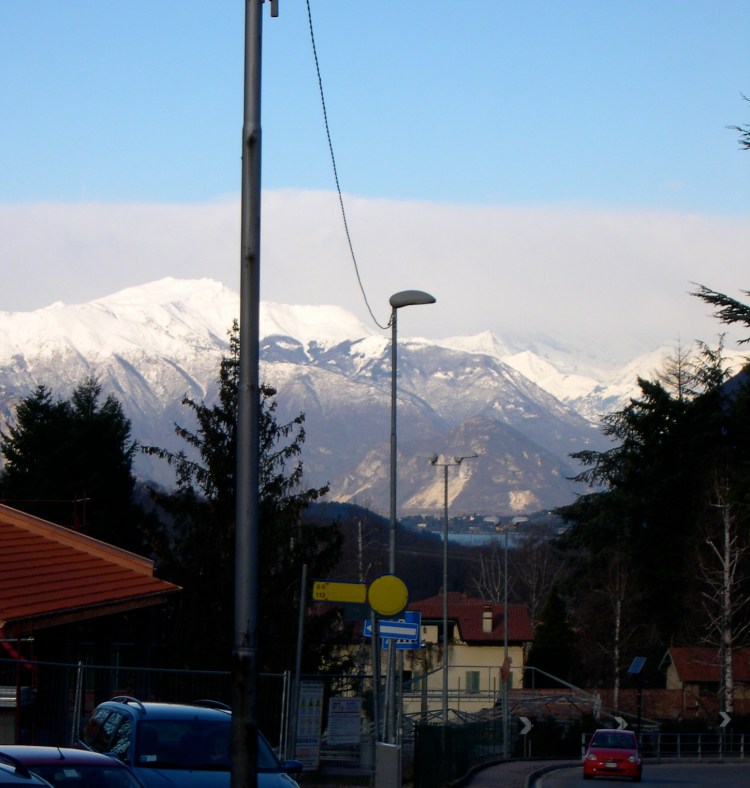
I have lived in Italy for three years now and it never stops being beautiful. The concept of a quotidian and yet extrodinarily beautiful vision continues to fascinate me as did the daily magic of the sky when I lived in Texas.
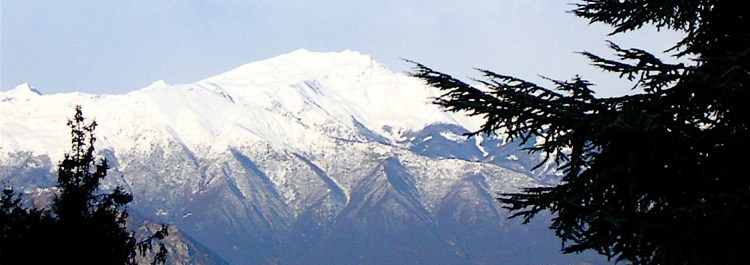
I wrote this poem parked in the parkinglot of the cemetery of the town of Orino, Italy. The cemetery is along the local road that I drive down on the way to and from my daughter’s daycare in Castello Cabiaglio. I encounter a vision twice a day on this drive: Monte Rosa. The mountain is the wallpaper of my everyday life. Despite the ubiquity of this beauty, I feel an ache in my chest that has the emotional resonance of loss everytime I round the curve in the road that brings the moutain into sight. I’m still working my brain around living with something so beautiful that it hurts to look at.
Eugenio Montale

English Horn

The wind this evening attentively plays
-bringing to mind the ringing metallic
slip of a blade-
the instrument of thick trees and open
copper horizon
where the lath of light yanks itself straight
like kites to the sky rebounding

(Traveling clouds, pale realms
of above! Of the high Eldoradeans
ill-closed door!)

and the sea that flake by flake
of mute, livid colours
thrusts at the ground a blast
of twisted foam;
the wind that births and dies
within the slowly darkening hour
may also be singing to you this evening,
disused instrument,
heart.

Corno Inglese

Il vento che stasera suona attento
-ricorda un forte scuotere di lame-
gli strumenti di fitti alberi e spazza
l’orizzonte di rame
dove strisce di luce si protendono
come aquiloni al cielo che rimbomba

(Nuovole in viaggio, chiari
reami di lassu! D’alti Eldoradi
malchiuse porte!)

e il mare che scaglia a scaglia
livido, muta colore
lancia a terra una tromba
di schiume intorte;
il vento che nasce e muore
nell’ora che lenta s’annera
suonasse te pure stasera
scordato strumento,
cuore.
In celebration of International Poetry Month, the following poem was submitted by:
Georgianna Krieger
There are small pieces of joy which flutter
through your fingers and
drift about your eyelashes
like windborn cinders, still warm
from the blaze they were born in
yet unable to ignite
even the smallest whisper of a flame
And you forget they are there
because the blizzard is pelting your cheeks,
the wind burns your eyes
your fingers are numb and stinging from the cold
at the same time
even though this cannot be
So, you have forgotten joy,
but the small particles (little bastards)
follow you
just the same
poem copyright 2009 Georgianna Krieger (all rights reserved to the author)







 Bonnie McClellan-Broussard