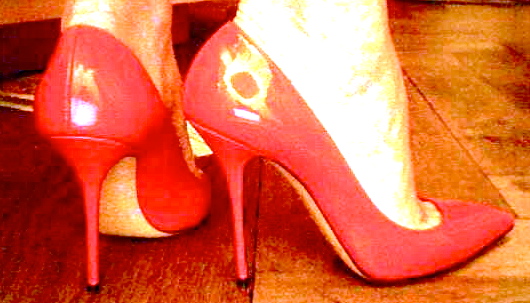
We will know her by her symbolic attributes; In her image neither lily nor byzantine purple signify. We will note that in the hard-drawn felt-tip icon of the Mother God She is ever shown wearing Red high heels.
Some colored squares in our territory’s mapped legend fade,
Re-worn and illegible as old confetti on a wet asphalt street
tracked back by our insistent, diminishing feet.
Others cling, vibrant in the hanging dark:
stripes of light cotton voile:
one turquoise,
one lime
green.
In more contemporary images we will note: The hard-drawn, felt-tip Icon of the Mother God Wears Red high heels. Her dress, now codified, is the color of the first oak leaf in spring; however
it lacks the turquoise
of Texas’ summer skies.
This color cooled has flown
from our mother’s dress,
to hold light purchase only
in our daughters’ eyes.
My sister’s voice
shattered across
an inconsistent, oscillating
field
stammering in and out
of being
then gone
but imprinted
on the field
not of you are here
but of you are this.
lack
My grandmother’s pearl
earrings oscillating
one black pearl one
the color of cream
thick with fat.
– she moves her head, lifting
her hands to speak
two palms holding up
a weightless field –
her lips move and issue
the sound of glass
sublimed
expansion
I am made up of stars that are not, or
the container of their memory:
fireworks cracking the saint’s day
of the insomniac night
I became not always the one who leaves
but the one who is (for her)
the fertile field/the constant star.
dispersion
How long until she knows
what it is to be the glass
flowing into flatness,
ceding the vertical,
breaking the light,
into water?
by Bonnie McClellan
a note on the title: Italians often refer to a place in which there is no reception for mobile devices as “un posto dove non c’è campo” – although the word campo translates as field (with the same degree of semantic density as field in English) it also implies range or depth of field.
One year when the awakened plane trees
find themselves struck yellow in the night,
there will be nothing left of me but
a memory in your hands as they pull
wet laundry from the spun drum or
open the window’s case –
inviting October’s last, warm breath
to communicate the dust
between one room
and another.
Venerdi Santo, Cristo morirà ancora come ha fatto ogni anno poichè Dio sa quando.*
—-
They held a New Orleans Funeral for Jesus:
Woodwinds, brass and the big bass drum.
After awhile the rain began to come;
Parishioners popped up their umbrellas,
Madonna was sacked to protect the stars
Spangling perfect electrified hair that
Should have been disheveled in grief.
Christ: unable to awaken, trapped in an opiate nightmare,
Pallid, couch-ridden, sick with flowers,
Widow-borne through the streets on a lacy bier.
Mary: politely dolorosa, her face more composed than that
Of the old mother dressed in black
Hanging out of the window to watch Her pass,
Baptizing the parading crowd with tears
Thrown out like old wash water.
What is left clean and what is soiled?
The sorrow of sin shifts from house to street
To be tracked back in on the slack-shod feet
Of grandchildren, dogs and beggared questions,
Salved in the last moment with words and oil:
quidquid deliquisti / in all that you have failed.
***********************************
*Good Friday, Christ will die again As he’s done every year Since God knows when.
ATTENTION: This is not truly a story about a toddlers encounter with real farm animals or about expatriate Americans having an “Under the Tuscan Sun” experience. It is a story that extends forward and backward from the vanishing point of a life, the life of a baby goat. This is also not a story about how terrible it is to kill and eat animals: in this place, butchering a goat for Easter is like picking an orange, an ordinary part of life. These shepherds are kind to and value their animals for what they are – their livelihood. If you are squeamish about the idea of a goat being butchered, stop reading when you get to the picture of the heard of goats.
It has taken me four years to finish this story. The memory so visceral and the series of sensations so complex that it has resisted my every effort to make it into a comprehensible story or a poem as I have those things from Serra San Bruno or from inside the city walls. This is a liminal place, on the border between the named place – the city – and the lush density of the landscape as it thickens in a following line towards the sea.
A rooster crows, where is the sound coming from? Robin wants to find it. We wander and talk, Matthew’s work day will start soon, we put our feet on the path to go up, to say thank you and goodbye. The three men stand on the side porch. Peppe holds his hand up in warning, his whole body says don’t let the child see: Gianni has brought the stranger to buy a kid, they are slaughtering it, for Easter.
Gianni’s Goats
Peppe is an able butcher and there is not even a bleat. I turn with my child on my hip, my arm between her gaze and the house; I point out to her something on the opposite horizon. I look down and the whey in the gully is mixing with blood. Who would have thought such a tiny thing held so much? When do you explain this to a child…with our language that so neatly separates the words used for meat and those used for animals? We walk, gesturing and talking always pointing Robin’s attention away from the trussed and headless goat on the porch. I look back. It’s skin now hangs down in a tidy rope from the pallid, marbling of meat, veiled with the translucent tissue that keeps it all compact – lubricating the movement between skin and muscle – meat that is still anchored to hoof, hoof that is still tied to a rope slung over the porch’s lintel beam.
They’re hosing down the concrete in front, the dog that had been drinking a bucket of whey pokes his white muzzle down into the gully to lap at the water tinged with milk and blood. Walking back to my van I see the coursing streamlet of whey and blood as it mixes with the almost motionless trickle of shit and urine running under the passenger-side front tire. It flows across the dirt road and into a hillside so full of green that it looks like Eden – will the ground soak it all up, all of this nitrogen and potassium, everything good for making verdant things stronger?
I am nauseous, not simply from the death – all of my senses are too full: baby goats like ballet dancers, the thick scent of manure, the widening red streamlet coursing cheerfully through the green hillside and the little bucket of creamy cheese in my hand. The ancientness of the act dizzyingly dissonant with the shininess of the cars, the space-age plastic of my shoes. I look up.
The sick dog lies on a warm patch of grass. The healthy dog that is tied up ignores his tithe: a fluorescent red round of bone taken from the freshly slaughtered goat that still hangs from the lintel.
A consecutive flow of fluids convene into a single flow: whey/blood/water from the place of men – water/urine/feces from where men keep the animals. In the flow that reaches the bottom of the path in this moment, the color of blood predominates.
Behind the ovile rises the hillside full of breccia – the eroded face of rock worn away by the river far below, flowing towards the Ionian sea. This moment collapses inward and dilates outward: a vanishing point.
From the house there is now a flow of clear water, washing everything clean.
If you haven’t read “The Ovile of Memo and Pepe: Part One” (click here).
Peppe and Mimmo
Inside, the room was clean and sparse. A bucket of water just inside the door held the meter-and-a-half-long wooden stick with which they stirred the cheese. The cheese was boiling in a black iron cauldron, with a mouth a meter wide, that hung over a wood fire burning so hot and clean that I do not recall even a breath of smoke in the tiny room. Some sausages hung from the rafters; on a table catty-corner from the fire a wood plank table held up two bottles of wine and several packs of cigarettes. In the far corner, opposite the fire, Mimmo and Peppe were busy at a shallow-sided, waist-high stone sink, squeezing whey from the cheese through plastic sieves. They looked up from their work, smiling, verbally poking at Matthew for having taken so long to bring his family down to the ovile, saying hello to me and saving all of the best sweet talk for Robin.
Now I’m going to cheat, this is a blog and not a novel so I can show you a picture of Mimmo and Peppe that I’ve posted above and ask you to look at their hands. They are amazing hands, impressively large and smooth, these hands make almost anything they hold look small. I’m also going to break another writer’s rule and slip into something more comfortable, the present tense:
They offer us some curds of the cheese they’re cooking; it tastes like fresh farmers cheese, bright and dry. Mimmo explains that this is the first cooking and that they will cook it again, making it into creamy, rich ricotta (literally: re-cotta/re-cooked). In the meantime they are busily pressing and compressing the cheese, the whey runs down the slanted work surface and into the drain feeding the rivulet of whey specked with curd that we encountered on the way in. Matthew pops another bit of crumbly bright cheese in my mouth and I understand why the dog outside is so happy to lap up the remnants.
Robin is squirming and agitated by the fire, the dark room and the two robust men with hands bigger than her head. She says alternately, “want to go OUTside.” and “want to see BABY goats!” She wants nothing to do with the fresh cheese. She’s squiggled down out of my arms and hoisted up onto her papa’s shoulders. Matthew asks for permission to go through the door next to where Mimmo and Peppe are working; this is the door that leads to the enclosed concrete part of the ovile where all the goats, too young to go out to pasture, are kept.
Inside the Ovile
Ducking through the door we see goats of all ages from ones that look grown to ones that are barely standing, only 24 hours old. Amongst the goats is a lone lamb with his tight white wool looking tidy in comparison to the splendor of speckles, spots and stripes that embellish the surrounding swirl of goats. Their legs and bellies thick with damp feces, the baby goats are still enchanting. Robin shimmies down from her father’s shoulders and her sneakers smack on the wet cement. The baby goats resist her attempts to pat them by dancing away on their delicate hooves in a wave, like startled ballerinas on point. We explain that they’re nervous, that she needs to walk slowly so she can get a little closer. She won’t get her hands on one this time but she’s happily talking to and about them, informing the world in general about which ones are what colors, and which ones are sleeping, or jumping. Then, like any toddler, her attention span is used up and she wants to go.
We come back into the cheese making room where Mimmo and Peppe have started the second cooking. Our shoes, everyone’s shoes, are slimed with goat shit so I am relieved to see that Mimmo meticulously rinses his hands and keeps the cheese stirring stick always up or resting in the bucket of clean water. Robin cannot be tempted to try the cheese and now wants to go outside, see pigs, see pretty, sad puppy. As we walk back down the path towards the pig pens Mimmo and Peppe’s brother, Gianni, is coming up the path with another man, he sees Robin and scoops her up on to his hip, like a veteran papa, and chucks her startled cheek with his broad knuckle and tells her what a lovely girl she is.
Robin balks at being picked up by Gianni but she doesn’t cry she just wriggles and chants her latest mantra, “mama gon pick you up!” Gianni gets the message and puts her down. He, the stranger and Matthew all walk back up to the cheese room and Matthew returns with a small, plastic basket full of hot and creamy fresh ricotta. He spoons bites into my mouth at happy intervals as we walk up and back down the path. Robin is balanced on my hip and we alternately shoot the breeze and point out things to her, rocks in the cliff face, flowers by the side of the road. The ricotta is magnificent.
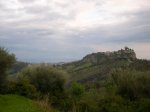
I found these poems by chance in a book amongst a pile of books and papers on a side table in an efficency apartment loaned to us in Caulonia (RC). I had never heard of Lucia d’Amato and, unfortunately, I don’t think you will find her book “Sostenere il sogno” anywhere other than this table, next to its clot of dusty papers. These few poems express the dense and lovely reflections of what I saw everyday that late winter and early spring in Caulonia Superiore.
CALDI PASSATEMPI
Caldi passatempi nell'aria,
E un vago color mattone
nel cuore,
parla di case abitate.
Un sonno silenzioso.
L'inverno passa.
WARM PASSTIMES
Warm passtimes in the air
and a vague brick colour
in the heart,
speaks of inhabited habitations.
A silent sleep.
Wintertime passes.
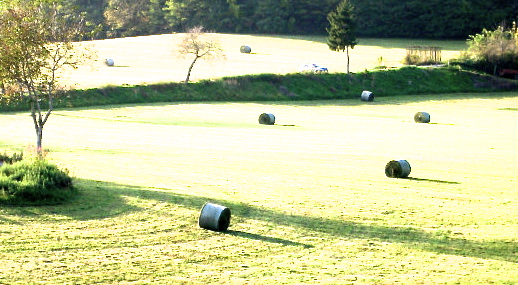
LE PRIME ORE D’UN POMERIGGIO
Le prime ore
d'un pomeriggio brullo,
color di terra, di sabbia, e d'oro,
e la solennità
dei gochi più sereni
del tempo.
Dall'autunno al'inverno
andando verso l'estate,
come un grosso pacco
la campagna si svolge.
Un gregge sta,
come una nevicata sporca
Da un rotolio di nuvole
sguscia il sole.
THE FIRST HOURS OF AN AFTERNOON
The first hours
of a bare afternoon,
Colour of earth, of sand,
and of gold,
and the solomnity
of weather's more serene games.
From Autumn to Winter
now tending towards summer,
the countryside unwraps herself
like a fat package.
A flock stands
like dirty snow fallen
from a roll of clouds
that just slip-shelled the sun.
nota bene: Original poems in Italian by Calabrian poet Lucia D’Amato as published in “Sostenere il Sogno”. Translations in English copyright 2009 Bonnie M. McClellan.







 LE PRIME ORE D’UN POMERIGGIO
 Bonnie McClellan-Broussard