The written version of this poem has disappeared. If you’re wondering why, click HERE.
To listen to the podcast of this poem click on the player below:
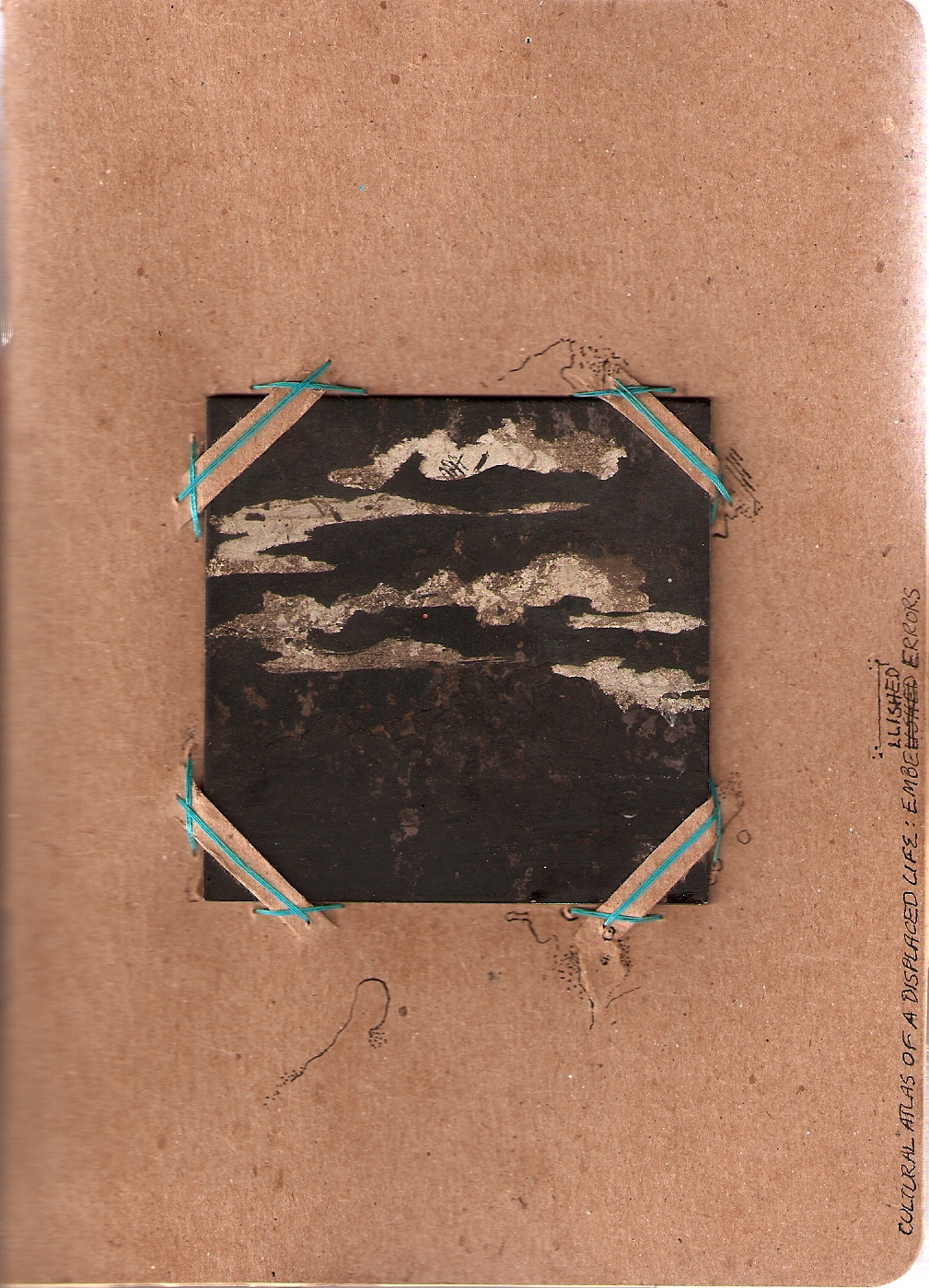
reflection: spare crop / fleet mind
Starting on February 1st and ending on February 28th…a month long flash poetry event. One poem a day for 28 days and then they dissappear, maybe forever…
“I wonder if Dante would smile to know that,
reading his words aloud
(as they used to long ago),
a future poetess would blush to feel
the smooth white marble of his tercets
trace their dust across the center of her tongue?”
How ironic (or bizarre) would Dante or Sappho find it to think of a 21st century reader/writer, reading, parsing, and borrowing from his or her work; women in pants, men in pants!…all speaking a strange, barbaric language and with access to technology that makes words instantly available to millions.
I am both a passionate reader and a passionate writer. I believe that writing serves two excellent functions: it works as a tool to help both the reader and the writer digest, formulate, and reconsider ideas; and, it works as a creative discipline that binds the ephemeral nature of experience to the architecture of words. What we are writing now is a bridge. Who knows how long it will last or who will cross it? Let’s find out.
The time has come to ask for submissions for International Poetry Month! I will post ten of my poems which are the nucleus of a new book that I’m working on with poems inspired by music, cadences, and stories that have been used as vessels for conveying both cultural information and emotive content. For this year’s celebration of poetry I am looking for work that is inspired by the work of others (using borrowed materials for a new construction) or where the form/structure is related to the content (or both)…interpretation of these guidelines will be liberal.
So…lets build something. In addition to my 10 poems I will post a selection of original poetry submitted to me between Jan. 22nd and February 10th of 2010. Please submit your poetic brick (or stone or mortar or slender flash of lath sustaining a fluttering bit of rice paper) to:
bmcclellan.lapoeta@gmail.com
Happy reading and hope that you enjoy International Poetry Month! Submissions in any language will be considered. Needless to say, all rights to works published for International Poetry Month will remain with the author.

Now is the time
I play the game
of let’s pretend
that you’re all here
to draw my face.
At this moment,
before beginning,
I still have hope that you all
will not
randomly cut off
my head.
my hands.
my feet.
Do you mean to perform
these amputations or
is it fear and lack of skill
that leave my multi-copied, uni-facet self
speechless.
unable to grasp a fork;
helpless to walk away
or even cast an angry,
or tired,
or curious glance
back at you.
You,
all diligent charcoal and eraser
perfecting the sine curve
from my armpit
to my breast
as if
it could
divorce
my breath.
O SALUTARIS HOSTIA
o
SALVIAMO/SALE/MINERAUX
I would I were a wingéd thing
And these white stones not bruised my feet.
From half sky’s arc this groundscape see;
Like girasoleil and moth at once.
Face then Gomorrah’s candled sun,
And false to God like Mrs. Lot
Turn arbre-form in Halite caught;
Qualcosa utile, quotidienne.
Ground down and lightly sown across
Unrisen flower and fragrant oil;
Then in the mouth of Adam lost
Mineral dust to dust returned.
poem copyright Bonnie McClellan 2009
“The eye comes always ancient to its work, obsessed by its own past and by old and new insinuations of the ear, nose, tongue, fingers, heart, and brain. It functions not as an instrument self-powered and alone, but as a dutiful memeber of a complex and capricious organism.”
– Nelson Goodman from “Languages of Art
This poem is one in a series that I am currently writing that takes it’s inspiration from the rhythms and subject matter of sacred texts varied and sundry. It is also the fruit of my continuing struggle as a poet to reconcile the three languages that jostle for position in my work as I am searching for exactly the right word. This particular piece is inspired by the rhythm of the Latin Hymn “O SALUTARIAS HOSTIA”. The content inspired by conversations had with the Artist, Matthew Broussard and the film director, Michangelo Frammartino about Pythagoras’ four states of being: Human, Animal, Vegetable, Mineral. The concept of the observed walk as a transformative experience is also inspired in part by the work of sculptor Richard Long.

Paint everything which is not
mountain;
only sky only
the tranquil green of a hayfield
tumbling towards a horizion
ignorant
of what it’s missing.
It is this void, superimposed upon the mountain
which instructs the heart:
Constrict!
There is the possibility of absence.
Bonnie M. McClellan
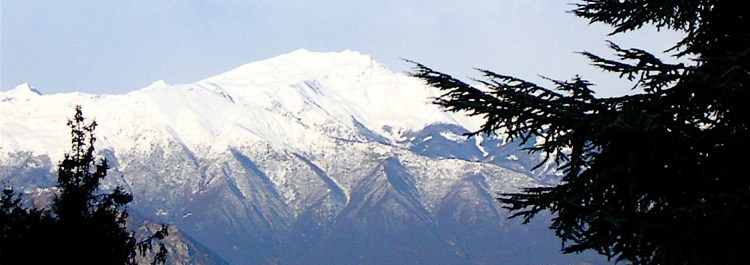
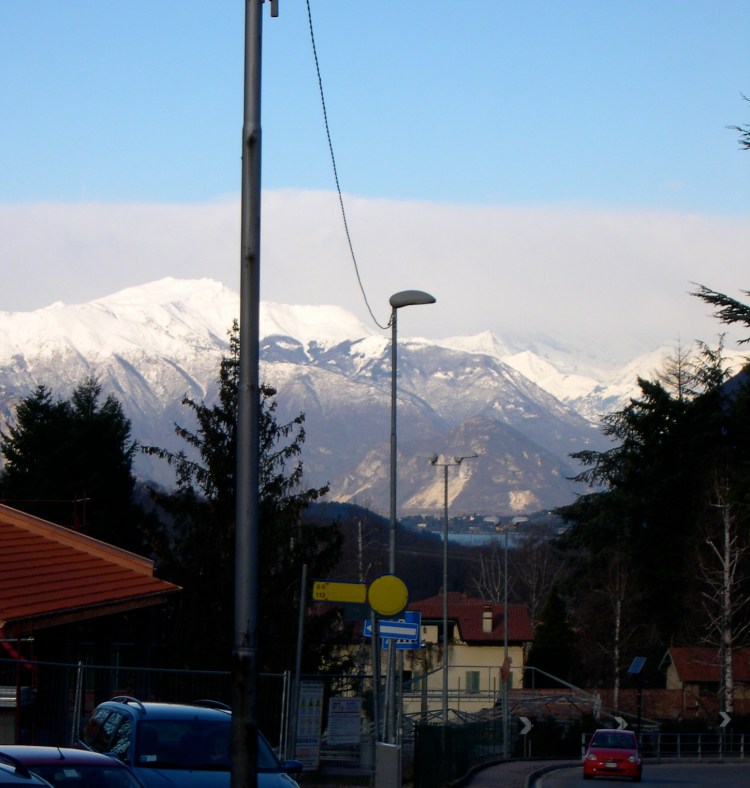
I have lived in Italy for three years now and it never stops being beautiful. The concept of a quotidian and yet extrodinarily beautiful vision continues to fascinate me as did the daily magic of the sky when I lived in Texas.
I wrote this poem parked in the parkinglot of the cemetery of the town of Orino, Italy. The cemetery is along the local road that I drive down on the way to and from my daughter’s daycare in Castello Cabiaglio. I encounter a vision twice a day on this drive: Monte Rosa. The mountain is the wallpaper of my everyday life. Despite the ubiquity of this beauty, I feel an ache in my chest that has the emotional resonance of loss everytime I round the curve in the road that brings the moutain into sight. I’m still working my brain around living with something so beautiful that it hurts to look at.




 Bonnie McClellan-Broussard