I found these poems by chance in a book amongst a pile of books and papers on a side table in an efficency apartment loaned to us in Caulonia (RC). I had never heard of Lucia d’Amato and, unfortunately, I don’t think you will find her book “Sostenere il sogno” anywhere other than this table, next to its clot of dusty papers. These few poems express the dense and lovely reflections of what I saw everyday that late winter and early spring in Caulonia Superiore.
CALDI PASSATEMPI
Caldi passatempi nell'aria,
E un vago color mattone
nel cuore,
parla di case abitate.
Un sonno silenzioso.
L'inverno passa.
WARM PASSTIMES
Warm passtimes in the air
and a vague brick colour
in the heart,
speaks of inhabited habitations.
A silent sleep.
Wintertime passes.
LE PRIME ORE D’UN POMERIGGIO
Le prime ore
d'un pomeriggio brullo,
color di terra, di sabbia, e d'oro,
e la solennità
dei gochi più sereni
del tempo.
Dall'autunno al'inverno
andando verso l'estate,
come un grosso pacco
la campagna si svolge.
Un gregge sta,
come una nevicata sporca
Da un rotolio di nuvole
sguscia il sole.
THE FIRST HOURS OF AN AFTERNOON
The first hours
of a bare afternoon,
Colour of earth, of sand,
and of gold,
and the solomnity
of weather's more serene games.
From Autumn to Winter
now tending towards summer,
the countryside unwraps herself
like a fat package.
A flock stands
like dirty snow fallen
from a roll of clouds
that just slip-shelled the sun.
nota bene: Original poems in Italian by Calabrian poet Lucia D’Amato as published in “Sostenere il Sogno”. Translations in English copyright 2009 Bonnie M. McClellan.
Unable to traverse the swallow’s path
Or tread roof tiles as the agile cat,
upon his brothers’ labouring backs
A polychrome Christ will make a rough pilgrimage of His own;
Pillar bound, to that church above from this one below.
Square-shouldered, tow-haired nine-year old will run and clap
His acolyte’s bell laughingly at black curls that lap
The tender nape of his fellow impenitent in Mary’s blue.
And so this honour guard will hew
four hundred years of progress’ path
Pelligrinago from first to last,
Across the stuck in stones.
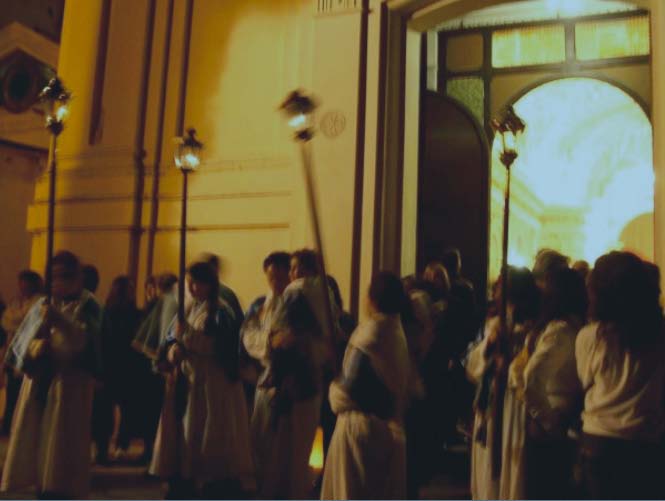
AT 5:30 THIS AFTERNOON
Piazza della carmine is desirous of tumbling towards the sea.
Boys gyre round parked cars in this town the Greeks begot.
A truck full of music winds lamenting through the streets;
Calling forth ancient Eves to buy their compassionate widow’s tot
Of what, to Adam’s sweaty brow, this fallen earth bequeaths.
poem and photo copyright Bonnie McClellan 2011 all rights reserved
This poem is the third in a suite of poems written about 24 hours in Caulonia Superiore.
As the end of March approaches, I think of southern Italy – Calabria – the tiny town of Caulonia Superiore where we spent the weeks leading up to Easter and watched it unfold around us.
Cat spelunks the canyon down
picking through lichen broidered tile.
My lover's hands diagram, inform:
slab after slab of wet clay
curved across the thigh to pave
the high square meteres of the sparrows' way.
This mute arc reiterates the form
of what coulted femeur's slack desire?
Makers now in abandoned bone box stacked
Shout their names marked in black
at dull, dun, desanctified walls.
Amnesiac tiles cup together, deaf above
foxed timbers dressed in sixty years of lime.
They uphold each others' weight,
Sweet compression.
As distracted as August lovers
(lost thigh to sweaty thigh)
trying to topple not the slender wooden frame
of a kitchen chair.
Busy, keeping the rain out.
poem and photo copyright Bonnie McClellan 2009This is the first of a suite of 3 poems that treat 24 hours in Caulonia Superiore
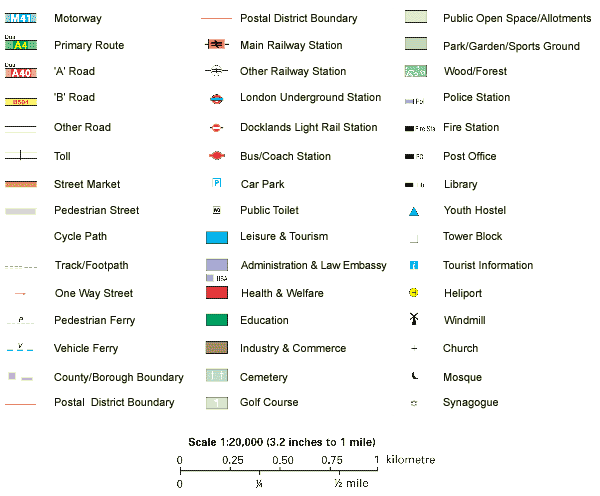
“Since a map is a reduced representation of the real world, map symbols are used to represent real objects. Without symbols, we wouldn’t have maps.” – Compass Dude
In my previous essay I talked about mapping the terrain, the “You Are Here” aspect of a Cultural Atlas. That, and a response to the post by Brad Frederiksen, got me thinking about another aspect of maps, the key. I have always loved those little boxes at the bottom of a map, the ones that tell you what those mysterious hieroglyphs printed across the terrain mean. Even their names are inviting, intimating the possibility of deciphering and understanding unknown territories both physical and cultural: The Map Key. The Map Legend. Without this key, the caption to the photo, a physical or cultural context, where are we? Who are we?
We all have our own cultural ‘legends’ which help us read and interpret the surrounding terrain. Often, one is unaware of what these symbols are until we are called upon to function in a situation or a place where our internal ‘key’ is not consonant with the one in which we’re operating. These legends and keys tell us not only: ‘you are here’ when they align (or don’t) with our external circumstances; but also ‘you are this’: these recognized symbols can place us in the centre or on the periphery of nations, professions, spiritual communities, families and historical epochs.
The language in which a poem is written can place it in the realm of ‘fully accessible’ only to people who understand our cultural or even personal keys and legends. Each reader in the center or on the periphery of a language group, a professional or family environment will give a new reading, using their own symbols and associations to navigate a poem – superimposing their Map Key upon the poet’s – or they may give up, the two keys too dissonant to be reconciled.
Starting at the end of this week (Feb. 1st), IPM will be presenting poems that map territories both broad and intimate, urban and rural, topographies of nations, family relationships and internal landscapes. I invite you all to come and read, bring your keys and re-map the territory of the coming 28 days of poetry…who know’s what you’ll discover about your own territory:
You Are Here?
You Are This?
“Being in a foreign country means walking a tightrope high above the ground without the net afforded a person by the country where he has his family, colleagues, and friends, and where he can easily say what he has to say in a language he has known from childhood.” – Milan Kundera from The Unbearable Lightness of Being
“You are Here” installation sculpture in cut grass at Novara’s Vespolate airfield by Matthew Broussard as part of the exhibition: Clicking the Territory
The time has come for the introductory essays for International Poetry Month 2013, a project I started 5 years ago in an effort to create a dynamic space for poetry around the world to be read and heard. Each year has had a theme and this year’s theme is ‘Cultural Atlas’. I admit, I stole this theme from The Sketchbook Project 2013. As I started working on my sketchbookI began to think of all of the ways this theme dovetailed nicely with what IPM is about: making cultures accessible to one another, sounding the similarities and marveling at the differences.
The photograph to your right is of an installation sculpture that my husband, Matthew Broussard, did for an exhibition called ‘Clicking the Territory’ in 2009 (the first year of IPM). It’s titled “You are Here” and is an image of the ‘clicky hand’ – that we all know and love from the virtual world – mown into the grass of Novara’s Vespolate airfield. So, you are here but where is here? Without google maps and panoramio how would you ever know how find or even be able to imagine the dirt runway and green grass of Vespolate if you’d never been there?
So, where am I? The ‘location’ box to the right of my screen says gemonio, varese italy; but I feel my internal, physical and cultural map of Texas bumping up against Gemonio’s every day. This is not a bad thing, it’s just noticeable. As a poet I appreciate the fact that it makes me think and inspires me. The interesting part is how often I need to superimpose these two maps to orient myself both internally – culturally and historically – and externally, for others who don’t have an internal map of Texas for reference.
As a Texan living in Italy, “Where are you from?” is a question I get asked a lot. It’s an easy answer; I grew up in Dallas and I have yet to meet an Italian who doesn’t know that it’s the city where either:
JFK was shot, or
the TV series Dallas was made.
I fall into this nebulous terrain on an Italian’s mental map, though few of them could indicate Texas on a map of the U.S. I am often, when describing where I’m from, constrained to superimpose a map of Europe over my internal map which results in comparisons like:
“Texas is about as big as France / Texas è più o meno la stessa grandezza della Francia.”
Or, time/distance equations with multiple variables:
“It takes the same amount of time to drive from Dallas to the border with Mexico as it does to drive from Liguria to Calabria / Ci vuole lo stesso tempo di guidare da Dallas al confine con il Messico, come fa a guidare dalla Liguria alla Calabria.”
In blog land we are all in an ever evolving here, no matter how far apart we are. Here is where we begin our IPM exploration.
Where is your here? If you’ve written a poem that touches on mapping your cultural territory (interior or exterior) I’m interested in reading. Check out the submission guidelines HERE.
Stay tuned! Up next: Cultural Atlas of the Periphery and the Center…
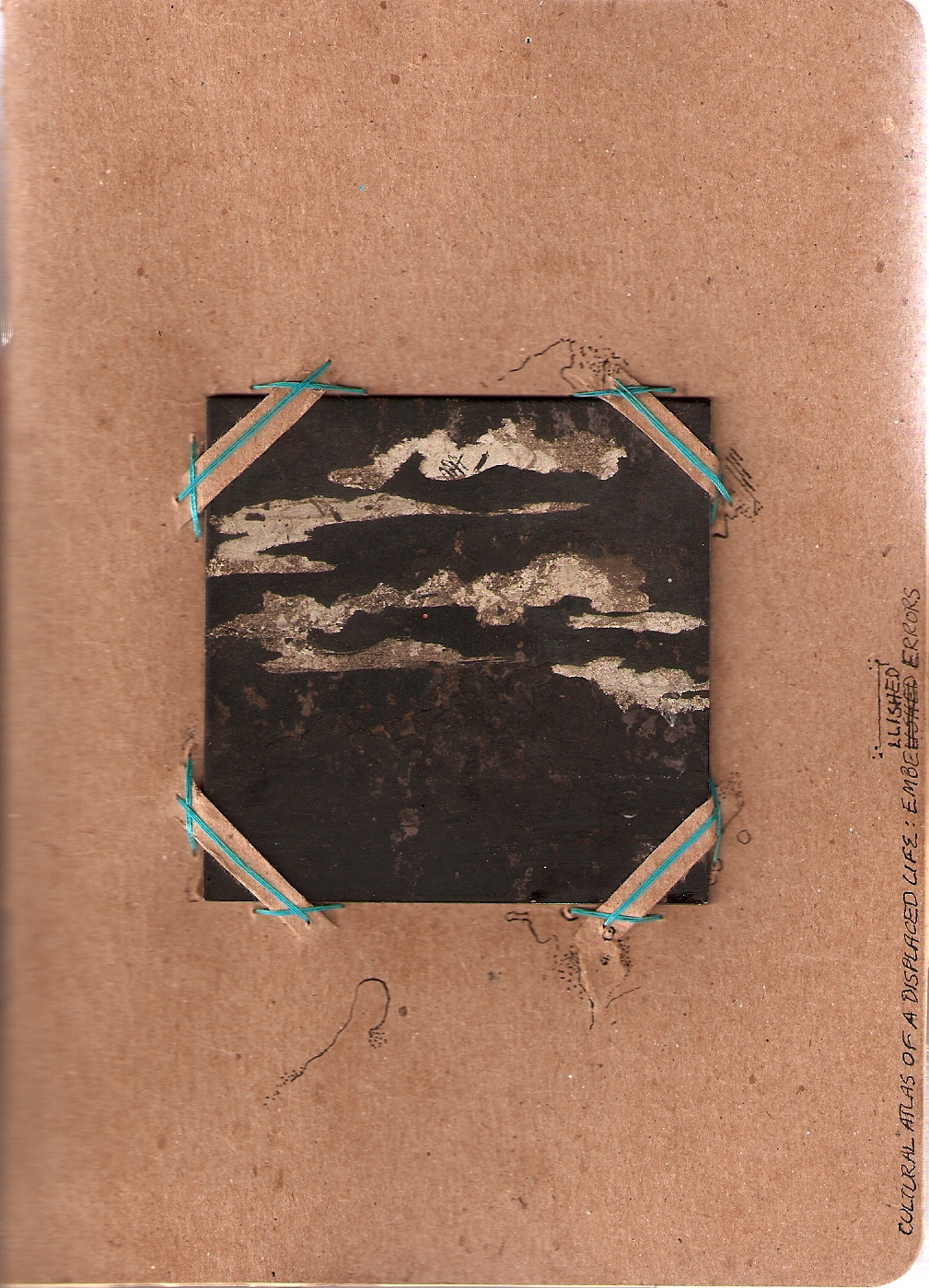
The inside cover of my Cultural Atlas is covered with Italian shelf-paper. I used it because when I tore up thefront cover, I thought that the inside should be stabilized (another embellished error). This paper is still made in this country; a lovely, heavy, egg-cream ground with black, red, dark blue, or green patterns. When I had first moved to Italy, I lived in a rural valley outside Florence; I was trading work for a place to stay with an American-Italian couple. One of the first things Adele asked me to do was strip off the old paper from her kitchen shelves and re-cover them with new paper. It marked one of my first trips into the treasure-palace that is the Italian ‘whatnot’ store. While I was living there I was in the process of a separation that turned into a divorce and a cultural shift that involved re-evaluating the (then) 38 years of my life in Texas.
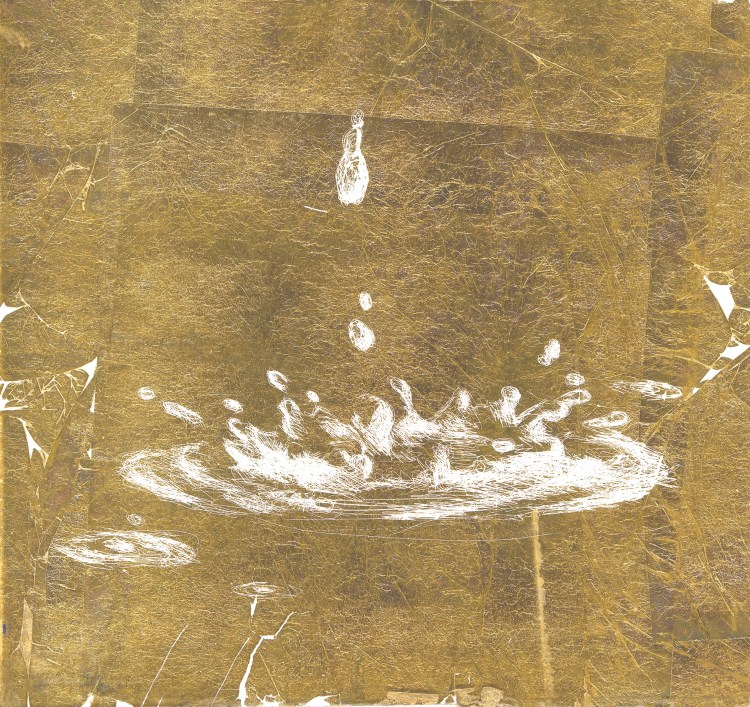
The poetry/story of this can be found in my Orphan Poetry series; however, later, I also made, from the empty tissue paper ‘books’ that remain after one has used up the thin sheets of gold leaf, a series of impressions of my left hand made with white marble-dust and gum arabic. In these two ‘books’ there is one page and one hand-print for each year of my life with the year written in pencil on the bottom-left and my age on the top-right. They overlap and stick, they are messy (as my life has been) and made of the dust of rocks that were once marine fossils, our common calcite frame.
This attempt to make peace between my Texas past and my Italian present is included in the collage on the first page of the Cultural Atlas. The envelope from the gold leaf (delivered from Italy to Texas and then repatriated when I moved here) holds the book. Above the envelope is the word PAX – which speaks to the common Roman/Latin cultural roots between the two places – from the instructions for an IKEA shelving unit – representing a more recent, consumer empire that uses those common roots to try and make clients feel ‘at home’.
This song is written for an audience of one.
for your eyes and your mouth alone;
in hope that you may catch
the cadence of my breath
in rhythm of these words,
as I felt Dante’s breath, weighted
against my lips, chanting out
a novena of tercets, beginning:
Nel mezzo del cammin di nostra vita
mi ritrovai per una selva oscura,
che la diritta via era smarrita.
The straight path also lost to me,
I follow the sound of my voice
whispered across your lips.
Trembling at the gates of hell,
inside the silent center of this caesura
we inhale.
ALL OTHER POEMS FROM THE SERIES “In Vocation of the Muse” have been removed from this blog. If you would like to order a bound copy of the book complete with colour illustrations at a cost of 25.00 EURO ($35 USD) + postage and handling please contact me at: bmcclellan.lapoeta@gmail.com
Torano, Italy below the Quarries of the Alpi Apuani
Back story:
In May of 2007 our family moved to the town of Torano in Italy. Torano is a quarry town, the last one between Carrara and some of the oldest marble quarries in Italy. There were two bars, a bakery, and a small convenience store that sold milk, butter, and a few dusty bottles of wine. It was a town that was, for the most part, empty of all but retired people. A few younger couples lived down near the bus stop. The top of the hill was reserved for houses scrupulously tended by stoop-shouldered women and gardens planted and puttered over by silver-haired men.
For the first two months I was recovering from the birth of our daughter and so stayed in the house except for a few brief walks. Later I would push the baby in her stroller to make the loop of the town on the one road that circled through it. At the top of the hill on the sunniest spot there was a bench across from some houses where I would stop and look down the hill at our town and the others below. It was here that I first met Carlito. He was carrying a bag of leaves down from his garden to the dumpster by the side of the road and stopped on the way back to get a look at little Robin. Italians are crazy for babies and Tuscan people are in some sense the quintessential Italians, falling right between the extreme hospitality of people in the south and the blinkered, work-horse mentality of the north.
When I was talking to Carlito I was looking into the sun and noticed only that he had a deeply lined face and spoke haltingly…a Da Vinci drawing of a slightly grizzled old man. Several walks later I noticed that while others asked new questions, he always asked the same ones: “Is it a girl baby or a boy baby?”, “What’s her name?”, “You live in Torano?” After this brief exchange I would head of down the hill to the sound of the 4:30 p.m. detonation of explosives rumbling down from the quarries as regular as the church bells ringing vespers.
The fourth time I saw Carlito, Matthew was with me as we took the baby for her afternoon stroll. Matthew’s Italian is fluent and so he asked Carlito if he had worked in the quarries. Carlito told the story of how he got the dent in his head in a quarry accident when he was 25. Now I saw it, the concavity of the left side of his scull…I suppose that 40 years ago in a provincial Italian hospital there wouldn’t have been much they could do. There may not be much more that they can do now. How do doctors treat accidents that happen between men and 8 ton blocks of stone that make giant drag lines and front-end loaders look like bright yellow Tonka trucks?
Later, Matthew pointed out to me how dented and battered the men of the town were. One missing a leg, several limping, many wearing thick, smoke-tinted glasses to save their eyes damaged from squinting at the brilliant white stone for years on end…and above the town the quarries were stunning, beautiful. At sunset the flat white faces changed colours like a magic mirror: silver, blazing orange, downy pink as a baby’s cheek. Down from these mountains had come the marble from which some of the most famous monuments in Italy were made; The Colosseum, Michelangelo’s David. Now it goes to make, the tourist-trinket sculpture sold down in Carrara, floor tiles, and pedestal sinks; the gravel paves roads, the dust goes into toothpaste. What remains the same? Quarry men have been taking take their bite of the mountain for the last 3000 years; and the mountain…
To Carlito di Torano
‘Lizzatura’, impossibility of scale.
The slipping of the lizard ton, slow heave:
Skittering run of started stones, pale
As the knuckles above a dust-rimed sleeve.
What chemic system drives the reptilian mind
Of these men, of you, to scatter with wet
And laboured breath the dandelion seed
Of your life across this osteal range
Of unrelenting, unrepentant, white?
White, heavy enough to burn you blind;
Grind bone and work-hard skin to paste and lard.
As Atlas’ report rambles down the quarry hour;
You turn your head towards the hard, square place
That men dented, limping leave
At twenty-five to tend their flowers.
-Bonnie McClellan
To see the poem published in the “Blood Orange Review” click HERE.
Quarries in the Bacino di Torano as seen from our old house.
“A minor seventh concordant soundswith this planched hillside and my dry mouth.Acrid greenness that smells like a copper cointipped to the tongue.Secco, secchio. Mare, ammaro.”
-bonnie mcclellan
The big things, the wide things, are general. The Mediterranean coast line full of lavender, and other sun baked shrubs that exude the smell of curry and thyme. The eye and the mouth taste something astringent and ochre in this intense green baked soft. It leaves a metallic twinge on the tip of my tongue, on the basin of my retina, nickel cadmium, a licked penny.
The water diffuses everything, the small stones that line the undersea shelf shush-hush-shushing the smack-happy surface which is busy redrawing the coastline; excavating more stones to council silence. Onshore, some of these stones have gone utterly verdigris, church-dome green arching up from the general chaos of grey-scale slashed with white.
What is specific and at the same time wildly general to the vacation house terraces, repeated with small variations along the Mediterranean coast: the banality of bougainvillea and lime, the white table, the beach umbrella, the backpacks crammed with towels, folding chairs, concrete, tile, the ground scattered with ants, crumbs and a child’s plastic toys, the taut umbrella over the table and the shadow of the butterfly that crosses above it.
What is exactly here? FRAMURA, frazione ANZO the lower section but above COSTA and the train station. Folding chairs, the old kind that are made of wood and metal with a little rust, at one point they were white but have been repainted with a colour the paint store has labeled ‘azure’. The umbrella over the table is a deep cherry red. It has six wooden ribs. The branch of a lime tree with one lime has tucked up underneath the umbrella’s far edge. All the parts of the lime leaves facing up towards the inside of the umbrella are catching the reflected red, turning these sides into a chromatic shift of red-russet-brown-black. The contrast between the green of the underside of the leaf and it’s reddark surface makes each transitional edge as hard and clean as a struck blank.

 LE PRIME ORE D’UN POMERIGGIO






 Bonnie McClellan-Broussard