Body Language and Poetry: giving words wings

“Written words, from the days of Sumerian tablets, were meant to be pronounced out loud, since the signs carried implicit, as if it were their soul, a particular sound. The classic phrase scripta manet, verba volat –– which has come to mean, in our time, ‘what is written remains, what is spoken vanishes into air’ –– used to express the exact opposite; it was coined in praise of the word said out loud, which has wings and can fly…”
Alberto Manguel from
A History of Reading

When IPM-2MXI closed last year I was thinking, as I often do, about how poetry serves as a bridge across time and culture. I was thinking back to poetry readings that I had done and that I had attended. I have vivid memories of a writers workshop sponsored by my high school where, among others, Max Apple, Frank H. Schaefer, and Tim Seibles came to read their work and talk about writing with interested students. We were lucky.

Funny thing is, what has stuck with me for thirty-odd years, is less what they had to say about writing (sorry guys) but their physical presence, the sound of their voices: how their bodies bore their words. Gesture: Max Apple, his narrow shoulders folded in, glanced up at the auditorium of expectant students and smiled before looking down at the podium and reading from The Oranging of America and Zip along with a poem about wanting visitation rights with his ex-wife’s breasts. His nasal, northern voice held back half of a laugh. Frank Schaefer, whose laconic, matter-of-fact tone somehow matched the arch of his bushy eyebrows and the way his arms swung from his shoulders, read from The Ghosts of Elkhorn and spoke to us about ballads and the art of story-telling. Tim Seibles, whose deep, impassioned voice matched the sweep of his arms, gave his words wings as he read Double Dutch, The Leap, and Big Mouth from his first book that was then yet to be published: Body Moves.

Years later I found that slender volume of Tim Seibles poetry in a bookshop and recognized his photo on the back cover. Inside the book were the poems he’d read, lots that he hadn’t, and the sound of his voice double-exposed over the written words. That book found it’s way into my apartment here in Northern Italy and makes part of the inspiration for this year’s theme. But of course there’s more…

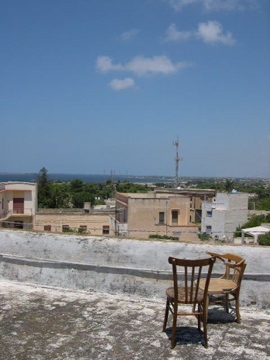
Olive oil from Sicily: a mouth full of flowers and memories.

A summer long, long ago on an island not so far away my husband and I were working with a friend to renovate a house just outside of the town of Marsala in Sicily. The client put us up in an apartment nearby and provided us with olive oil in 5 litre jugs. There was a grove of orange and lemon trees on the property and open-air market two days a week. I would ride there on a borrowed bike with an orange crate wired to the back to carry the produce. Much to the dismay of our friend I did so in a skirt; he said that would attract the wrong kind of attention while I felt it would somehow keep the erratically driven cars from crashing into my erratically piloted bicycle. As far as I’m concerned, my strategy paid off.

It was the end of June and cherries were in season. I bought them 5 kilo at a time; Matthew and I ate them on the roof of the apartment in the cool of the morning while looking out over the suburban rooftops and antennae, towards the sea where we imagined we might glimpse Tunisia.

It was gloriously hot and we ate lunches of melon with prosciutto crudo and sandwiches of fresh tomato and buffalo milk mozzarelle and basil grilled in the skillet. All of it with this olive oil that densely green, perfumed and which tasted like a mouth full of flowers.

We left Sicily in late July having visited Trapani and Palermo all too briefly; having watched Italy win the world cup on the television in a barber’s shop where complete strangers had invited us in to watch and then joined in the explosion of jubilation in the streets that followed. On the way back north, with us we carried 5 litres of olive oil, it didn’t last long enough.

Olive oil is to Italians (and some ex-pats) as chilli is to Texans: everyone has an opinion. Tuscan oil is best, but no, the stuff from Abbruzzo is just as good and less expensive; still, others prefer oil from Umbria or even as far north as Lago di Garda where a microclimate allows olives to survive the cold winters. I’m a solid fan of Sicilian Olive oil although I have to say that I’ve bought jars of olive oil from Trapani at the supermarket in hopes of recapturing that mouth full of flowers and found it light and bland. We’ve made due, enjoyed other lovely olive oils from other parts of Sicily, and lately had some nice oil from Lazio.

Matthew is working again with that same friend, this time designing a staircase for an apartment in Milan. He came home for the weekend of the Epiphany with this:

My mouth is singing flower songs. Orange blossoms tumble in with memories of rooftop cherries, summer swimming in crystaline, warm water and platters mounded high with fresh, steamed mussels. It’s hard to imagine a lovelier way to start the new year.

I wrote a suite of 4 poems about this experience, you can find some images and the audio HERE.

Notte è morta – a reverse haiku

I’ve been awake for hours                            Per ore sono sveglia

Church bells are just now                                Campane solo ora

Shaking their mourning heads.                Lutto, scuotono teste.

International Poetry Month 2012: Time to submit!

INTERNATIONAL POETRY MONTH 2012 IS NOW OPEN FOR SUBMISSIONS from now until 31 January 2012. KEEP READING BELOW FOR THIS YEAR’S THEME AND HOW TO SUBMIT:

Vedi sotto per le linee guida per la presentazione in italiano (tutto in verde)

Voir ci-dessous pour les directives de soumission en français (toute en blu)

The theme  for IPM 2012 will be The Gesture:

political gestures, gestures of affection, heriditary gestures, cultural gestures, empty gestures’

corporeal gestures (body language), and gestures towards communication (the gesture of writing,  translation and reading).

Send submissions in any language (no more than 3 poems of any length) to:

bmcclellan.lapoeta@gmail.com

You will receive a receipt confirmation and a response within one week of your submission.

Poems will be published during February of 2012. For poems in other languages an English translation is welcome but not obligatory.

ITALIANO

INTERNAZIONALE MESE DELLA POESIA  2012 è ora aperto per contributi provenienti da ora fino al 31 gennaio 2012. Continua a leggere sotto per il tema di quest’anno e come inviare la vostra poesia:
Il tema di IPM 2012 sarà il Gesto:
gesti politici, i gesti di affetto, gesti ereditari, culturali gesti, gesti vuoti,
gesti corporei (linguaggio del corpo), e gesti verso la comunicazione (il gesto della scrittura, traduzione e lettura).

Inviare la poesia proposta (non più di 3 opere di qualsiasi lunghezza) al redazione a:

bmcclellan.lapoeta@gmail.com 

Riceverete una conferma di ricevuto e una risposta entro una settimana dalla vostra presentazione.

Le opere saranno pubblicate nel mese di febbraio (2012) come l’anno scorso, ma voglio avere la poesia in gennaio se possibile (in qualsiasi lingua – traduzione in inglese gradito ma non obbligatorio).

FRANÇAIS

INTERNATIONAL Mois de la poésie 2012 est maintenant ouvert pour les soumissions à partir de maintenant jusqu’au 31 Janvier 2012. Continuer la lecture ci-dessous pour le thème de cette année et la façon de présenter votre poème:

Le thème de l’IPM 2012 sera le geste:
gestes politiques, des gestes d’affection, de gestes héréditaires, les gestes culturels, les gestes vides,
gestes du corps (langage corporel), et des gestes vers la communication (le geste de l’écriture, la traduction et la lecture).

Envoyer une proposition de poésie (pas plus de 3 œuvres de n’importe quelle longueur) à la rédaction:

bmcclellan.lapoeta @ gmail.com

Vous recevrez une confirmation et reçu une réponse dans une semaine après votre présentation.

Les œuvres seront publiés en Février (2012) que l’année dernière,
mais je veux avoir la poésie en Janvier si possible (dans n’importe quelle langue – traduction anglaise bienvenue mais pas obligatoire).

Orphan Poetry or Paradise Regained: Still life with Romance (Natura Morta)

Still Life with Romance (Natura Morta)

For my sister Robin Glynn (1962-2006)

My world, if full – is full of sunlight and bees.
We both know that Courbet was a communard;
without looking down.
I hear the water in his painting singing below.

A plover calls.
The soft scent of not wisteria,
The Pollack swirls of dried grass,
Make no shape, no pattern.

Acquacheta / still water

Fat unthinking bees hover.
My sister says it must be a sweet life if I’m pissing on rose petals.

There is that air about it:

The Romance

Begun at 38 instead of 21 when one is meant to have the grand adventure;
At 21 when it is impossible to imagine how sharp pain will taste when you let it age.

And so it begins:

I was in love with a sculptor, born in Louisiana, who now lived

near the Adriatic coast. I came to live in the hills outside Florence

looking to find the shape of my soul and to unwind the threads of

our love…

How much of that is real and how much a hollow in the light?

Sitting on a bench in front of a small cabin that
I share with a bulb on a wire, a suitcase and a family of rats;
Drinking grappa, smoking Gauloises,
Watching the sun set over the Tuscan hills.

This is real
No more and no less real than
the romance
Driving from DeSoto to Irving, Texas.
Having de-composed my ordered, still life.

Cutting down through weak and inconsistent flesh,
To find the white, persistent honesty of bone.

Orpan Poems or Paradise Lost: X. Virgil/Vigil

Virgil / Vigil

Will you boldly walk with me the road our good intentions paved;
Or stand balking, faint
    with fear at that long path from there to here
Trusting my hand, like Virgil’s to lead you through the gates?

Advent

Christmas is coming, the goose is getting fat…

Advent calendar our family made together

and I think he’ll keep getting fatter because we can only afford a chicken! At least my daughter still thinks it’s cool to make stuff. Last night she asked me to cuddle up with her and talk about Christmas. She asked me what I liked best about Christmas and I listed the standard stuff: the songs, the tree, the decorations, the visiting, sitting by the fire. When I asked her the same she said: “Snow.” It’s cold here but no snow yet…maybe she’ll get her wish yet (along with a puzzle and a yo-yo).

Orphan Poetry or Paradise Lost: IX. Water from a Stone

I have pounded myself out

on the rock of this memory,

cracked open and drained out;

is there water left

in this stone?

Orphan Poetry or Paradise Lost: VIII. Enchanted Rock / The Ides of March

Enchanted Rock / The Ides of March

I will remember the branches and the light
filtering through the locust grove.
You will remember the emerald brilliance
of the grass.
We will remember together the unyielding line of granite
that still gives way over time:

the fine fullness of the moonlight across our whiteness
the vermilion flash of the cardinal
Cool air rolling lightly over and under everything like water
filling our mouths with flower petals
tasting of honey olive oil fresh bread

The sacrament of breath.

Orphan Poetry or Paradise Lost: VII. Tishomingo Granite

Tishomingo Granite

From the Quarry at Tishomingo
Comes this Pre-Cambrian intrusion
Begotten when the first rain dropped on boiling rock.
Only later to be named
With sounds recalling some child’s summer game.
These random elements, the stuff of stars
Cooled by Bowen’s ruled order (though he was not invented yet)
Pyroxene first, then salmon coloured plagioclase;
Last, cloudy silicate of common quartz
All this a billion years ago.
You know I loved you even then;
The day this rock was formed.