Perfect Orange Cake!

Gâteau à l’orange or The French know their cake:

Years ago my mother gave me this cook book. It’s a first edition from 1950 of French recipes by Mme. Germaine Carter. Of interest for the story of how it was compiled as for the recipes themselves; Mme. Carter, her husband (the British consul at Boulogne) and Mr. Rapp (British ambassador to Mexico) were interned together in Brandenburg during WWII and passed much of the time discussing French cooking and compiling this book.

Easy and delicious:

Although there are many things in this book that I will probably never make – say, Calf’s Brains with Cream Sauce or  Lark Pâté – I have found that the recipe for mayonnaise is stupendous and, like the two cake recipes I use again and again, easy to follow with reliable results. First take a look:

 Mme. Germaine Carter’s Gâteau à l’orange

Looks good, yes! Here’s the recipe:

4 eggs beaten
2 cups sugar
3/4 cups milk
3 cups sifted flour
4-1/2 tsp. baking powder
1 tsp. salt
grated peel of 2 oranges
juice of 1 orange**
1 cup butter

Beat the eggs wit the sugar; add a little milk. Sift the flour wit the baking powder and salt. Add milk and flour alternately, beating well. Add the orange peel and juice of 1 orange then the butter. Beat well and pour into 2 greased loaf pans. Bake in a moderate oven (350ºF / 180ºC) for 40 min. Remove from the pan to a cooling rack.

It is in fact, as easy as it sounds. My only modifications have been to bake the whole shebang in a large sheet cake pan and to check it after 35 min. She follows this recipe with another for ‘orange syrup’ which uses the juice of the second orange, another cup of sugar and a 1/2 cup of water; however, I’ve only done that once. The cake is quite ‘orangey’ enough without and my whole family loves it ‘as is’ with no icing or with sweetened whipped cream and fresh strawberries as in the photo. It does make a lot of cake so it’s perfect for a party, the layer cake you see in the picture is what I made with the 1/3 that was left over the second day after the other 2/3’s had been devoured ;).

Hope that you all enjoy Mme. Carter’s Gâteau à l’orange as much as we do.

**This is one recipe in which those beautiful Italian ‘blood’ oranges are not recommended unless you want your cake to turn a bluish-grey! The beautiful hot pink juice of these oranges is Ph reactive and will  change color when it combines with the baking powder

Sing and Speak, Read and Play!

SING AND SPEAK, READ AND PLAY!

Per chi è pensato?
“Sing and Speak, Read and Play” è pensato per i bimbi in età da 5-7 anni: sarà una bella esperienza di apprendimento della lingua inglese con l’obiettivo di trasmettere ai giovani allievi l’amore per la lingua.
Come saranno organizzate le lezioni?
I bambini potranno frequentare due lezioni alla settimana (ogni martedì e giovedì), della durata di circa un’ora, dal 4 giugno al 25 luglio (per un totale di 16 lezioni). Il programma del corso sarà supportato da canzoni, giochi, attività manuali e storie scelto accuratamente per i bimbi di questa età ed eseguito da una docente madrelingua. Ogni settimana un nuovo tema:
A giugno, scopriremo:
  • v  Colori e fiori (giocheremo con i colori della natura)
  • v  In cucina (frutta e verdure, pane e biscotti)
  • v  I nostri amici animali (nomi e versi degli animali)
  • v  Che bella la musica (strumenti musicale)

e a luglio:
  • v  Quanti sono? (numeri e giochi di conteggio)
  • v  Muoviamoci! (braccia, spalle, ginocchia e piedi – tutti in movimento)
  • v  Com’è il tempo? (pioggia, neve, sole e nuvole)
  • v  Vacanze estive (in montagna o sulla spiaggia, come fare la valigia?)

Verranno utilizzate storie, attività manuali, canzoni e giochi. Le lezioni saranno prevalentemente a carattere comunicativo; il metodo d’apprendimento rifletterà il modo con il quale i bambini apprendono la propria madrelingua.
Orari giugno-luglio 2013:
  • Ø  giugno (4-27): Ogni martedì e giovedì dalle 16:30 alle 17:30
  • Ø  luglio (2-25): Ogni martedì e giovedì dalle 16:30 alle 17:30

Costo per bambina/bambino:
  • Ø  8 lezioni (solo giugno o solo luglio) – €80,00 in due rate di €40,00
  • Ø  16 lezioni (iscrizione per entrambi i mesi, una lezione gratuita!) – €150,00 in tre rate di €50,00

Dove:
  • Ø  via Statuto 14, Gemonio (VA)

L’iscrizione è limitata. Per iscriversi ai corsi “Sing and Speak, Read and Play” o per ulteriori informazioni si prega di contattarci a bmcclellan.lapoeta@gmail.com o di telefonare Bonnie McClellan allo 0332 601 690. 

Wool in Italy – What’s new?

I’ve realized that I was blogging alot about knitting and wool, so I’ve moved that over to my new blog:
come take a look and find out about:
So, if you’re interested in receiving my latest knitting, spinning and wool-working news and inspirations, please stop by at Wool in Italy and click the ‘follow’ box to your right on the home page.
Meanwhile, the rest of life in Italy will keep posting here so stay tuned for recipes, art, random thoughts, gardening and other things going on at the house.
Thanks for reading and happy wool-working to you woolies out there.

Paperworks…Matthew Broussard

Who would recognize this as a Drafting tool –
Manual CAD 1940
pencil on laid manuscript paper
(25 cm x 37 cm / 10″ x 14.5″)
I enjoy the Morandi-like play of shadows and surfaces
in this survey of my kitchen table.
Pencil on laid manuscript paper.
(25 cm x 37 cm / 10″ x 14.5″)

 Paperworks: Estimates and Perspectives

My husband, Matthew Broussard, has been working on a series of drawings, a survey of our house. The paper he is using is from an old book (c. 1846) regarding how to correctly survey land and estimate its value. The book is from the era when Lombardy was still occupied by Austria. The Italian Revolutions of 1848 were still brewing and Garibaldi would not take part in the famous but brief Roman Revolution for another 3 years. Lombardy would not become part of independent Italy until 1859. Within the book there are annotations on supplemental pages, lined like notebook paper (but larger) and written in a calligraphic longhand, that describe amendments made to the surveying and assessment rules in following years. It is on these pages, turned upside down, that Matthew has begun a survey of the iconic yet intensely human images of our territory.
Dish rack over the sink – a prosaic object rendered poetic with close observation:
the tools of our daily life offer a survey map of how we inhabit our own territory.
Pencil on laid manuscript paper (25 cm x 37 cm / 10″ x 14.5″)

Just a little bit…


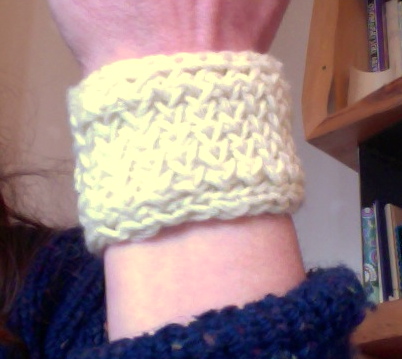
Herringbone-pattern wool cuff

 You know that feeling when you just have one tiny ball left from a project, not enough to do anything but you loved the yarn and can’t bear to use it just to tie up other skeins. I invented a tiny project that was fast and fun.

I was so inspired by this amazing herringbone pattern at purlbee: 

That I had to try the stitch. It’s EASY (once you get the hang of it). 

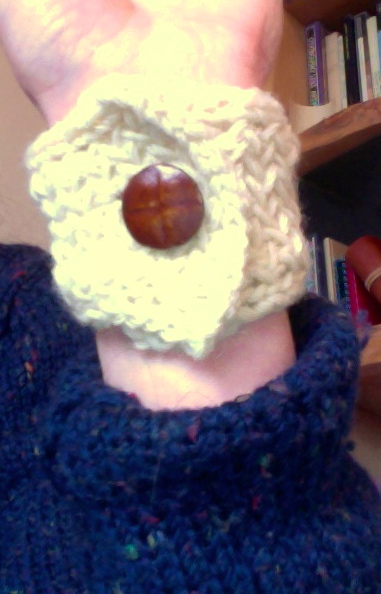
I had just a tiny ball of The Wool Box’s PETTINATO BOSE 1/1200 left over from when I  made my current favorite hat and found that it was the perfect yarn for the stitch. I was so pleased with my sample that I added a leather button and made a wrist-warmer cuff.

With a vintage leather button
Makes a great wrist-warmer cuff

If you want to know how to make it, leave me a  note and I’ll post the pattern. 
P.S. Last Saturday I made a trip to visit Biella and The Wool Box. What an amazing place and what an incredible project…I’ll tell you more soon.

Slip-stitch Rib and the Graft: Still Spinning out of Control

Slip-stitch ribbing knit in the round with hand spun yarn.

So, I have begun the sweater I was thinking about when I wrote Norwegian Wool and the Magic Sweater  10 days ago, and my spinning has stabilized since I wrote Spinning Out (of Control) a week ago. My output of spun yarn has doubled to two-hundred yards this week and I have a good 7″ knitted. I’m in luck with this sweater both because my husband (who requested it) is slender – so I only have 36″ of ‘tube’ to knit for the body – and because I decided to knit it on U.S. #10 (6mm) needles! After working on my standard U.S. #2 (2.75mm) needles to make socks this sweater seems to be knitting up so quickly that I could finish it before the long Lombard winter actually ends.

I have learned two new techniques on this sweater. The first is the slip-stitch rib knit. I’ve found that it’s the perfect stitch to forgive the uneven quality of my different skeins of ‘beginner’s’ hand-spun yarn, the slipped stitches add density where the yarn is thin and at the same time allow enough openness to keep the thick spots from looking bulky…nice. If you don’t know this stitch, it’s easy and both the ‘right’ and ‘wrong’ sides look cool:

Row 1: K1, P1 rib until you reach the marker at the beginning of your round
Row 2: *S1 (purl-wise with yarn in back), P1* repeat these two stitches until you reach the marker
Repeat rows 1 and 2 for as long as you’d like.

The second technique is grafting. My wonderful (and insanely talented) mother, Sara, sent me this link for yarn grafting that I have adapted for my wool. Considering that both my spindle and the Andean plying that I’m doing, limits me to a maximum skein length of 50 yards, without grafting I’d have a whole lot of little ends to be worked back into the fabric. Grafting two or more skeins together has allowed me to make up much larger balls and just keep knitting. Once again, the very forgiving stitch hides the grafts well. Thanks Mom!

Turning the corner, down at the heel…

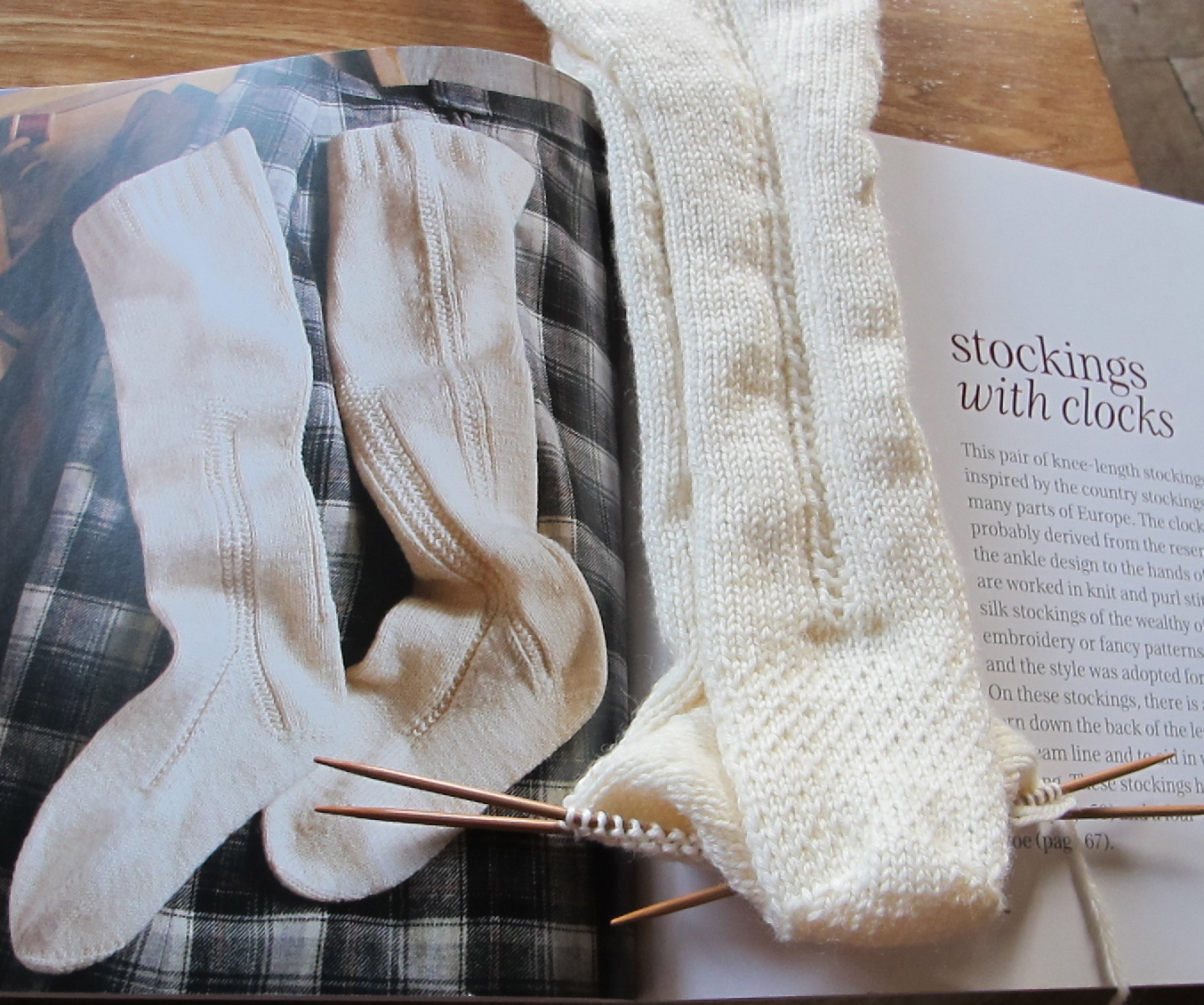
      I have been knitting my first pair of long ‘stockings’ all winter. With all of the other projects large and small in the middle, I have just now arrived at the heel and turned the corner. Fortunately, for this project I decided to knit both stockings at once so that I can’t finish one and let a year pass before I finish the other!
The pattern is the first one in Nancy Bush’s fine book “folk socks” which is a lovely resource for patterns and techniques even if, like me, you have a tendency to not be able to follow any pattern without making just a little change or like to mix the gauge and technique from one source with the textures or colours of another. 
     I did just that with the modified highland hose, mentioned in a previous post, where I combined the gauge and construction techniques of the finnish socks on page 97 (which suited my heavier yarn – The Wool Box’s Morron Bouton 2x) and the leg ribbing pattern of the highland kilt hose on page 109.
     Even with these stockings with clocks, I couldn’t resist adding the honeycomb patterned reinforcement stitch to the heel, both because it’s beautiful and because I really do wear my hand knit socks all the time!

Now, having seen how nicely the seam comes out, I have an idea swimming around in my head to make a pair of long stockings like these but with the ribbing, the seam and a textured heel and sole in a contrasting color….but first I’m going to turn the other heel and finish these stockings so that I can wear them :). 

Thanks for reading and happy Wool-works!


Spinning Out (of Control) and Fancy Socks

Questo fine di settimana ho filato oltre 100 metri di lana…
ma sto diventando più brava (vedi la differenza tra i due prima 
alla sinistra e l’ultimi alla destra)! 
Cosa devo fare con le due qualità diverse di filato?

 So I’ve been spinning with the drop spindle this weekend and managed to meet my goal of making up at least 100  meters of plied yarn…that was more than 200 meters of singles and then andean plying all 4 skeins (whew!). My only problem now is that I’m getting better. My twist is ever smoother and more consistent and I can really see the difference between the yarn I made on Saturday and the yarn I made on Sunday. But now what do I do? The skeins are really different.

Theoretically this yarn is to make a sweater for my husband who fell in love with the roving as soon as I opened the package from the Wool Box. “It’s so smooth, it’s so shiny, it’s so soft! It’s almost as beautiful as your hair,” he says. If you read the last post you’ll know why he’s partial to Norwegian wool. He wants a close-fitting, raglan-sleeve turtleneck in slip-stitch rib so I’m thinking that I might use my ‘first’ skeins for the collar, the cuffs and the 1×1 rib that I’ll be using for the bottom edge and then hope that I can try not to get any better just yet!

“mini-trecce con merlatura” queste costa/mini-treccia
ho usato su due differente paio di calzini
e credo che il ‘merli guelfi’ ai talloni e punte
sono un modo divertente
per rendere la transizione tra i colori.

Meanwhile, the sock equilibrium is changing. I’ve been making wool socks for myself for some time now and at first my husband teased me about spending weeks on a single pair…until I made some for him. “They’re soft,” he says, “they’re comfortable,” he adds, “they’re beautiful!” So, now that he’s been converted to the joy of wearing hand-knit socks, I’m trying to make up the gap. I have more than 7 pair (one that my Mother made and sent me). He has ‘only’ three. These ‘toe-up’ grey ones with mini-cable rib and ‘crenellations’ are the latest. He’s hard on his footwear so I made a slip-stitch reinforced heel (alternating the rows to get a more delicate honeycomb effect rather than straight lines). I have done the square crenellations as a colour transition technique on several pairs of socks and find it quite nice for transitioning into a rib.
The blue and white striped ‘sailor’ socks are his favorites. Made from Lanagatta’s ‘Nuova Irlanda’ knit up on U.S. #3’s; I have to say that they have stayed soft, have not pilled at all and have not shrunk or stretched a millimeter since they came off the needles a year ago.

Questi “calzini di marinaio ”
sono i preferiti del mio marito.
His fourth pair will be the Modified Highland Hose that I posted a few weeks back made with a gorgeous and very sturdy, natural tweed Morron Bouton” that is a soft un-dyed tan with tiny fuchsia, marigold, and grass-green flecks.  I’m  knitting those top down  and on 3’s though  that needle gauge is a bit tight…I managed to snap one of my bamboo needles while cabling! However, between the snug gauge and the fully-reinforced Dutch heel, I don’t suspect he’ll be wearing through them any time soon.

Thanks for stopping by to read and Happy wool-working!

Norwegian Wool and the Magic Sweater!

This beautiful sweater was made for my husband Matthew when he was an exchange student in Norway. He was 16 then and is now edging close to 50.

It’s like a magic sweater out of a fairy tale. Matthew tells a story of how he took it off at a party when he was studying at the Maryland Institute in Baltimore and when he went to get it off the pile of coats he found it had gone missing. He thought it was gone forever. Then, three years later when he had his truck packed to move back to Texas he saw it. As he passed St. Johns University on his way out of town, he saw a woman walking the other way wearing his sweater. He stopped the car, jumped out and asked her where she’d gotten it. She said she’d found it at a thrift store. He told her the story of the sweater (then only 10 years into its history) and offered to buy it from her, offered to pay any amount she asked for. She kindly gave it back and he’s had it ever since.

Now that I think about it, this sweater has survived without a single bit of darning for more than half his lifetime. The wool is still glossy; there is not a single ‘pill’ anywhere on the inside or the outside. It has moved from Norway to Texas to Maryland back to Texas and, along with Matthew, settled in Italy. Now in it’s 35th year, I have put a few reinforcing stitches at the cuffs and have noticed that the yarn is thinning around the elbows. I wash it carefully in cold water, dry it flat; despite its age, we both wear it often. It has seen me through a few cold, Lombard days when no other thing in the house could keep me from shivering. This is the kind of sweater that a knitter aspires to.

Inspired by this sweater I recently ordered some Norwegian wool (washed, carded and combed) from a local Italian wool co-op. The box arrived and I have to say it’s beautiful. The same gloss as the wool in the magic sweater. It’s a dream to spin, the staple at least as long (if not longer) than the BLF that I tried at the spinning workshop I went to last fall. It’s also about a third again less expensive than BLF (1.50 euro/100g for the Norwegian wool vs. 2.20 euro/100g for the BLF).

TOPS WOOL NORWEGIAN MOORIT BROWN from The Wool Box

Now the challenge is for me, not only to do a decent job of spinning it, but also to make it into something as beautiful and enduring as the magic sweater.

Back to the Wool-Works!

I spent all of February putting heart and soul into International Poetry Month. Now it’s March (and still crazy cold, wet and even threatening to snow) here in Lombardy…

So I’m happily back to knitting and about to think about starting in on spinning the wonderful fluff that I ordered from The Wool Box back in January. Want to see what’s in the basket?

beautiful pink fingerless gloves requested by my daughter

new pair of ‘highland hose’ adapted for bulky yarn
here they are from the side where you can see the reinforced heel.

My new hat that I just finished yesterday! Love that SSPTBL decrease….