Aleppo Galls or The Theater Way: by Bonnie McClellan


Some mornings when I go walking,
on my promenade sauvage,
you are my mind’s companion.
Not today, à cause de la pluie;
It was Monday that we walked together.
I said to you,
nothing of any real importance.

I pointed out a pleasing branch,
winter-bare, cracking the sky’s solid blue
into angular panes.
All the while, the curious eye of a downy woodpecker
peered at us across the top of a telephone pole.

(“Amazing that telephone poles still are,” I say.
you nod agreeably, watching the bird away.)

Houseman goes jogging by;
In my mind’s eye
he turns his head across his shoulder and
back to us in lovely iambs shouts:
“Loveliest of trees the cherry now…”

(steam rising from his mouth into the frigid air.)
I look down;

Lady Murasaki is at my elbow,
kimonos layered seventeen deep.
At her neck and sleeve
a pulsing chromatic order
from bamboo’s winter gold to white,
honors the season with
the echo of its colours.
She raises not her eyes to me.
I glimpse the iron black
of her eleventh century teeth
as she murmurs,
“Golden bamboo sighs
beneath winter’s white weight.”
Recalling to me Friday’s now absent snow.

(Matter never lost, transformed to water.)

She takes her cordial, silent leave
of me, still standing on the bridge.

I press deep-coated ribcage
against the galvanized steel
that keeps us seekers
on the middle path.
Now it holds me from falling to the street below,
leaning out to show you the galls
among my favorite live-oak’s leaves.

(you have turned from whatever personal curiosity held you back while Murasaki and I had our tête-à-tête.)

I tell you: in a housewife’s notebook
that comes to pieces in my hands, I have found
(along with a laudanum label from 1832,
instructions for concocting
A Paste for Cleaning Gloves,
Court Plaster, and
Essence for the Handkerchief,)
her recipe for SOLID INK.
It requires 42 parts Aleppo Galls to
3 parts Dutch Madder.

“Would this work,” I ask
“if we soaked live-oak galls in vinegar
and warm water?”

What could be drawn with such an ink,
bitter recriminations?
rancorous, impudent washes?
We laugh together at this unlikely experiment,
After all, the galls rest too far off the path to reach.

I leave you to work that out, bridge-bound.
Maybe you will have an answer for us tomorrow.

“A Demain.”
I smile to you and,
hands pocketed in the cold,
amble towards home.

THE ARKANSAS: by Lee Elsesser

The written poem has disappeared. To hear Lee’s reading of this poem, click the arrow on the player below:

To hear readings of more poetry by Lee Elsesser, click HERE.

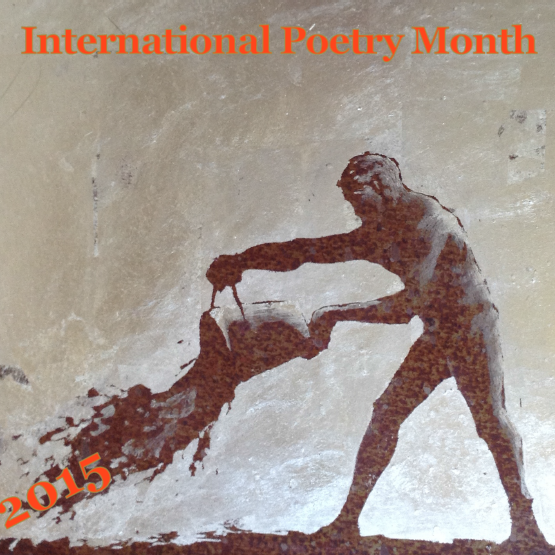
Water Under the Bridge: IPM 2015 is open for Submissions

IPM 2015 - Water Under The Bridge

Jump right in, the water is full of poetry…

Splash! Throw the poems out with the bath water and see what you can fish up; IPM 2015 is open for submissions. I’m late with posting the call for submissions because I’ve been immersed in reading Zola’s Au Bonheur des Dames a series of entrancing social and political observations of turn of the century Paris and the rise of the department store in the guise of a romance novel. His mesmerizing descriptions of the ‘new’ architecture captures the theme of this year’s IPM perfectly:

“The iron staircases developed bold curves, multiplying the landings; the iron bridges suspended in space, ran straight along, very high up; and all this iron formed, beneath the white light of the windows, an excessively light architecture, a complicated lace-work through which the daylight penetrated, the modern realisation of a dreamed-of palace, of a Babel-like heaping up of the storeys, enlarging the rooms, opening up glimpses on to other floors and into other rooms without end.”

It’s all water under the bridge

Poetry gives us the opportunity to offer our observations to present and future readers, be they from the perspective of one standing on the bridge watching events or of one standing below and taking on the current. I’m looking forward to a month of editing and I know that my IPM readers are standing on the bridge waiting for the flow of poems to begin.

Find the submission guidelines and info about IPM HERE.

The Glassmen: by Bonnie McClellan

The glassmen run reconnaissance

like fluorescent-vested spiders

through the web of night streets;

lacing the village tightly

from downhill church to up.


Dawn crashing they come

green reflections

of wined evenings upended

echoing through the fog.

Horizontal Clock: for Robin Kay – by Bonnie McClellan

What counter-force
turns you like a clock
telling only horizontal
time?

Eternal quarter-to-three,
your sleeping frame
crosses the deserted
rectangle of my bed.

Piedmont: by Bonnie McClellan

Nude summer feet

on sheepish boulders falling,

……….through peasant ices’ glacial tread

floe following light, tripping

roll, down running fleet

……….biting toes with

………………..ever-glancing snows

………………………..green-moistened lisp.

IMG_0741

Where The Lost Things Are

A poem that’s just right for summer from IPM contributor John Stevens:

John Looker's avatarPoetry from John Looker

At the back of the west wind,
where the evening sun wakens a bird-rich isle:
that’s where the lost things are.

Where the hummingbird
quivers at a trumpet dripping with nectar
and clouds of scent rise over a turquoise sea,
that’s where they are, the things that can’t be found.

The golden sovereign that slipped between
the boards in the Tudor Hall; the Hall itself lost at cards
in Venice on the long Grand Tour;
they’re here; this is the spot.

Even the daughter, forswearing carriages and
pianoforte, who was carried away in steam and smoke
for love; and the son gone surfing in foreign lands;
they too are here. They all come here.

And therefore you.
You’ve raced across the foot-burning sand
to float like a starfish in the clear lagoon,
your tequila-on-ice waiting you back in the shade.

If only mine were too.
…….If only I were…

View original post 18 more words

What’s New? A literary “Gathering”

Author Chris Fillebrown, a long-time IPM contributor, has been working on the third book in his short fiction series about the character Phillip Young. Published in weekly installments, he has now arrived at the halfway point of his newest work exploring the touchy terrain of marriage, grief, loss and the mesmerizing mazes the central character’s internal monologue can construct and deconstruct. Below is an excerpt from Part 6 – Gathering: Early Arrival


He turned the radio off, rolled his window down. The early morning air. Smells of oil and gasoline. The sickly sweet nectar of antifreeze rising up from green puddles on the vast expanse of concrete, dripped from hissing engines. Sharp metal sounds. Highway construction. The beep of garbage truck backing up behind a shuttered restaurant. The clank of its tusks, the whine of its motor lifting, toss rotted dumpster smells onto its back. 

It is this density of description that brings the reader not only fully into the realm of Phillip Young but also into an awareness of his or her own environment, re-observing a mundane activity – such as waiting for an oil-change – through the tone poems of Young’s internal monologues.

If you’d like to read more, you can begin at the beginning – in the midst of a dream – by clicking at the link below:

Gathering – Part 1 – The dream of ascending