Cultural Atlas: White Skirt on the Train

In looking at experiences that are culturally specific to my life in Italy, there is the train…a marker, something utterly distinct from transport in Texas by car. I chose the light moving across the surface of a white linen skirt in an attempt to localize the sensory experience of being on the train to a specific focal point.

Cultural Atlas of a Displaced Life: Embellished Errors – (Pax Texana)

Pax Texana - copyright 2012 Bonnie McClellan all rights reserved

The inside cover of my Cultural Atlas is covered with Italian shelf-paper. I used it because when I tore up the front cover, I thought that the inside should be stabilized (another embellished error). This paper is still made in this country; a lovely, heavy, egg-cream ground with black, red, dark blue, or green patterns. When I had first moved to Italy, I lived in a rural valley outside Florence; I was trading work for a place to stay with an American-Italian couple. One of the first things Adele asked me to do was strip off the old paper from her kitchen shelves and re-cover them with new paper. It marked one of my first trips into the treasure-palace that is the Italian ‘whatnot’ store. While I was living there I was in the process of a separation that turned into a divorce and a cultural shift that involved re-evaluating the (then) 38 years of my life in Texas.

The poetry/story of this can be found in my Orphan Poetry series; however, later, I also made, from the empty tissue paper ‘books’ that remain after one has used up the thin sheets of gold leaf, a series of impressions of my left hand made with white marble-dust and gum arabic. In these two ‘books’ there is one page and one hand-print for each year of my life with the year written in pencil on the bottom-left and my age on the top-right. They overlap and stick, they are messy (as my life has been) and made of the dust of rocks that were once marine fossils, our common calcite frame.

PAX TEXANA - detail (copyright 2012 Bonnie McClellan, all rights reserved)

This attempt to make peace between my Texas past and my Italian present is included in the collage on the first page of the Cultural Atlas. The envelope from the gold leaf (delivered from Italy to Texas and then repatriated when I moved here) holds the book. Above the envelope is the word PAX – which speaks to the common Roman/Latin cultural roots between the two places – from the instructions for an IKEA shelving unit – representing a more recent, consumer empire that uses those common roots to try and make clients feel ‘at home’.

A Saracen grain cake was in her mouth…adventures in cooking with buckwheat

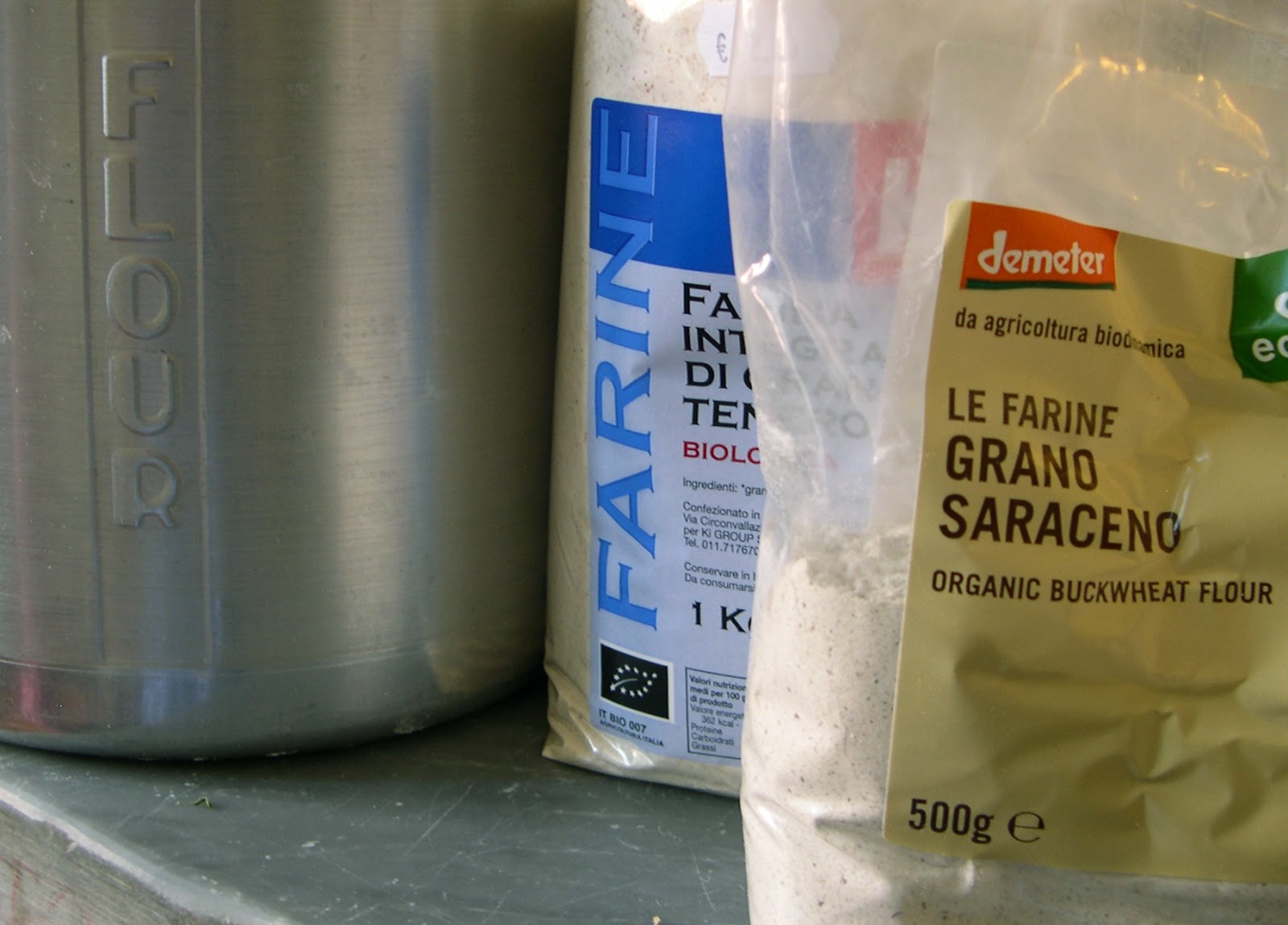
 Several weeks ago I was at the Italian version of Whole Foods Market (only much smaller). I was getting some nice organic flour for my bread making and on the aisle on the way to the register I ran across a package of ‘mixed seeds’ on sale, it had pumpkin, sesame and sunflower in there (some of my favorites) and then ‘grano saraceno tostato’. Thinking the Italian version of ‘hmmm, well, what d’ya know?’ which is the much shorter ‘boh.’ – I plopped the little package into my basket and went on with my day.
Of course when I offered some to my curious 5 year old daughter – “Hey, want some of these seeds on your yogurt?”, her inevitable question: “What kind of seeds?!?” was not to be fobbed off with a quick, “Lots of different ones.” So, I had to lay one of each kind out on the table in a row from smallest to largest, and give them their appropriate names in English and Italian:

semi di sesamo = sesame seed
semi di lino = flax seed
grano saraceno tostato = boh, I don’t know, toasted Saracen grain?
semi di girasole = sunflower seed
semi di zucca
= pumpkin seed

And of course mamma’s “I don’t know” was pounced on.
Robin Kay: “What’s Saracen grain?”
Mamma: “It must be these little triangular ones that are so crunchy.”
Robin Kay: “But is it called that in English?”
Mamma: “I don’t think so, but I don’t know exactly what it’s called in English…let’s look it up”

On behalf of mamma’s the world over, I offer my profound thanks to Wikipedia! I found the entry in Italian and went down the language list to English and in a click there it was:

Mamma: “Oh look, it’s Buckwheat, like in Ol’ Suzanna (singing) ‘a buckwheat cake was in her mouth, a tear was in her eye…”
Robin Kay: “What’s a buckwheat cake? Can you sing the rest of the song?”
Mamma: sigh…

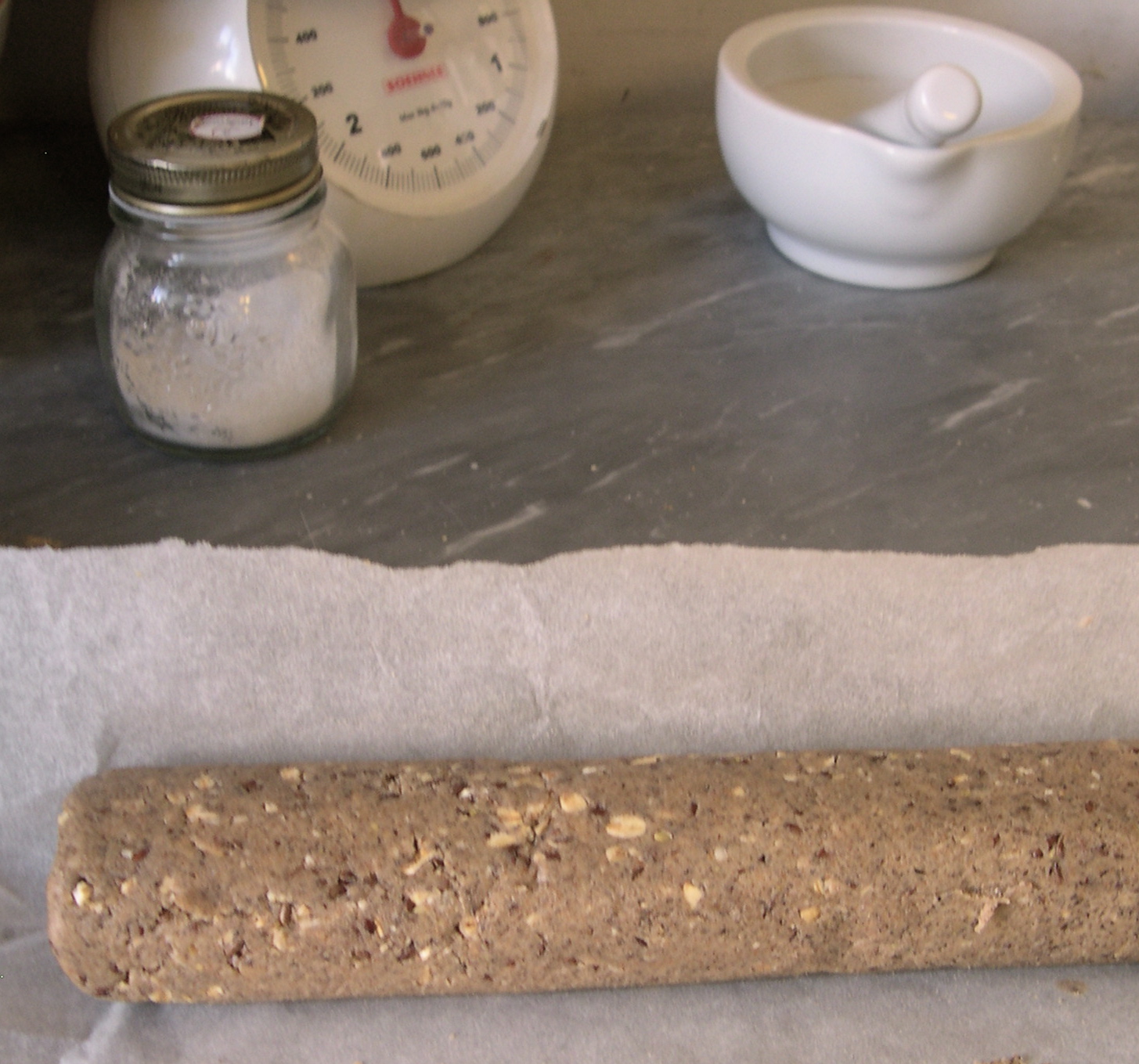
Needless to say the next time I went to the store I bought some buckwheat flour and I’ve been experimenting with using it in bread. Today, because I don’t feel like making something as complex as a cake, I found a recipe for a buckwheat shortbread cookie on the L.A. times website.  I made only a few changes based on what I had in the pantry and what I didn’t: I used wholewheat flour rather than white for the 1/2 cup of ‘not-buckwheat flour’, I used brown (turbinado/demerara) sugar and, for lack of walnuts or almonds, I toasted a mix of pine nuts, oatmeal and flax seeds which I then went over a few times with the mezzaluna…

Yes, I know, it looks like a log of compressed wood; buckwheat flour is, well, gray. The dough has to be rolled up and put in the fridge for a few hours before slicing and baking so I’m hoping that, with a dusting of powdered sugar, the finished ‘Saracen grain cakes’ will look as good as they promise to taste (the the bit of dough that stuck to the bowl was delicious!). We’ll let you know how they come out…

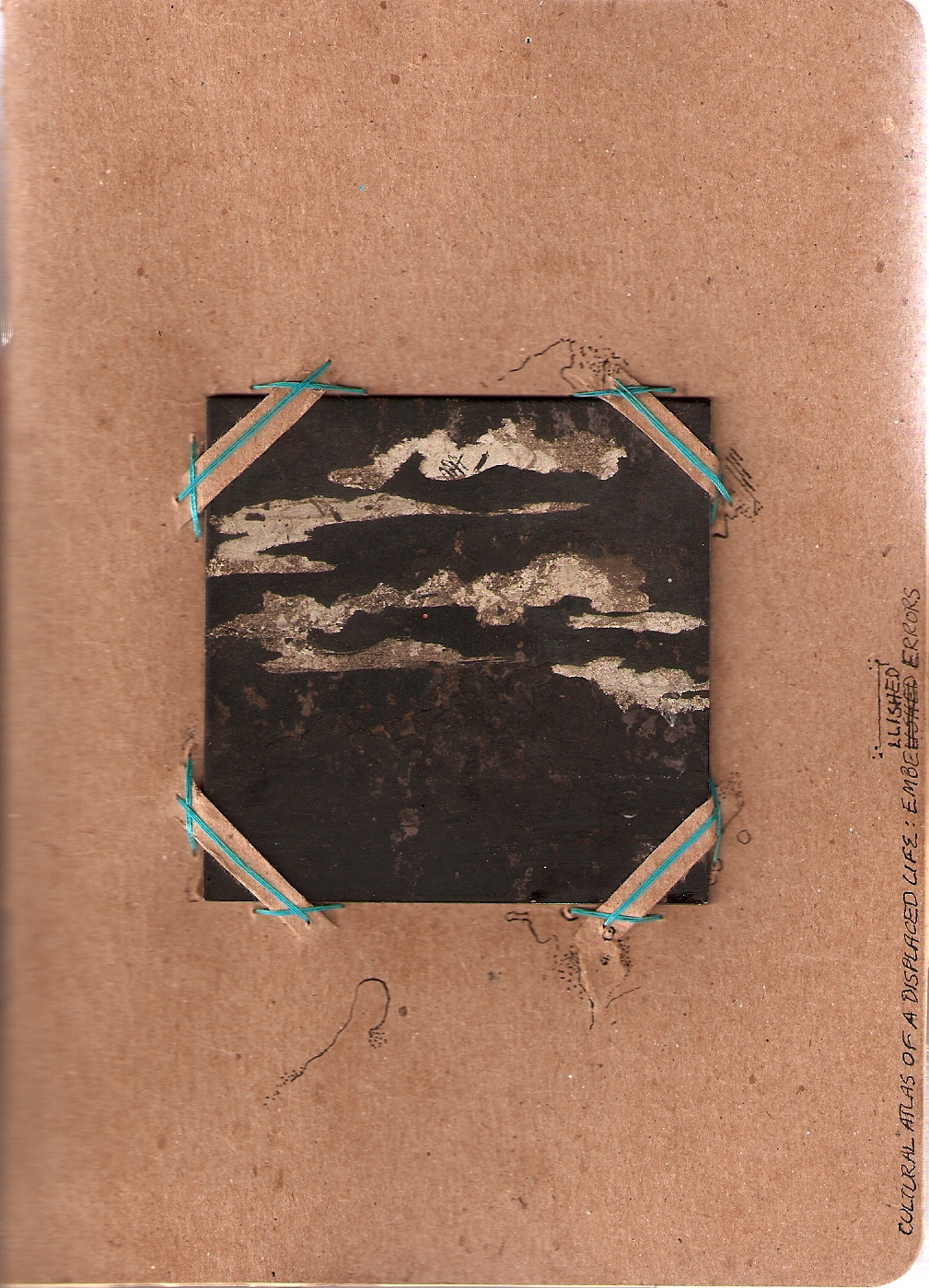
Cultural Atlas of a Displaced Life: Embellished Errors (cover)

copyright Bonnie McClellan-Broussard 2012 all rights reservedI’ve started working on my ‘Sketchbook Project 2013’. I tried once in 2010 (starting late) and couldn’t finish in time. Maybe I’ll make it this year. I chose the theme ‘Atlas’ because I’ve been considering Cultural Atlas as the theme for IPM 2013.

We all come into our adulthood with a series of images, advertising jingles, cartoons, and some language appropriate icons from pre-school coloring pages that helped us learn our alphabet, equivalent to “A is for apple and B is for Ball”.

How the houses were built where we grew up, what form the windows took, the layout and width of the streets and how much of the sky’s expanse could be seen, all form part of an internal cultural atlas that we carry with us. We may remain unaware of how deeply etched these ‘maps’ are until they are challenged by living in a different cultural context.

The image above is a small panel of black steel on which I drew with white gold leaf and rust converter. The image is of the sky, something I love watching change where I live in Northern Italy and also something I miss from my birthplace, Texas. I tore the soft, cardboard cover while trying to insert the rigid panel and then glued the torn bits back together and sewed over them with turquoise thread.  Thus, the subtitle of the book, “Embellished Errors” refers both to my way of making art – often so impatient to see the results of an experiment that paper is torn, fingerprints are left where glue and ink have smeared that are then ‘fixed’ by pointing out their presence and letting it become part of the work, sometimes even the focus – and the series of, sometimes painful, decisions that have made the beautiful and densely embellished ‘stuff’ of my life so far.

I hope that my readers will enjoy the upcoming ‘visual poetry’ and that poets interested in submitting poetry for International Poetry Month next January will keep this theme in mind.

The Store (For Matthew): by Bonnie Broussard

The written version of this poem has disappeared. Find a reading and a link to other work by this poet below:

To listen to a reading of this poem, click on the player:

To read or hear more work by Bonnie McClellan-Broussard, click HERE

Notte è morta – a reverse haiku

I’ve been awake for hours                            Per ore sono sveglia

Church bells are just now                                Campane solo ora

Shaking their mourning heads.                Lutto, scuotono teste.

Orphan Poetry or Paradise Regained: Still life with Romance (Natura Morta)

Still Life with Romance (Natura Morta)

For my sister Robin Glynn (1962-2006)

My world, if full – is full of sunlight and bees.
We both know that Courbet was a communard;
without looking down.
I hear the water in his painting singing below.

A plover calls.
The soft scent of not wisteria,
The Pollack swirls of dried grass,
Make no shape, no pattern.

Acquacheta / still water

Fat unthinking bees hover.
My sister says it must be a sweet life if I’m pissing on rose petals.

There is that air about it:

The Romance

Begun at 38 instead of 21 when one is meant to have the grand adventure;
At 21 when it is impossible to imagine how sharp pain will taste when you let it age.

And so it begins:

I was in love with a sculptor, born in Louisiana, who now lived

near the Adriatic coast. I came to live in the hills outside Florence

looking to find the shape of my soul and to unwind the threads of

our love…

How much of that is real and how much a hollow in the light?

Sitting on a bench in front of a small cabin that
I share with a bulb on a wire, a suitcase and a family of rats;
Drinking grappa, smoking Gauloises,
Watching the sun set over the Tuscan hills.

This is real
No more and no less real than
the romance
Driving from DeSoto to Irving, Texas.
Having de-composed my ordered, still life.

Cutting down through weak and inconsistent flesh,
To find the white, persistent honesty of bone.

Veronica

Summer débutante’s gown

grown shy

blushing falls

thrilling leaf by burnishing leaf

spinning through Constables’ light

grace-full arms:

bare/baring/embarrassed

brace/bracing/embrace

November.

Marsala: Caulk it all up to Experience…

Back in a long ago summer I was working on a remodeling project in the suburbs of the Sicilian town of Marsala, a stunningly beautiful place where Garabaldi’s ‘mille’ made their first landing: the beginning of the work-still-in-progress known as Italian Unification.

Contrary to the myth one hears in Northern Italy, I saw southern Italian’s working hard from six in the morning until four in the afternoon with not much of a break. I recall, after lunch, laying down on the cool tile floor before launching into the next part of the project…and this poem about the often unsung pleasures of manual labour:

Caulk it all up to experience…

I’ve had enough silicone under my nails

To make a fertility goddess of a Hollywood starlette

(or at least to make five clean breasts of it).

You’d think I’d have the bank account

Of a Brazilian plastic surgeon by now…

Fat chance,

Folks don’t pay the big bucks

To have their tiles enhanced.

Will I list this work on my table of discontents?

It could be a Tuesday.

I could be anchored to an anonymous desk

In some downtown gratte-ciel looking out a window that isn’t there

Blinking against no sunlight, thinking:

“Out, out brief candle.”

“out, out.”

“out!”

then, looking down at the shame of clean and idle hands:

“If only I had enough silicone under my nails

To make a fertility goddess of a Hollywood starlette…”

To read more of the back story click HERE.