Calabrian Chronicles: The Ovile of Mimmo and Peppe – Part Two

If you haven’t read “The Ovile of Memo and Pepe: Part One” (click here).

Memo and Pepe at the Ovile
Peppe and Mimmo

Inside, the room was clean and sparse. A bucket of water just inside the door held the meter-and-a-half-long wooden stick with which they stirred the cheese. The cheese was boiling in a black iron cauldron, with a mouth a meter wide, that hung over a wood fire burning so hot and clean that I do not recall even a breath of smoke in the tiny room. Some sausages hung from the rafters; on a table catty-corner from the fire a wood plank table held up two bottles of wine and several packs of cigarettes. In the far corner, opposite the fire, Mimmo and Peppe were busy at a shallow-sided, waist-high stone sink, squeezing whey from the cheese through plastic sieves. They looked up from their work, smiling, verbally poking at Matthew for having taken so long to bring his family down to the ovile, saying hello to me and saving all of the best sweet talk for Robin.

Now I’m going to cheat, this is a blog and not a novel so I can show you a picture of Mimmo and Peppe that I’ve posted above and ask you to look at their hands. They are amazing hands, impressively large and smooth, these hands make almost anything they hold look small. I’m also going to break another writer’s rule and slip into something more comfortable, the present tense:

They offer us some curds of the cheese they’re cooking; it tastes like fresh farmers cheese, bright and dry. Mimmo explains that this is the first cooking and that they will cook it again, making it into creamy, rich ricotta (literally: re-cotta/re-cooked). In the meantime they are busily pressing and compressing the cheese, the whey runs down the slanted work surface and into the drain feeding the rivulet of whey specked with curd that we encountered on the way in. Matthew pops another bit of crumbly bright cheese in my mouth and I understand why the dog outside is so happy to lap up the remnants.

Robin is squirming and agitated by the fire, the dark room and the two robust men with hands bigger than her head. She says alternately, “want to go OUTside.” and “want to see BABY goats!” She wants nothing to do with the fresh cheese. She’s squiggled down out of my arms and hoisted up onto her papa’s shoulders. Matthew asks for permission to go through the door next to where Mimmo and Peppe are working; this is the door that leads to the enclosed concrete part of the ovile where all the goats, too young to go out to pasture, are kept.

Inside the Ovile
Inside the Ovile

Ducking through the door we see goats of all ages from ones that look grown to ones that are barely standing, only 24 hours old. Amongst the goats is a lone lamb with his tight white wool looking tidy in comparison to the splendor of speckles, spots and stripes that embellish the surrounding swirl of goats. Their legs and bellies thick with damp feces, the baby goats are still enchanting. Robin shimmies down from her father’s shoulders and her sneakers smack on the wet cement. The baby goats resist her attempts to pat them by dancing away on their delicate hooves in a wave, like startled ballerinas on point. We explain that they’re nervous, that she needs to walk slowly so she can get a little closer. She won’t get her hands on one this time but she’s happily talking to and about them, informing the world in general about which ones are what colors, and which ones are sleeping, or jumping. Then, like any toddler, her attention span is used up and she wants to go.

We come back into the cheese making room where Mimmo and Peppe have started the second cooking. Our shoes, everyone’s shoes, are slimed with goat shit so I am relieved to see that Mimmo meticulously rinses his hands and keeps the cheese stirring stick always up or resting in the bucket of clean water. Robin cannot be tempted to try the cheese and now wants to go outside, see pigs, see pretty, sad puppy. As we walk back down the path towards the pig pens Mimmo and Peppe’s brother, Gianni, is coming up the path with another man, he sees Robin and scoops her up on to his hip, like a veteran papa, and chucks her startled cheek with his broad knuckle and tells her what a lovely girl she is.

Robin balks at being picked up by Gianni but she doesn’t cry she just wriggles and chants her latest mantra, “mama gon pick you up!” Gianni gets the message and puts her down. He, the stranger and Matthew all walk back up to the cheese room and Matthew returns with a small, plastic basket full of hot and creamy fresh ricotta. He spoons bites into my mouth at happy intervals as we walk up and back down the path. Robin is balanced on my hip and we alternately shoot the breeze and point out things to her, rocks in the cliff face, flowers by the side of the road. The ricotta is magnificent.

To be continued (Click here for part three)

If you’re curious to see when Robin finally got her hands on the baby goats, click here: Robin of the goats


Calabrian Chronicles: Caulonia outside the walls – The Story of Mimmo and Peppe’s Ovile

In the spaces between the rains the sky runs and falls; gathers itself and plunges again towards the sea. Cumulonimbus titans strike their shins on the horizon line as they stumble through the Mediterranean, dead drunk and anxious to reach Ithaca. This is a place where mothers still name their sons Ulysses.

The houses are like barnacles on a rock; roof tiles buried in lichen and slathered with concrete where they meet at the crown in an uneasy sea-sick ridge. Below the rust-eaten white iron boundary of the balcony-rail I can see two flaps of a prickly pear struggling out from between two heavy arcs of terracotta.

The edge of the sky at dawn over the water is like Montale’s description, a singing strip of metal lath, a kite string straining against the rebounding vault of blue. His was the western sea, the Ligurian coast, a sunset light. Here the Ionian dawn makes eastern music…Jove’s mute mistress writes her name in the sand with a round hoof…IO.

Despite lying just above the Ionian Sea, named for Jove’s mythic mistress transformed into a cow, Caulonia Superiore is a place of goats. The goats, along with a few sheep, are kept in enclosures called ‘ovile’ just outside the town walls. There should be a better English translation for the Italian word, “ovile” (oh-VEE-layh) but there is not. “Fold” is inadequate, it’s too short in sound and too broad in meaning. “Goat fold” although accurate, is just plain ugly, clanking off the tongue like a broken carburetor. I mention this translation difficulty because I am about to tell the story of “The Ovile of Mimmo and Pepe” and I don’t want to leave readers scratching their heads as to what an “OH-vile” is until they reach the third paragraph. And so we begin…

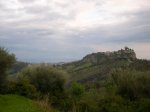
View of the land below the Piazza della Carmine - Caulonia Superiore
View of the land below the Piazza della Carmine in Caulonia Superiore – the Ovile is on the far right towards the bottom…way down there.

THE STORY OF THE OVILE OF MIMMO AND PEPPE

This morning Matthew, Robin and I woke up early to go and visit the ovile of Mimmo and Peppe so that Robin could see the baby goats and we could all have a breakfast of fresh ricotta. The three of us piled into my big blue van and Matthew managed to squeeze, nudge, and coerce it through the slender streets of Caulonia Superiore until we found ourselves on the dirt road that meandered below the vaulting walls that are still (just barely) sustaining Piazza della Carmine above. Matthew parked the van atilt on the shoulder of the road, leaving room for another car to pass, maybe.

The ovile was what you would expect: a big fenced in plot of land for the grown sheep and goats in which every hint of something green had been eaten. Three rambunctious, gangly white puppies tumbled over one another, and a minor river of water, goat shit and urine ran across the road and under the front tires of my van. Adjacent to the large open pen was a roofed enclosure where the baby animals were kept separate and which was abutted by a cinder block shed where Peppe and Mimmo were working making the cheese.

As we walked up the path towards the porch that fronted the shed we passed by a fluffy white dog whose eyes were badly infected, the skin all around them pitted and inflamed. Robin wanted to pet it until she got a little closer and her good will towards animals banged flat up against something sad and ugly. She solved the struggle by resorting to reassuring herself with words, “Bobbie give sad puppy hug, now she happy puppy!” She looked obliquely at the dog while hugging her own round, pink arms. I found my self wondering when we should start teaching her to look at the ugly things straight on and with compassion instead of looking at the ground and calling them beautiful; then I remembered that I was still working on that one myself and our daughter was not yet two years old. Today would not be the day.

We passed by a small fenced in garden with olive and lemon trees. Across from this were a series of low-walled concrete pens one of which housed two large, pink pigs. Matthew held his hand down to their wiggly snouts saying, “See, it’s a pig. He has a wiggly nose.”  Robin edged nervously against my leg saying, “Mama gonna pick you up. Don’t want pigs.” For the first time she was seeing the real animals and they were not wearing plaid shirts and blue jeans like the small, shiny, cartoon pigs in her picture book. They were twice as big as she, I would have been nervous too. I lifted her up. “Lets go see Mimmo and Peppe and the BABY goats,” I said.

As we neared the shed we saw another white dog, this one young and healthy, tied up near a large tree. He was lapping up the water and whey and bits of curd that came from a tube functioning as a drain that led from the cheese making shed out the door and on to the concrete sluice that angled down from the porch. As we reached the open door to the shed Matthew said the obligatory “con permesso” as we walked in.

To Be Continued….(click here for part two)

Calabrian Chronicles: Translations of poetry by Lucia d’Amato

I found these poems by chance in a book amongst a pile of books and papers on a side table in an efficency apartment loaned to us in Caulonia (RC). I had never heard of Lucia d’Amato and, unfortunately, I don’t think you will find her book “Sostenere il sogno” anywhere other than this table, next to its clot of dusty papers. These few poems express the dense and lovely reflections of what I saw everyday that late winter and early spring in Caulonia Superiore.
casa a piazza della carmine caulonia

CALDI PASSATEMPI

Caldi passatempi nell'aria,
E un vago color mattone
nel cuore,
parla di case abitate.
Un sonno silenzioso.
L'inverno passa.

WARM PASSTIMES

Warm passtimes in the air
and a vague brick colour
in the heart,
speaks of inhabited habitations.
A silent sleep.
Wintertime passes.

view towards the sea from caulonia superioreLE PRIME ORE D’UN POMERIGGIO

Le prime ore
d'un pomeriggio brullo,
color di terra, di sabbia, e d'oro,
e la solennità
dei gochi più sereni
del tempo.
Dall'autunno al'inverno
andando verso l'estate,
come un grosso pacco
la campagna si svolge.
Un gregge sta,
come una nevicata sporca
Da un rotolio di nuvole
sguscia il sole.

THE FIRST HOURS OF AN AFTERNOON

The first hours
of a bare afternoon,
Colour of earth, of sand,
and of gold,
and the solomnity
of weather's more serene games.
From Autumn to Winter
now tending towards summer,
the countryside unwraps herself
like a fat package.
A flock stands
like dirty snow fallen
from a roll of clouds
that just slip-shelled the sun.
nota bene: Original poems in Italian by Calabrian poet Lucia D’Amato as published in “Sostenere il Sogno”. Translations in English copyright 2009 Bonnie M. McClellan.

Caulonian Suite: III. Piazza della Carmine / The Two Times


PIAZZA DELLA CARMINE / THE TWO TIMES

AT 7:30 TONIGHT:

Unable to traverse the swallow’s path
Or tread roof tiles as the agile cat,
upon his brothers’ labouring backs
A polychrome Christ will make a rough pilgrimage of His own;
Pillar bound, to that church above from this one below.

Square-shouldered, tow-haired nine-year old will run and clap
His acolyte’s bell laughingly at black curls that lap
The tender nape of his fellow impenitent in Mary’s blue.
And so this honour guard will hew
four hundred years of progress’ path
Pelligrinago from first to last,
Across the stuck in stones.

AT 5:30 THIS AFTERNOON

Piazza della carmine is desirous of tumbling towards the sea.
Boys gyre round parked cars in this town the Greeks begot.
A truck full of music winds lamenting through the streets;
Calling forth ancient Eves to buy their compassionate widow’s tot
Of what, to Adam’s sweaty brow, this fallen earth bequeaths.

poem and photo copyright Bonnie McClellan 2011 all rights reserved

This poem is the third in a suite of poems written about 24 hours in Caulonia Superiore.

Caulonian Suite: II. Caulonia Supriore

As the end of March approaches, I think of southern Italy – Calabria – the tiny town of Caulonia Superiore where we spent the weeks leading up to Easter and watched it unfold around us.

bonniemcclellan's avatarBonnie McClellan-Broussard

CAULONIA SUPERIORE

for Matthew

The sky roils;

swallows knit webbed gyres

among the baroque sag of rooftops.

Across the way they’re fixing one;

new russet barrel tiles sealed over

old timber bones.

I hear a sound like the pounding

Of a battering ram or the cleaving

Of an immense stump

Contrapunted with a loud HUP.

My daughter sleeps with the abandon

of an unfettered shutter swinging in a stiff wind.

A woman in her fifties climbs the stairs

to the house where she and my daughter

were both conceived.

We regard each other with

that part of the eye

which admits an alternate aim.

The pounding stops.

The church bells go off

with the percussive invective

of a fire alarm

DANGATIDANGATIDANGDANGDANG.

They say it’s peculiar to here:

someone sounds the bell

not with the pull of a knotted rope

but with the unlevered force of arms.

This is the…

View original post 10 more words

Caulonian Suite: I. Coppi in Cotto

Coppi in Cotto
Terracotta Roof Tiles with Lichen

Coppi in Cotto

Cat spelunks the canyon down
picking through lichen broidered tile.
My lover's hands diagram, inform:
           slab after slab of wet clay
           curved across the thigh to pave
           the high square meteres of the sparrows' way.

This mute arc reiterates the form
of what coulted femeur's slack desire?
Makers now in abandoned bone box stacked
Shout their names marked in black
at dull, dun, desanctified walls.

Amnesiac tiles cup together, deaf above
foxed timbers dressed in sixty years of lime.
They uphold each others' weight,

           Sweet compression.
           As distracted as August lovers
           (lost thigh to sweaty thigh)
           trying to topple not the slender wooden frame
           of a kitchen chair.

Busy, keeping the rain out.

poem and photo copyright Bonnie McClellan 2009
This is the first of a suite of 3 poems that treat 24 hours in Caulonia Superiore

Cultural Atlas: Mapping the Terrain

"You are Here" installation sculpture in cut grass at the airfield of Vespolate in Novara by Matthew Broussard
“You are Here” installation sculpture in cut grass at Novara’s Vespolate airfield by Matthew Broussard as part of the exhibition: Clicking the Territory

The time has come for the introductory essays for International Poetry Month 2013, a project I started 5 years ago in an effort to create a dynamic space for poetry around the world to be read and heard. Each year has had a theme and this year’s theme is ‘Cultural Atlas’. I admit, I stole this theme from The Sketchbook Project 2013. As I started working on my sketchbook I began to think of all of the ways this theme dovetailed nicely with what IPM is about: making cultures accessible to one another, sounding the similarities and marveling at the differences.

The photograph to your right is of an installation sculpture that my husband, Matthew Broussard, did for an exhibition called ‘Clicking the Territory’ in 2009 (the first year of IPM). It’s titled “You are Here” and is an image of the ‘clicky hand’ – that we all know and love from the virtual world – mown into the grass of Novara’s Vespolate airfield. So, you are here but where is here? Without google maps and panoramio how would you ever know how find or even be able to imagine the dirt runway and green grass of Vespolate if you’d never been there?

So, where am I? The ‘location’ box to the right of my screen says gemonio, varese italy; but I feel my internal, physical and cultural map of Texas bumping up against Gemonio’s every day. This is not a bad thing, it’s just noticeable. As a poet I appreciate the fact that it makes me think and inspires me. The interesting part is how often I need to superimpose these two maps to orient myself both internally – culturally and historically – and externally, for others who don’t have an internal map of Texas for reference.

As a Texan living in Italy, “Where are you from?” is a question I get asked a lot. It’s an easy answer; I grew up in Dallas and I have yet to meet an Italian who doesn’t know that it’s the city where either:

  1. JFK was shot, or
  2. the TV series Dallas was made.

I fall into this nebulous terrain on an Italian’s mental map, though few of them could indicate Texas on a map of the U.S. I am often, when describing where I’m from, constrained to superimpose a map of Europe over my internal map which results in comparisons like:

“Texas is about as big as France / Texas è più o meno la stessa grandezza della Francia.”

Or, time/distance equations with multiple variables:

“It takes the same amount of time to drive from Dallas to the border with Mexico as it does to drive from Liguria to Calabria / Ci vuole lo stesso tempo di guidare da Dallas al confine con il Messico, come fa a guidare dalla Liguria alla Calabria.”

The same size(mic) translation is required for my family and friends in Texas when trying to contextualize media frenzy over Italian earthquakes.

In blog land we are all in an ever evolving here, no matter how far apart we are. Here is where we begin our IPM exploration.

Where is your here? If you’ve written a poem that touches on mapping your cultural territory (interior or exterior) I’m interested in reading. Check out the submission guidelines HERE.

Stay tuned! Up next: Cultural Atlas of the Periphery and the Center…

Cultural Atlas of a Displaced life: Empirical Logo(s) or Graphic Incision

Scan 2
second hand bed linens, paint, graphite and embroidery on paper. plastic bag and staples.

Cultural Atlas of a Displaced Life: Size(mic) Map of Texeuropa

copyright 2012 Bonnie McClellan - all rights reserved
Metaphorical scale map of Texas and Europe

Texas is large but the map is only metaphorically in scale. I spent 38 years in Texas and just 7 in Europe but European culture also holds the underpinnings of U.S. culture. In real terms, Texas is about equal to continental France, Belgium, Luxembourg and Switzerland all stuck together (but not nearly as densely populated).

As a Texan living in Italy, “Where are you from?” is a question I get asked a lot. It’s an easy answer; I grew up in Dallas and I have yet to meet an Italian who doesn’t know that it’s the city where either:

  1. JFK was shot, or
  2. the TV series Dallas was made.

This is where I fall on a map though few of them could tell you where the state is in the U.S. and I am often, when describing distances in Texas, constrained to superimpose a map of Europe over my internal map which results in comparisons like:

“Texas is about as big as France / Texas è più o meno la stessa grandezza della Francia.”

Or time/distance equations with multiple variables:

“It takes the same amount of time to drive from Dallas to the border with Mexico as it does to drive from Liguria to Calabria / Ci vuole lo stesso tempo di guidare da Dallas al confine con il Messico, come fa a guidare dalla Liguria alla Calabria.”

The interesting part to me is how often I need to superimpose these two maps to orient myself both internally – culturally and historically – and for others who don’t have and internal map of Texas for reference.

Cultural Atlas of a Displaced Life: El Pescador / Fingerprint:Ring

Cultural Atlas of a Displaced Life: Il Pescador / Fingerprint:Ring
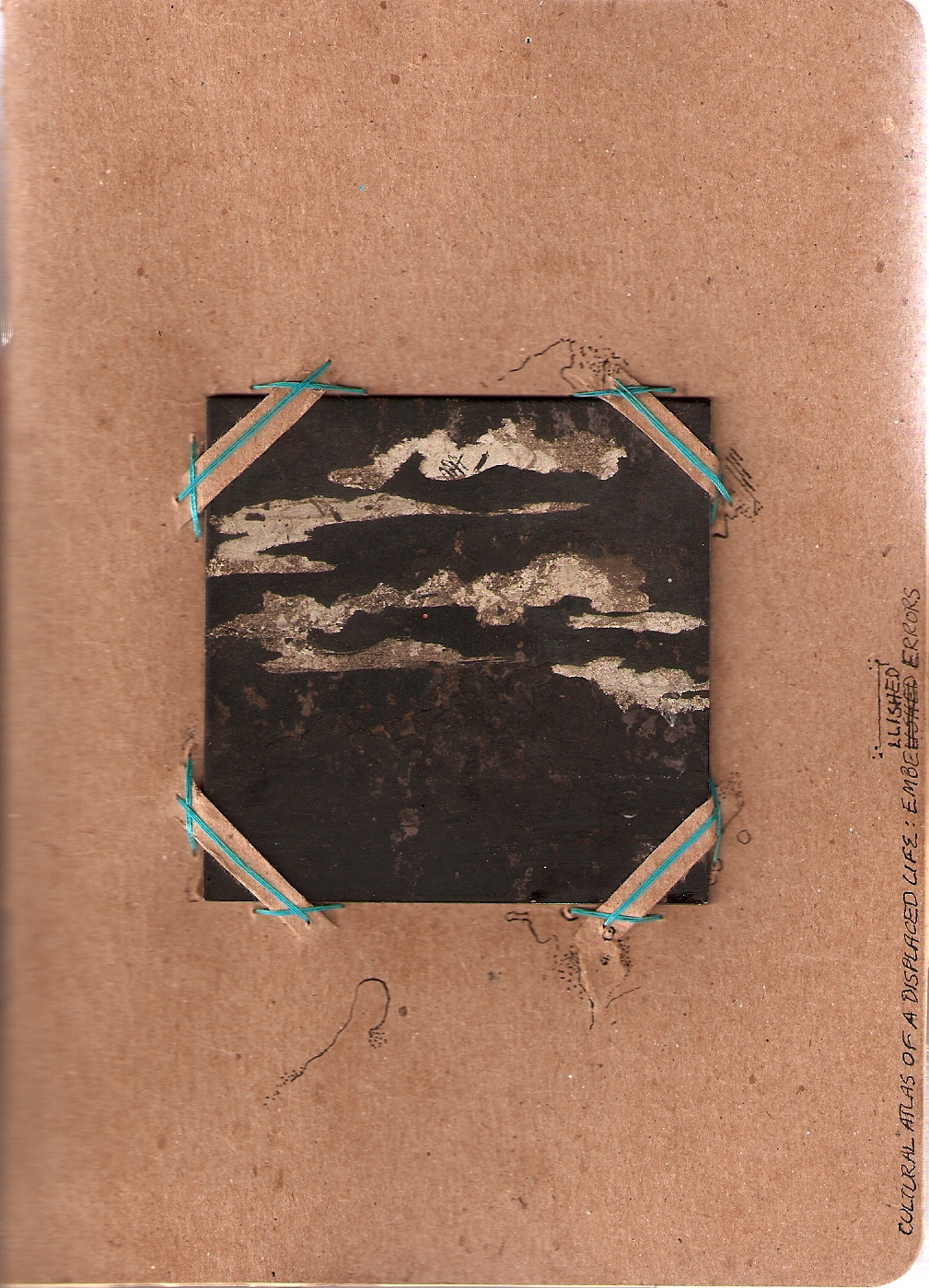
El Pescador/Fingerprint: Ring – a multimedia collage from “Cultural Atlas of a Displaced Life: Embroidered Errors.”

This will make more sense if you take a look at the previous pages of the Cultural Atlas of a Displaced Life: Embellished Errors

The title El Pescador is from the Mexican lotteria card (that somehow emigrated from Texas to Italy tucked between the pages of a book) included in the mixed media collage on the left hand page. Behind it is another hand print in marble dust on tissue painted round with lampblack. The hand print reaches towards a neon-pink sticker with my mother’s handwriting, towards an unreachable past from a composite future represented by El Pescador – the fisherman – who must always be anchored within in order not to be lost. Ironically, although the image is taken from my Texas cultural roots, the landscape on the card looks surprisingly like that of Lago Maggiore with the Alps in the background, a landscape I’ve addressed in two poems: Monte Rosa or the Picturesque and the Sublime, and Lombard Spring / Rondeau á Lago Maggiore.

The left hand page is connected to the right by a coat of white paint that covers (on the center left) an image of a person who has just opened a box (Pandora’s?), and is holding instructions for what to do with the contents but looks doubtful – again from IKEA. Living in a different cultural context with a different language and only the cultural map from my ‘mother-culture’ to navigate by was a bewildering sensation that I explored in Testimonio.

I found myself searching for constants, strangely comforted by being near the Mediterranean sea whose waters – in some slow, circumnavigation through white clouds and shifting currents – must have once broken on the sands of the Gulf of Mexico. Fingerprint:Ring expresses that unity through another universal language: hardware (no, not the computer kind). A pencil drawing of a hose clamp, comfortingly the same in any country, neither metric nor standard, adjustable with a flat-head screwdriver, a slender coin, or the tip of a butter knife. At the top left of the page, my pale, smeary fingerprint, an intentional error, both unique and universal.