It’s All Too Much: the ‘Whatfore?’ of Poetry

Wordle: Gestures ‘Poetry, poetry, whatfore art thou poetry?’

In the previous post I wrote about the friable nature of digital media; but, often analogue media does not fare much better. Humans are not gentle beasts and the destruction, intentional or unintentional, of libraries, archives and museums is old as Alexandria and recent as Iraq (2003), Weimar (2004),  and Egypt (2011).

Some of them do make it; but, is trying to give words wings, making a poetic gesture – like Occupy Wall Street or the Arab Spring – an endeavour that will be obscured in apathy and confusion, or flower into something enduring? Is writing worth it when the world is already full of really good poetry that not many bother to read anyway? Poetry, what for?

In answer I offer a quote from the poet Andrea Scarpino, featured in a recent issue of Blood Orange Review:

“There are millions of reasons not to write: earning an income, a beautiful fall day, that greasy brunch spot. What keeps me moving forward is a commitment to my own voice, my own stories, to sharing with others. A commitment to telling stories that I think need to be told. A commitment to sound and light and the ways in which language shapes our understanding of the world, the things that language can teach us about ourselves. And also, a rebelliousness. A friend once told me, ‘No one will make it easy for you to write.’ So sometimes, I sit down at my desk just to prove that I can. Because committing to my own writing can be such an act of rebellion, of going against the grain, of proving that no matter what the world thinks I should value, I value this.” – Andrea Scarpino

It is this gesture towards real communication, offered in the midst of the flash-flood of information that our culture deluges us with every morning as soon as we open our eyes, that is being offered by the poets who will be presented over the next 29 days. An arbitrary flower in the midst of chaos for you, the reader.

Take it.

Déjà vu: Poetry in Hand

As I mentioned in the previous post, poetry serves as a bridge across time and culture, carrying the author’s ‘voice’ across generations and places but what about the gesture, the language of the body? Will the YouTube video that I posted, or all of those digital photos carefully placed in albums on my hard drive, and on Face Book, last as long as an inscription on a clay tablet? As you read this sentence and I write it we both know that the answer is already, emphatically no. Yet, gesture does seem to have a life of its own…

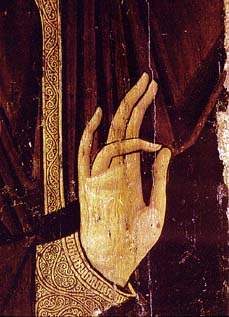
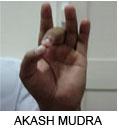
When my daughter was tiny I noticed that her hands made shapes that I recognized from images of both Byzantine and Hindu art; I called them ‘baby mudras’. Where did these miniature, elegant gestures come from?

Those tiny conical fingers, with their slender tips and chubby bases that, for my husband and I, recalled 10 little Campari Soda bottles, eventually grew longer and more slender. One day, having eaten some toast at the kitchen table, my then two year old began sweeping crumbs along the yellow Formica surface and into the open face of her cupped palm. I recognized the gesture immediately as my mothers and only later caught my own hands in the act. So, from where had my mother received this gesture and just how old was it?

Although it is impossible to know either the source of the ‘baby mudra’ or the genealogy of that peculiar arc of the fingers as they sweep up crumbs, the questions scratched at that vague itch for meaning that seems so basic to being human.

Gestures that gives words wings, gestures that give wings to what cannot be said with words – evoking only questions; then there are the gestures that are meant to express something but somehow end up clanking emptily. Futile, hollow gestures…

Body Language and Poetry: giving words wings

“Written words, from the days of Sumerian tablets, were meant to be pronounced out loud, since the signs carried implicit, as if it were their soul, a particular sound. The classic phrase scripta manet, verba volat –– which has come to mean, in our time, ‘what is written remains, what is spoken vanishes into air’ –– used to express the exact opposite; it was coined in praise of the word said out loud, which has wings and can fly…”
Alberto Manguel from
A History of Reading

When IPM-2MXI closed last year I was thinking, as I often do, about how poetry serves as a bridge across time and culture. I was thinking back to poetry readings that I had done and that I had attended. I have vivid memories of a writers workshop sponsored by my high school where, among others, Max Apple, Frank H. Schaefer, and Tim Seibles came to read their work and talk about writing with interested students. We were lucky.

Funny thing is, what has stuck with me for thirty-odd years, is less what they had to say about writing (sorry guys) but their physical presence, the sound of their voices: how their bodies bore their words. Gesture: Max Apple, his narrow shoulders folded in, glanced up at the auditorium of expectant students and smiled before looking down at the podium and reading from The Oranging of America and Zip along with a poem about wanting visitation rights with his ex-wife’s breasts. His nasal, northern voice held back half of a laugh. Frank Schaefer, whose laconic, matter-of-fact tone somehow matched the arch of his bushy eyebrows and the way his arms swung from his shoulders, read from The Ghosts of Elkhorn and spoke to us about ballads and the art of story-telling. Tim Seibles, whose deep, impassioned voice matched the sweep of his arms, gave his words wings as he read Double Dutch, The Leap, and Big Mouth from his first book that was then yet to be published: Body Moves.

Years later I found that slender volume of Tim Seibles poetry in a bookshop and recognized his photo on the back cover. Inside the book were the poems he’d read, lots that he hadn’t, and the sound of his voice double-exposed over the written words. That book found it’s way into my apartment here in Northern Italy and makes part of the inspiration for this year’s theme. But of course there’s more…

Notte è morta – a reverse haiku

I’ve been awake for hours                            Per ore sono sveglia

Church bells are just now                                Campane solo ora

Shaking their mourning heads.                Lutto, scuotono teste.

International Poetry Month 2012: Time to submit!

INTERNATIONAL POETRY MONTH 2012 IS NOW OPEN FOR SUBMISSIONS from now until 31 January 2012. KEEP READING BELOW FOR THIS YEAR’S THEME AND HOW TO SUBMIT:

Vedi sotto per le linee guida per la presentazione in italiano (tutto in verde)

Voir ci-dessous pour les directives de soumission en français (toute en blu)

The theme  for IPM 2012 will be The Gesture:

political gestures, gestures of affection, heriditary gestures, cultural gestures, empty gestures’

corporeal gestures (body language), and gestures towards communication (the gesture of writing,  translation and reading).

Send submissions in any language (no more than 3 poems of any length) to:

bmcclellan.lapoeta@gmail.com

You will receive a receipt confirmation and a response within one week of your submission.

Poems will be published during February of 2012. For poems in other languages an English translation is welcome but not obligatory.

ITALIANO

INTERNAZIONALE MESE DELLA POESIA  2012 è ora aperto per contributi provenienti da ora fino al 31 gennaio 2012. Continua a leggere sotto per il tema di quest’anno e come inviare la vostra poesia:
Il tema di IPM 2012 sarà il Gesto:
gesti politici, i gesti di affetto, gesti ereditari, culturali gesti, gesti vuoti,
gesti corporei (linguaggio del corpo), e gesti verso la comunicazione (il gesto della scrittura, traduzione e lettura).

Inviare la poesia proposta (non più di 3 opere di qualsiasi lunghezza) al redazione a:

bmcclellan.lapoeta@gmail.com 

Riceverete una conferma di ricevuto e una risposta entro una settimana dalla vostra presentazione.

Le opere saranno pubblicate nel mese di febbraio (2012) come l’anno scorso, ma voglio avere la poesia in gennaio se possibile (in qualsiasi lingua – traduzione in inglese gradito ma non obbligatorio).

FRANÇAIS

INTERNATIONAL Mois de la poésie 2012 est maintenant ouvert pour les soumissions à partir de maintenant jusqu’au 31 Janvier 2012. Continuer la lecture ci-dessous pour le thème de cette année et la façon de présenter votre poème:

Le thème de l’IPM 2012 sera le geste:
gestes politiques, des gestes d’affection, de gestes héréditaires, les gestes culturels, les gestes vides,
gestes du corps (langage corporel), et des gestes vers la communication (le geste de l’écriture, la traduction et la lecture).

Envoyer une proposition de poésie (pas plus de 3 œuvres de n’importe quelle longueur) à la rédaction:

bmcclellan.lapoeta @ gmail.com

Vous recevrez une confirmation et reçu une réponse dans une semaine après votre présentation.

Les œuvres seront publiés en Février (2012) que l’année dernière,
mais je veux avoir la poésie en Janvier si possible (dans n’importe quelle langue – traduction anglaise bienvenue mais pas obligatoire).

Orphan Poetry or Paradise Regained: Still life with Romance (Natura Morta)

Still Life with Romance (Natura Morta)

For my sister Robin Glynn (1962-2006)

My world, if full – is full of sunlight and bees.
We both know that Courbet was a communard;
without looking down.
I hear the water in his painting singing below.

A plover calls.
The soft scent of not wisteria,
The Pollack swirls of dried grass,
Make no shape, no pattern.

Acquacheta / still water

Fat unthinking bees hover.
My sister says it must be a sweet life if I’m pissing on rose petals.

There is that air about it:

The Romance

Begun at 38 instead of 21 when one is meant to have the grand adventure;
At 21 when it is impossible to imagine how sharp pain will taste when you let it age.

And so it begins:

I was in love with a sculptor, born in Louisiana, who now lived

near the Adriatic coast. I came to live in the hills outside Florence

looking to find the shape of my soul and to unwind the threads of

our love…

How much of that is real and how much a hollow in the light?

Sitting on a bench in front of a small cabin that
I share with a bulb on a wire, a suitcase and a family of rats;
Drinking grappa, smoking Gauloises,
Watching the sun set over the Tuscan hills.

This is real
No more and no less real than
the romance
Driving from DeSoto to Irving, Texas.
Having de-composed my ordered, still life.

Cutting down through weak and inconsistent flesh,
To find the white, persistent honesty of bone.

Orpan Poems or Paradise Lost: X. Virgil/Vigil

Virgil / Vigil

Will you boldly walk with me the road our good intentions paved;
Or stand balking, faint
    with fear at that long path from there to here
Trusting my hand, like Virgil’s to lead you through the gates?

Orphan Poetry or Paradise Lost: IX. Water from a Stone

I have pounded myself out

on the rock of this memory,

cracked open and drained out;

is there water left

in this stone?

Orphan Poetry or Paradise Lost: VIII. Enchanted Rock / The Ides of March

Enchanted Rock / The Ides of March

I will remember the branches and the light
filtering through the locust grove.
You will remember the emerald brilliance
of the grass.
We will remember together the unyielding line of granite
that still gives way over time:

the fine fullness of the moonlight across our whiteness
the vermilion flash of the cardinal
Cool air rolling lightly over and under everything like water
filling our mouths with flower petals
tasting of honey olive oil fresh bread

The sacrament of breath.

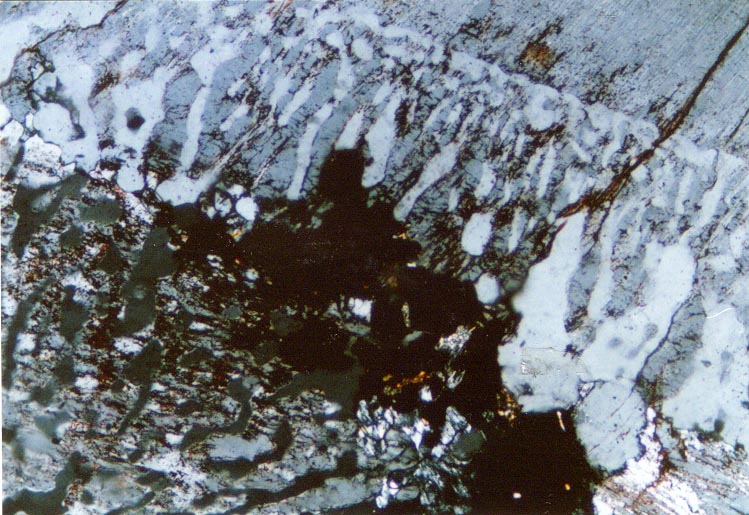
Orphan Poetry or Paradise Lost: VII. Tishomingo Granite

Tishomingo Granite

From the Quarry at Tishomingo
Comes this Pre-Cambrian intrusion
Begotten when the first rain dropped on boiling rock.
Only later to be named
With sounds recalling some child’s summer game.
These random elements, the stuff of stars
Cooled by Bowen’s ruled order (though he was not invented yet)
Pyroxene first, then salmon coloured plagioclase;
Last, cloudy silicate of common quartz
All this a billion years ago.
You know I loved you even then;
The day this rock was formed.