One year when the awakened plane trees
find themselves struck yellow in the night,
there will be nothing left of me but
a memory in your hands as they pull
wet laundry from the spun drum or
open the window’s case –
inviting October’s last, warm breath
to communicate the dust
between one room
and another.
A guest post for Easter from writer, IPM poet and essayist Tom McClellan
Dear Son,
You’ve done yourself proud at Officer Training School. Acing your course work and being the first to be selected Group Leader—Congratulations! You said you want to adopt me as your second father—You make me proud to think of you as a son – “My Son the Marine, Warrant Officer Burton.” That has a nice ring to it.
Official spring began two months ago, about the time real spring had peaked in an explosion of azalea blooms along Turtle Creek. Now spring continues cool and wet through the Ram and into the Fish.
Now shines the sun of spring,
And honeysuckle’s scent
Soaks air washed by the rain.
The proof of God’s as plain
As sunlight through the leaf
Exposing cell and vein.
…
Your mother and I had our first date on Mother’ Day, 1979. We ate at a Mexican restaurant and saw the movie “All That Jazz.”
Over the next year Carolyn became the Home I so much needed. We were married, as you probably remember, about one week before our first grandchild, your daughter, arrived.
Before we were married, Carolyn asked me if I was in love with her. Being in the process of recovery from a passionate relationship that had ended in divorce and, for me, a trip to the madhouse, I had no trust in being in love. I told her, “No, but give me five years and I’ll fall in love with you.”
It didn’t take that long though. We went to a dance some months later, and the memory of Carolyn in a sunshine yellow dress with flowered wrap—she’d made both herself—head thrown back, abandoned to the music—That is a memory I’ll carry with me into eternity.
I am blue in the face
words unexhaled;
sky’s edge, distant,
cracks and curls.
Ozone’s filthy fingers
ruck parched dusk.
I drink;
water and vinegar
think of Christ
Roman soldiers,
rough sponge,
cracked lip:
“E’-li, E’-li, la’-ma sa-bach’-tha-ni?”
After that
this same
amber thick, sour smell
slaps against our Savior’s sense.
Now he’s off –
Hard business for him to harrow hell;
Hard business for me,
just sitting still.
Venerdi Santo, Cristo morirà ancora come ha fatto ogni anno poichè Dio sa quando.*
—-
They held a New Orleans Funeral for Jesus:
Woodwinds, brass and the big bass drum.
After awhile the rain began to come;
Parishioners popped up their umbrellas,
Madonna was sacked to protect the stars
Spangling perfect electrified hair that
Should have been disheveled in grief.
Christ: unable to awaken, trapped in an opiate nightmare,
Pallid, couch-ridden, sick with flowers,
Widow-borne through the streets on a lacy bier.
Mary: politely dolorosa, her face more composed than that
Of the old mother dressed in black
Hanging out of the window to watch Her pass,
Baptizing the parading crowd with tears
Thrown out like old wash water.
What is left clean and what is soiled?
The sorrow of sin shifts from house to street
To be tracked back in on the slack-shod feet
Of grandchildren, dogs and beggared questions,
Salved in the last moment with words and oil:
quidquid deliquisti / in all that you have failed.
***********************************
*Good Friday, Christ will die again As he’s done every year Since God knows when.
ATTENTION: This is not truly a story about a toddlers encounter with real farm animals or about expatriate Americans having an “Under the Tuscan Sun” experience. It is a story that extends forward and backward from the vanishing point of a life, the life of a baby goat. This is also not a story about how terrible it is to kill and eat animals: in this place, butchering a goat for Easter is like picking an orange, an ordinary part of life. These shepherds are kind to and value their animals for what they are – their livelihood. If you are squeamish about the idea of a goat being butchered, stop reading when you get to the picture of the heard of goats.
It has taken me four years to finish this story. The memory so visceral and the series of sensations so complex that it has resisted my every effort to make it into a comprehensible story or a poem as I have those things from Serra San Bruno or from inside the city walls. This is a liminal place, on the border between the named place – the city – and the lush density of the landscape as it thickens in a following line towards the sea.
A rooster crows, where is the sound coming from? Robin wants to find it. We wander and talk, Matthew’s work day will start soon, we put our feet on the path to go up, to say thank you and goodbye. The three men stand on the side porch. Peppe holds his hand up in warning, his whole body says don’t let the child see: Gianni has brought the stranger to buy a kid, they are slaughtering it, for Easter.
Gianni’s Goats
Peppe is an able butcher and there is not even a bleat. I turn with my child on my hip, my arm between her gaze and the house; I point out to her something on the opposite horizon. I look down and the whey in the gully is mixing with blood. Who would have thought such a tiny thing held so much? When do you explain this to a child…with our language that so neatly separates the words used for meat and those used for animals? We walk, gesturing and talking always pointing Robin’s attention away from the trussed and headless goat on the porch. I look back. It’s skin now hangs down in a tidy rope from the pallid, marbling of meat, veiled with the translucent tissue that keeps it all compact – lubricating the movement between skin and muscle – meat that is still anchored to hoof, hoof that is still tied to a rope slung over the porch’s lintel beam.
They’re hosing down the concrete in front, the dog that had been drinking a bucket of whey pokes his white muzzle down into the gully to lap at the water tinged with milk and blood. Walking back to my van I see the coursing streamlet of whey and blood as it mixes with the almost motionless trickle of shit and urine running under the passenger-side front tire. It flows across the dirt road and into a hillside so full of green that it looks like Eden – will the ground soak it all up, all of this nitrogen and potassium, everything good for making verdant things stronger?
I am nauseous, not simply from the death – all of my senses are too full: baby goats like ballet dancers, the thick scent of manure, the widening red streamlet coursing cheerfully through the green hillside and the little bucket of creamy cheese in my hand. The ancientness of the act dizzyingly dissonant with the shininess of the cars, the space-age plastic of my shoes. I look up.
The sick dog lies on a warm patch of grass. The healthy dog that is tied up ignores his tithe: a fluorescent red round of bone taken from the freshly slaughtered goat that still hangs from the lintel.
A consecutive flow of fluids convene into a single flow: whey/blood/water from the place of men – water/urine/feces from where men keep the animals. In the flow that reaches the bottom of the path in this moment, the color of blood predominates.
Behind the ovile rises the hillside full of breccia – the eroded face of rock worn away by the river far below, flowing towards the Ionian sea. This moment collapses inward and dilates outward: a vanishing point.
From the house there is now a flow of clear water, washing everything clean.
I found these poems by chance in a book amongst a pile of books and papers on a side table in an efficency apartment loaned to us in Caulonia (RC). I had never heard of Lucia d’Amato and, unfortunately, I don’t think you will find her book “Sostenere il sogno” anywhere other than this table, next to its clot of dusty papers. These few poems express the dense and lovely reflections of what I saw everyday that late winter and early spring in Caulonia Superiore.
CALDI PASSATEMPI
Caldi passatempi nell'aria,
E un vago color mattone
nel cuore,
parla di case abitate.
Un sonno silenzioso.
L'inverno passa.
WARM PASSTIMES
Warm passtimes in the air
and a vague brick colour
in the heart,
speaks of inhabited habitations.
A silent sleep.
Wintertime passes.
LE PRIME ORE D’UN POMERIGGIO
Le prime ore
d'un pomeriggio brullo,
color di terra, di sabbia, e d'oro,
e la solennità
dei gochi più sereni
del tempo.
Dall'autunno al'inverno
andando verso l'estate,
come un grosso pacco
la campagna si svolge.
Un gregge sta,
come una nevicata sporca
Da un rotolio di nuvole
sguscia il sole.
THE FIRST HOURS OF AN AFTERNOON
The first hours
of a bare afternoon,
Colour of earth, of sand,
and of gold,
and the solomnity
of weather's more serene games.
From Autumn to Winter
now tending towards summer,
the countryside unwraps herself
like a fat package.
A flock stands
like dirty snow fallen
from a roll of clouds
that just slip-shelled the sun.
nota bene: Original poems in Italian by Calabrian poet Lucia D’Amato as published in “Sostenere il Sogno”. Translations in English copyright 2009 Bonnie M. McClellan.
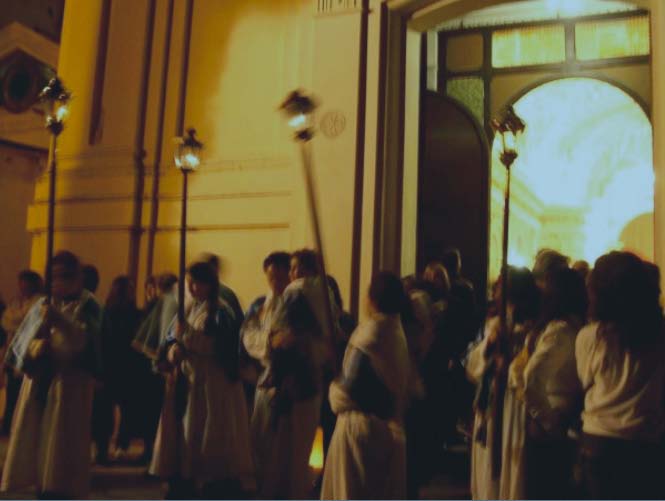
Unable to traverse the swallow’s path
Or tread roof tiles as the agile cat,
upon his brothers’ labouring backs
A polychrome Christ will make a rough pilgrimage of His own;
Pillar bound, to that church above from this one below.
Square-shouldered, tow-haired nine-year old will run and clap
His acolyte’s bell laughingly at black curls that lap
The tender nape of his fellow impenitent in Mary’s blue.
And so this honour guard will hew
four hundred years of progress’ path
Pelligrinago from first to last,
Across the stuck in stones.
AT 5:30 THIS AFTERNOON
Piazza della carmine is desirous of tumbling towards the sea.
Boys gyre round parked cars in this town the Greeks begot.
A truck full of music winds lamenting through the streets;
Calling forth ancient Eves to buy their compassionate widow’s tot
Of what, to Adam’s sweaty brow, this fallen earth bequeaths.
poem and photo copyright Bonnie McClellan 2011 all rights reserved
This poem is the third in a suite of poems written about 24 hours in Caulonia Superiore.
Cat spelunks the canyon down
picking through lichen broidered tile.
My lover's hands diagram, inform:
slab after slab of wet clay
curved across the thigh to pave
the high square meteres of the sparrows' way.
This mute arc reiterates the form
of what coulted femeur's slack desire?
Makers now in abandoned bone box stacked
Shout their names marked in black
at dull, dun, desanctified walls.
Amnesiac tiles cup together, deaf above
foxed timbers dressed in sixty years of lime.
They uphold each others' weight,
Sweet compression.
As distracted as August lovers
(lost thigh to sweaty thigh)
trying to topple not the slender wooden frame
of a kitchen chair.
Busy, keeping the rain out.
poem and photo copyright Bonnie McClellan 2009This is the first of a suite of 3 poems that treat 24 hours in Caulonia Superiore
“IPM will be presenting poems that map territories both broad and intimate, urban and rural, topographies of nations, family relationships and internal landscapes. I invite you all to come and read, bring your keys and re-map the territory of the coming 28 days of poetry…who knows what you’ll discover about your own territory…You are Here. You are This.”
That was the premise with which we began the journey of International Poetry Month. I hope that both Readers and Poets have enjoyed the trip. Today is the second of March, spring is on it’s way and the wind has come to blow through the leaves of these poems and carry them away, leaving only the voices behind. Some you will still be able to find on the web, or in a book. Some will be gone for good. Following is an alphabetical list of the participating poets; each name is also a link to the poet’s work posted at IPM. My deepest thanks to all of you who have participated in IPM 2013 by reading or writing or both.




 LE PRIME ORE D’UN POMERIGGIO


 Bonnie McClellan-Broussard