The Singer is Dead, Long live the Elna

I was in the middle of working on a new, bias-cut handkerchief dress – out of a fabulous marigold yellow, cotton-silk voile that I found for 3 euro at the thrift store – when my husband came into the room where I was pressing open seams to say the dreaded phrase:

“There was smoke coming from the motor of your sewing machine so I turned it off and unplugged it before it caught on fire.”

…sigh. With only the back pleats and the hem left to do it was a frustrating development. Besides, I loved that Singer. My husband bought it for me (at the same thrift store) for 25 Euro and it had been a real workhorse for the last 5 years, zig-zagging through jeans with holes, sewing up dolls and clothes for the girl, and straight stitching through a fair number of skirts, shirts, and my first try at pants from my own pattern.

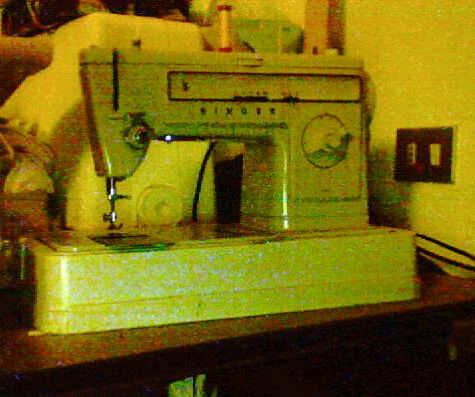
I tried to think positive, this was an opportunity to look for a more versatile machine that would work with knit fabrics, had newer feed dogs and perhaps even a presser foot that would not always send the fabric off at a slight angle. I live in the land of Necci…there was bound to be a cheap used one out there on ebay.it, right?As they say in this country, “Eh no eh…” The only used machine in my budget (less than 100 euro including shipping costs) was an Elna Lotus SP35. She just came yesterday and here she is:

It took me some time to get both the lower and upper tension harmoniously adjusted to work with the fine voile – I’m glad to say that it came with both the original users manual and the sewing guide which both helped me fine-tune the tension and introduced me to a whole new realm of Italian sewing terms. What can I say? Sturdy, light-weight, quiet and with a sensitive pedal. I’m looking forward to experimenting with knits and in the meantime, I finally finished the dress!

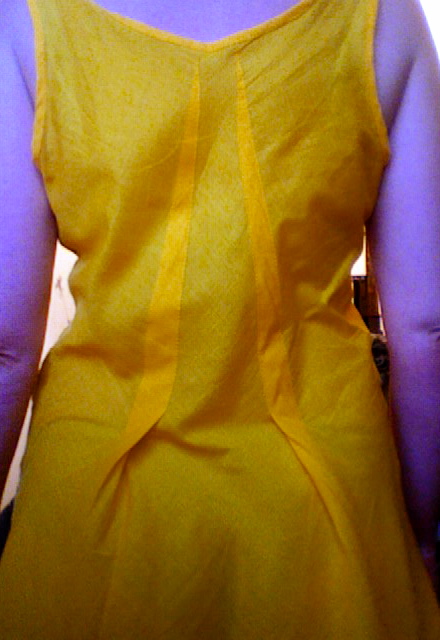
I hand ‘pick-stitched’ the back pleats.

Cultural Atlas of a Displaced Life: El Pescador / Fingerprint:Ring

Cultural Atlas of a Displaced Life: Il Pescador / Fingerprint:Ring
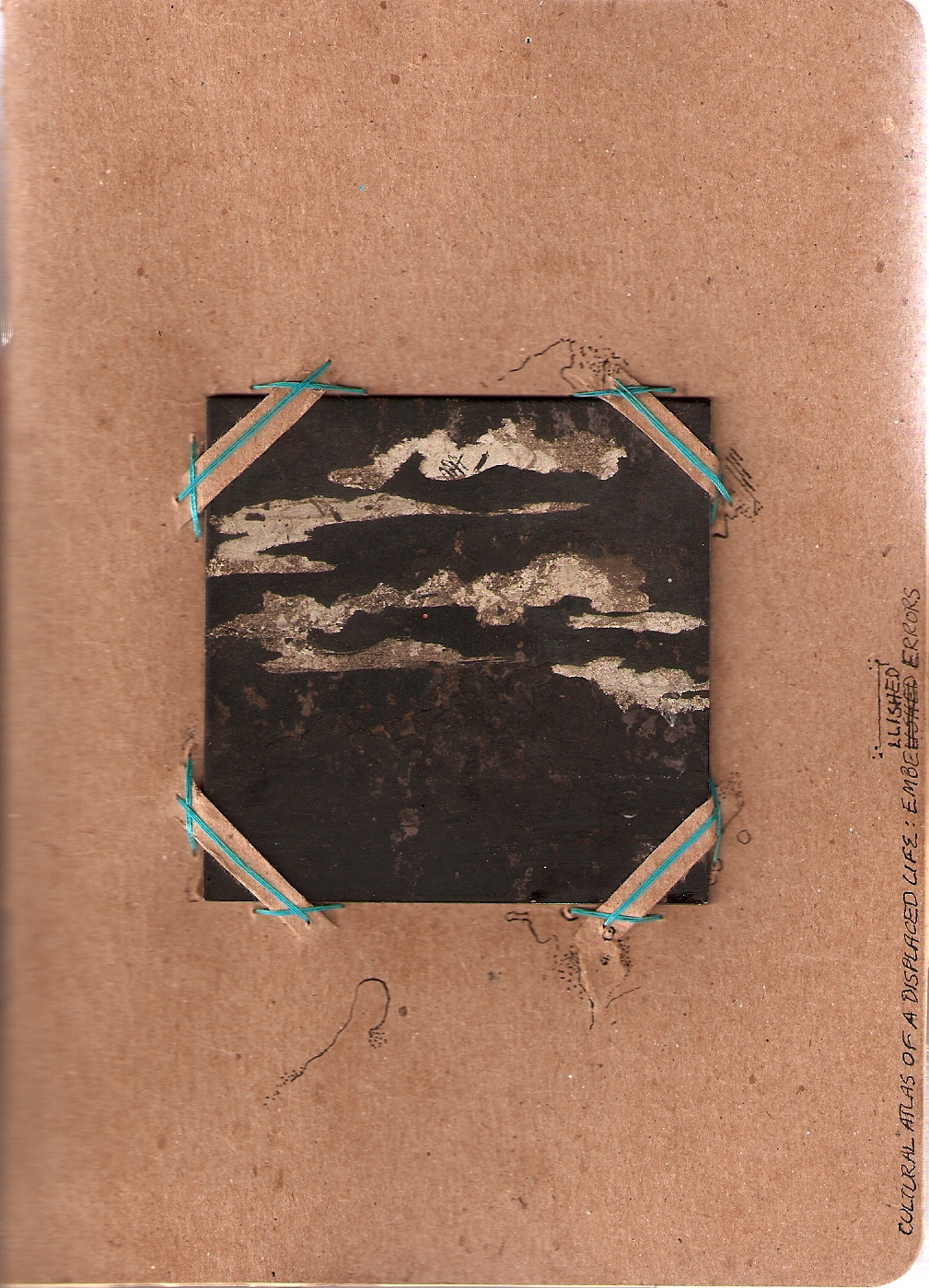
El Pescador/Fingerprint: Ring – a multimedia collage from “Cultural Atlas of a Displaced Life: Embroidered Errors.”

This will make more sense if you take a look at the previous pages of the Cultural Atlas of a Displaced Life: Embellished Errors

The title El Pescador is from the Mexican lotteria card (that somehow emigrated from Texas to Italy tucked between the pages of a book) included in the mixed media collage on the left hand page. Behind it is another hand print in marble dust on tissue painted round with lampblack. The hand print reaches towards a neon-pink sticker with my mother’s handwriting, towards an unreachable past from a composite future represented by El Pescador – the fisherman – who must always be anchored within in order not to be lost. Ironically, although the image is taken from my Texas cultural roots, the landscape on the card looks surprisingly like that of Lago Maggiore with the Alps in the background, a landscape I’ve addressed in two poems: Monte Rosa or the Picturesque and the Sublime, and Lombard Spring / Rondeau á Lago Maggiore.

The left hand page is connected to the right by a coat of white paint that covers (on the center left) an image of a person who has just opened a box (Pandora’s?), and is holding instructions for what to do with the contents but looks doubtful – again from IKEA. Living in a different cultural context with a different language and only the cultural map from my ‘mother-culture’ to navigate by was a bewildering sensation that I explored in Testimonio.

I found myself searching for constants, strangely comforted by being near the Mediterranean sea whose waters – in some slow, circumnavigation through white clouds and shifting currents – must have once broken on the sands of the Gulf of Mexico. Fingerprint:Ring expresses that unity through another universal language: hardware (no, not the computer kind). A pencil drawing of a hose clamp, comfortingly the same in any country, neither metric nor standard, adjustable with a flat-head screwdriver, a slender coin, or the tip of a butter knife. At the top left of the page, my pale, smeary fingerprint, an intentional error, both unique and universal.

Cultural Atlas of a Displaced Life: Embellished Errors

I’ve been working on some pages for the “Sketchbook Project 2013” that are a visual way of digesting my experience as an emigrant from Texas to Italy. Click on the links in the captions below each image to read the essay/story that goes with it and find links connecting the images with poetry.

Cover
Cultural Atlas of a Displaced Life: Embellished Errors – (Pax Texana)
Pax Texana (detail)
Cultural Atlas of a Displaced Life: El Pescador / Fingerprint:Ring

Cultural Atlas: White Skirt on the Train

In looking at experiences that are culturally specific to my life in Italy, there is the train…a marker, something utterly distinct from transport in Texas by car. I chose the light moving across the surface of a white linen skirt in an attempt to localize the sensory experience of being on the train to a specific focal point.

Matthew Broussard…a day at the office

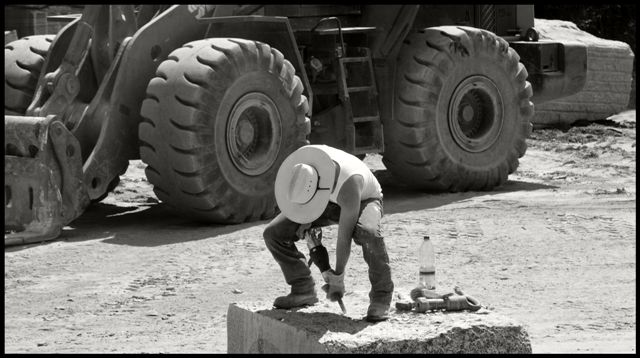
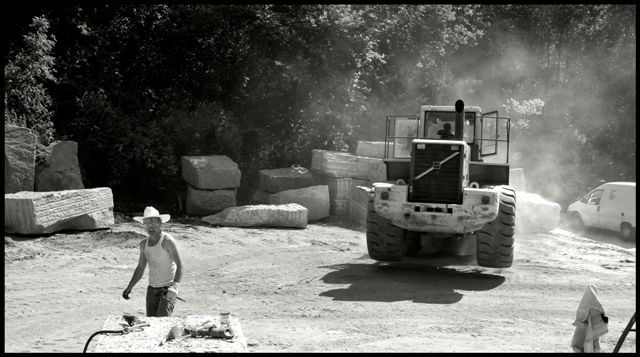
We received some great photos from the quarry where Matthew has been working for the last two months helping to realize a monumental sculpture for Ugo Rondinone. The quarry photographer, Roberto Toya, captured the intense working conditions of the Moro Serizzo quarry in Crodo in these beautiful black and white compositions.

Matthew Broussard at Moro Serizzo - photo Roberto Toya all rights reserved
Matthew Broussard at work in the Moro Serizzo quarry – photo Roberto Toya all rights reserved

Matthew Broussard at work in the Moro Serizzo quarry - photo Roberto Toya all rights reserved

Matthew Broussard at work in the Moro Serizzo quarry - photo Roberto Toya all rights reserved

The story of the Moro Serizzo quarry itself is quite romantic. Here is an excerpt from that story as told by one of the quarry owners, Mariateresa Moro:

Just before the second World War, my father Giovanni Mario Moro was working as a stone cutter in his hometown Montemerlo in the province of Padua. In 1938, at the age of 24 seeing as his finances weren’t flourishing, he decided to leave his hometown to seek his fortune taking only a few things with him, among which was his chisel which he was romantically proud of. When he arrived at Bolzano he heard of the Ossola Valley and the possibilities of finding work there. This is how he found his way to the Pelganta quarry in Crodo. The quarry belonged to the parents of my mother Gina, who was just a young lady at that time. As time went by, Gina and Mario fell in love, which was a worrying situation because he was too old for her and a stranger to the town and she was too young for my austere old fashioned grandparents. My parents decided to leave their work and their family to get married and start a new life together. This is how our family firm started in 1953: at first they exploited erratic boulders, then in 1963 they bought the family quarry and eventually in 1979 they created a laboratory where the entire work cycle was completed, from the extraction of the stone to its saw milling and to the final workmanship. Sixty years have now gone by since this project started, a project which grew and flourished from a love story. Our profession has evolved over the years, we have new machinery, new methods of working the stone and a different way of dealing with business. Today, Moro Serizzo is owned and run by three women: my two daughters Raffaella and Tiziana and myself.

A whole new page…

Anyone familiar with this blog knows that I work alongside my husband, contemporary artist and furniture designer Matthew Broussard, both as a partner in building bespoke furniture and as a studio assistant for his artistic projects. I sand, gild, apply fine finishes and, the best part: spend lots of time talking about painting compositions, production methods and how to get from concept to completed project. You’re welcome to take a look at our latest projects on the newest page that we’ve made HERE.

Matthew working on his latest commission “Citta del Sole”

 He writes: 

City of the Sun – a painting

by Matthew Broussard on Sunday, July 8, 2012 at 2:02pm ·

City of the Sun

This painting takes its name from Tommaso Campanella’s book, written in the sixteenth century, in which Campanella describes an ideal city, an ordered, just, and poetic society.

The image is of a piazza that was built by my daughter with wooden building blocks on the floor of our room. I was struck by this act of ‘tracing’ a city both conceptually (she explained in minute detail the reason behind the placement of each block) and as it is realized, even in the adult world. From philosophers to urbanistic experts and the ordinary city-dweller who lives in the midst of it, everyone has their own concept of what the city should or could be.

How am I doing? Sew-sew…

Pair of palazzo pants that I’ve finally finished
Second of two shirts I’m making for Matthew

 I have been sewing like mad lately. I finally finished the pants pictured at left and I’m wearing them! They’re really comfortable and great for hot days when one’s legs are not ‘summer perfect’. Made in cotton sateen, they’re a cinch to iron after hanging up to dry.

I have almost finished the second of two white shirts I’ve been making for my husband this summer. I decided to do the pin-tucks by hand on the second one and then made the mistake of hand-sewing the top-stitching! Now I have done all of the top-stitching  by hand so that it has continuity but…whew it’s a lot of little stitches.

Detail of pin-tucks on shirt

 Meanwhile, I realized only this morning that the girl’s kindergarten had sent home a list of ‘stuff to get’ for the summer session, one of which was ‘uno zainetto’ (aka a little knapsack). I hated to spend yet another 10 euro on some made in china nylon thing that would fall apart after 30 days (or the zip wouldn’t work or, or, or…). So, I made this little knapsack from a dress that my mother had made for her when she was three. It was nice to re-use this fabric for Robin Kay because I have a hard time giving away things that my mother made for her and, darn it, she keeps getting bigger and growing out of them anyway!

Cute little knapsack I made for my daughter to carry her things to ‘summer school’

So sew…that’s been my pile of projects lately (now that it’s too hot for knitting).

Summer Grain Salad

A great alternative to pasta salad for summer – serves 2 as a meal or 4 as a side dish. The trick is in the dressing; the balance of vegetables can be suited to your palate and what is fresh in your area. Nice additions are pitted nicoise olives, fresh corn, or even cucumber. If you want a non-vegan version some cubed, crumbled, or shaved cheese (aged parmesean always good but ricotta salata or even feta or peccorino will work – avoid soft cheeses).

1/8 cup pearlized spelt
1/8 cup pearlized barley
1/8 cup black (or red or wild) rice
1/8 cup brown rice
1 cup + a little liquid
1/2 cube of low-salt, vegetable bullion
1/4 cup diced cherry tomato
1/4 cup diced yellow bell pepper
1/4 cup diced carrot
1/4 cup diced zuccini

3-4 cups Arugula or Baby Spinach

toasted pumpkin seeds or pine nuts (optional)

Dressing: mix together in a glass dish beating vigorously with a fork as you pour it over the salad to keep everything evenly distributed.

2/3 cup olive oil (this is salad so use the good stuff)
1/3 cup made up from 1 part lime juice, 1 part red-wine or apple cider vinegar, 1 part balsamic vinegar
2 tsp. finely grated fresh ginger
2 tsp. finely grated fresh garlic
1 tsp. soy sauce
1/2 tsp. crushed dried mint or 2 tsp. fresh mint finely minced

Cook mixed grains according to cooking times for each (adding the faster cooking grains to the pot as you go). I start with the black rice, add the brown rice then the spelt and then the barley. About half way through the cooking time lower the heat and cover the grain.  Feel free to stop and taste the grain to see how it’s coming along but don’t stir. If it starts to get dry before it’s done, add some very hot water from the tap (a little at the time). While the grains are cooking dice the vegetables and prepare the dressing. Towards the end of the cooking (about 5 min. before it finishes) add the carrot and the zucchini to the top of the grain so that it is (very lightly) steamed.
Combine cooked grains, carrot, and zucchini with tomatoes and bell pepper. Mix dressing into warm grain. It can be eaten right away or allow to cool and then refrigerate for a cold salad.
To serve: divide greens evenly into dishes. Top with salad. Garnish with toasted pumpkin seeds.
Guaranteed to make you feel full and energized without feeling stuffed. Enjoy :-).

Cultural Atlas of a Displaced Life: Embellished Errors – (Pax Texana)

Pax Texana - copyright 2012 Bonnie McClellan all rights reserved

The inside cover of my Cultural Atlas is covered with Italian shelf-paper. I used it because when I tore up the front cover, I thought that the inside should be stabilized (another embellished error). This paper is still made in this country; a lovely, heavy, egg-cream ground with black, red, dark blue, or green patterns. When I had first moved to Italy, I lived in a rural valley outside Florence; I was trading work for a place to stay with an American-Italian couple. One of the first things Adele asked me to do was strip off the old paper from her kitchen shelves and re-cover them with new paper. It marked one of my first trips into the treasure-palace that is the Italian ‘whatnot’ store. While I was living there I was in the process of a separation that turned into a divorce and a cultural shift that involved re-evaluating the (then) 38 years of my life in Texas.

The poetry/story of this can be found in my Orphan Poetry series; however, later, I also made, from the empty tissue paper ‘books’ that remain after one has used up the thin sheets of gold leaf, a series of impressions of my left hand made with white marble-dust and gum arabic. In these two ‘books’ there is one page and one hand-print for each year of my life with the year written in pencil on the bottom-left and my age on the top-right. They overlap and stick, they are messy (as my life has been) and made of the dust of rocks that were once marine fossils, our common calcite frame.

PAX TEXANA - detail (copyright 2012 Bonnie McClellan, all rights reserved)

This attempt to make peace between my Texas past and my Italian present is included in the collage on the first page of the Cultural Atlas. The envelope from the gold leaf (delivered from Italy to Texas and then repatriated when I moved here) holds the book. Above the envelope is the word PAX – which speaks to the common Roman/Latin cultural roots between the two places – from the instructions for an IKEA shelving unit – representing a more recent, consumer empire that uses those common roots to try and make clients feel ‘at home’.