Italia: by Ginnie Siena Bivona

This poem in its written form has disappeared. If you want to know why, click HERE.

this work is licensed as Creative Commons Attribution-NonCommercial 3.0 Unported

To hear a reading of this poem, click on the player below:

Read more about Ginnie Siena Bivona and her writing HERE.

great curvature: by Anna Mosca

This poem in its written form has disappeared. If you want to know why, click HERE.

To hear a reading of this poem, click on the player below:

You can rediscover the written version of this poem HERE.

Read more poetry by Anna Mosca in English HERE.

copyright 2013 Anna Mosca all rights reserved

Window With a View: by Liliane Richman

This poem in its written form has disappeared. If you want to know why, click HERE.

To listen to a reading of this poem, click on the arrow below:

Copyright 2013 Liliane Richman, all rights reserved

To hear more poems by Liliane Richman, click HERE.

Cultural Atlas: You Are This (the periphery and the centre)

“Since a map is a reduced representation of the real world, map symbols are used to represent real objects. Without symbols, we wouldn’t have maps.” – Compass Dude

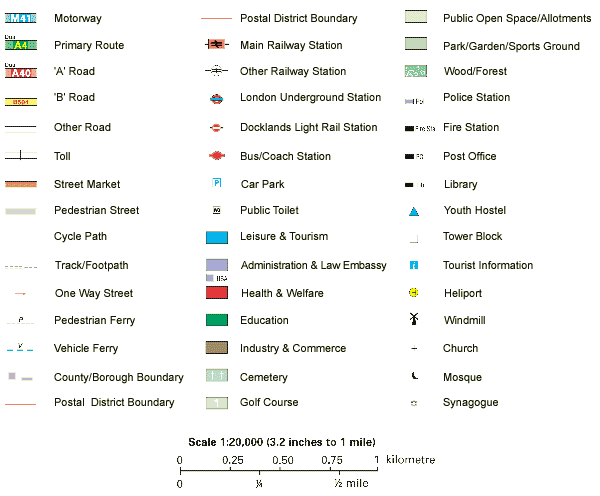
map key

In my previous essay I talked about mapping the terrain, the “You Are Here” aspect of a Cultural Atlas. That, and a response to the post by Brad Frederiksen, got me thinking about another aspect of maps, the key. I have always loved those little boxes at the bottom of a map, the ones that tell you what those mysterious hieroglyphs printed across the terrain mean. Even their names are inviting, intimating the possibility of deciphering and understanding unknown territories both physical and cultural: The Map Key. The Map Legend. Without this key, the caption to the photo, a physical or cultural context, where are we? Who are we?

We all have our own cultural ‘legends’ which help us read and interpret the surrounding terrain. Often, one is unaware of what these symbols are  until we are called upon to function in a situation or a place where our internal ‘key’ is not consonant with the one in which we’re operating. These legends and keys tell us not only: ‘you are here’ when they align (or don’t) with our external circumstances; but also ‘you are this’: these recognized symbols can place us in the centre or on the periphery of nations, professions, spiritual communities, families and historical epochs.

The language in which a poem is written can place it in the realm of ‘fully accessible’ only to people who understand our cultural or even personal keys and legends. Each reader in the center or on the periphery of a language group, a professional or family environment will give a new reading, using their own symbols and associations to navigate a poem – superimposing their Map Key upon the poet’s – or they may give up, the two keys too dissonant to be reconciled.

Starting at the end of this week (Feb. 1st), IPM will be presenting poems that map territories both broad and intimate, urban and rural, topographies of nations, family relationships and internal landscapes. I invite you all to come and read, bring your keys and re-map the territory of the coming 28 days of poetry…who know’s what you’ll discover about your own territory:

You Are Here?

You Are This?

“Being in a foreign country means walking a tightrope high above the ground without the net afforded a person by the country where he has his family, colleagues, and friends, and where he can easily say what he has to say in a language he has known from childhood.” – Milan Kundera from The Unbearable Lightness of Being

Cultural Atlas: Mapping the Terrain

"You are Here" installation sculpture in cut grass at the airfield of Vespolate in Novara by Matthew Broussard
“You are Here” installation sculpture in cut grass at Novara’s Vespolate airfield by Matthew Broussard as part of the exhibition: Clicking the Territory

The time has come for the introductory essays for International Poetry Month 2013, a project I started 5 years ago in an effort to create a dynamic space for poetry around the world to be read and heard. Each year has had a theme and this year’s theme is ‘Cultural Atlas’. I admit, I stole this theme from The Sketchbook Project 2013. As I started working on my sketchbook I began to think of all of the ways this theme dovetailed nicely with what IPM is about: making cultures accessible to one another, sounding the similarities and marveling at the differences.

The photograph to your right is of an installation sculpture that my husband, Matthew Broussard, did for an exhibition called ‘Clicking the Territory’ in 2009 (the first year of IPM). It’s titled “You are Here” and is an image of the ‘clicky hand’ – that we all know and love from the virtual world – mown into the grass of Novara’s Vespolate airfield. So, you are here but where is here? Without google maps and panoramio how would you ever know how find or even be able to imagine the dirt runway and green grass of Vespolate if you’d never been there?

So, where am I? The ‘location’ box to the right of my screen says gemonio, varese italy; but I feel my internal, physical and cultural map of Texas bumping up against Gemonio’s every day. This is not a bad thing, it’s just noticeable. As a poet I appreciate the fact that it makes me think and inspires me. The interesting part is how often I need to superimpose these two maps to orient myself both internally – culturally and historically – and externally, for others who don’t have an internal map of Texas for reference.

As a Texan living in Italy, “Where are you from?” is a question I get asked a lot. It’s an easy answer; I grew up in Dallas and I have yet to meet an Italian who doesn’t know that it’s the city where either:

  1. JFK was shot, or
  2. the TV series Dallas was made.

I fall into this nebulous terrain on an Italian’s mental map, though few of them could indicate Texas on a map of the U.S. I am often, when describing where I’m from, constrained to superimpose a map of Europe over my internal map which results in comparisons like:

“Texas is about as big as France / Texas è più o meno la stessa grandezza della Francia.”

Or, time/distance equations with multiple variables:

“It takes the same amount of time to drive from Dallas to the border with Mexico as it does to drive from Liguria to Calabria / Ci vuole lo stesso tempo di guidare da Dallas al confine con il Messico, come fa a guidare dalla Liguria alla Calabria.”

The same size(mic) translation is required for my family and friends in Texas when trying to contextualize media frenzy over Italian earthquakes.

In blog land we are all in an ever evolving here, no matter how far apart we are. Here is where we begin our IPM exploration.

Where is your here? If you’ve written a poem that touches on mapping your cultural territory (interior or exterior) I’m interested in reading. Check out the submission guidelines HERE.

Stay tuned! Up next: Cultural Atlas of the Periphery and the Center…

IPM 2013 : You Are Here

International Poetry Month 2013

INTERNATIONAL POETRY MONTH 2013 IS NOW OPEN FOR SUBMISSIONS from now until 15 Feburary 2013. KEEP READING BELOW FOR THIS YEAR’S THEME AND HOW TO SUBMIT:

Vedi sotto per le linee guida per la presentazione in italiano (tutto in verde)

Voir ci-dessous pour les directives de soumission en français (toute en blu)

The theme  for IPM 2013 will be Cultural Atlas:

How has your culture shaped your internal map? How does where you’re from affect how you see where and/or who you are? Which cultural points of connection/reference can be discovered in your poetry, even if obliquely?

Send submissions in any language (no more than 3 poems of any length) to:

bmcclellan.lapoeta@gmail.com

You will receive a receipt confirmation and a response within one week of your submission.

Poems will be published during February of 2012. For poems in other languages an English translation is welcome but not obligatory.

ITALIANO

INTERNAZIONALE MESE DELLA POESIA  2013 è ora aperto per contributi provenienti da ora fino al 15 febbraio 2013. Continua a leggere sotto per il tema di quest’anno e come inviare la vostra poesia:

Il tema di IPM 2013 sarà Atlante Culturale:

In che modo ha la tua cultura plasmato la tua mappa interna? Come le tue radici culturali o il tuo paese influenzano il modo di vedere dove e/o chi sei? Quali sono i punti culturali di collegamento / di riferimento può scoprire nella tua poesia, anche se obliquamente?

Inviare la poesia proposta (non più di 3 opere di qualsiasi lunghezza) al redazione a:

bmcclellan.lapoeta@gmail.com

Riceverete una conferma di ricevuto e una risposta entro una settimana dalla vostra presentazione.

Le opere saranno pubblicate nel mese di febbraio (2013) come l’anno scorso, ma voglio avere la poesia in gennaio se possibile (in qualsiasi lingua – traduzione in inglese gradito ma non obbligatorio).

FRANÇAIS

INTERNATIONAL Mois de la poésie 2013 est maintenant ouvert pour les soumissions à partir de maintenant jusqu’au 15 Février 2013. Continuer la lecture ci-dessous pour le thème de cette année et la façon de présenter votre poème:

Le thème de l’IPM 2012 sera l’Atlas Culturel:

Comment votre culture façonnée votre carte interne? Comment ça d’où vous venez affecter la façon dont vous voyez où et / ou qui vous êtes? Quels sont les points culturels de connexion / de référence peut être découvert dans votre poésie, même si obliquement?

Envoyer une proposition de poésie (pas plus de 3 œuvres de n’importe quelle longueur) à la rédaction:

bmcclellan.lapoeta @ gmail.com

Vous recevrez une confirmation et reçu une réponse dans une semaine après votre présentation.

Les œuvres seront publiés en Février (2013) que l’année dernière,
mais je veux avoir la poésie en Janvier si possible (dans n’importe quelle langue – traduction anglaise bienvenue mais pas obligatoire).

You Are Here: Poetry comes to save winter

I was asking my sweetheart this morning, what image he thought would work well for IPM 2013; he chose this one: De Rerum Natura.  It refers to cosmologies and the theme for IPM 2013 is ‘Cultural Atlas’ and exploration of how and where we grow up changes who we are and how we write – sometimes even without our noticing it.

So, if you have a poem that you think will fit, please check out the submission guidelines at:

This year I will be publishing a book of selected poems from the work submitted. Looking forward to a month of exploring new poetry in February 2013.

Just a few things in the basket…

The gloves are from a pattern in the Winter 2012 issue of ‘Knitting Traditions’. I modified the left palm to have a heart and monogram and turned the pearl-stitch ‘ring’ into a spiral knitted in green.

When I was in Texas this last Autumn, my mother gave me the gift of a spinning workshop at the Kid and Ewe wool show in Borne. It was loads of fun and I learned how to spin (a little bit) but haven’t had much time to practice since I got back. Before Christmas I spent most of my ‘wool time’ making these gloves for my husband (about which he is beyond happy):

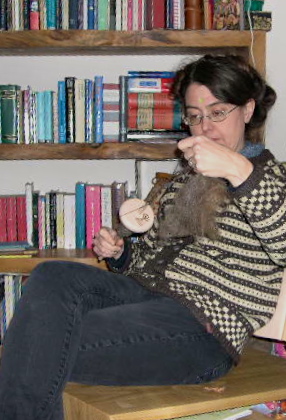
Meanwhile, my bags of ‘fluff’ and spindle were languishing in the project pile. So, yesterday I had the luxury of sitting by the fire for half a day spinning and I managed to come up with a little ball of brown yarn which, together with the ivory coloured yarn I spun at the workshop and some blue that my mother made and sent me last year, I decided to work into a cozy collar. It’s almost finished so I’ll post a picture soon. Meanwhile, my little girl is photo crazy and took 10 pictures of ‘mamma spinning’ of which I found two that are in focus! Meanwhile, if you haven’t seen what fabulous fiber art my mother does, go take a peek at her blog http://sarazmuz.blogspot.it.

 I’m excited to say that I’ve also found a local wool supplier for both fluff and un-dyed local wools in nearby Biella where they are working to save the traditional local wool industry. I wish they had more than the title in English but the pictures are pretty!
Biella The Wool Company

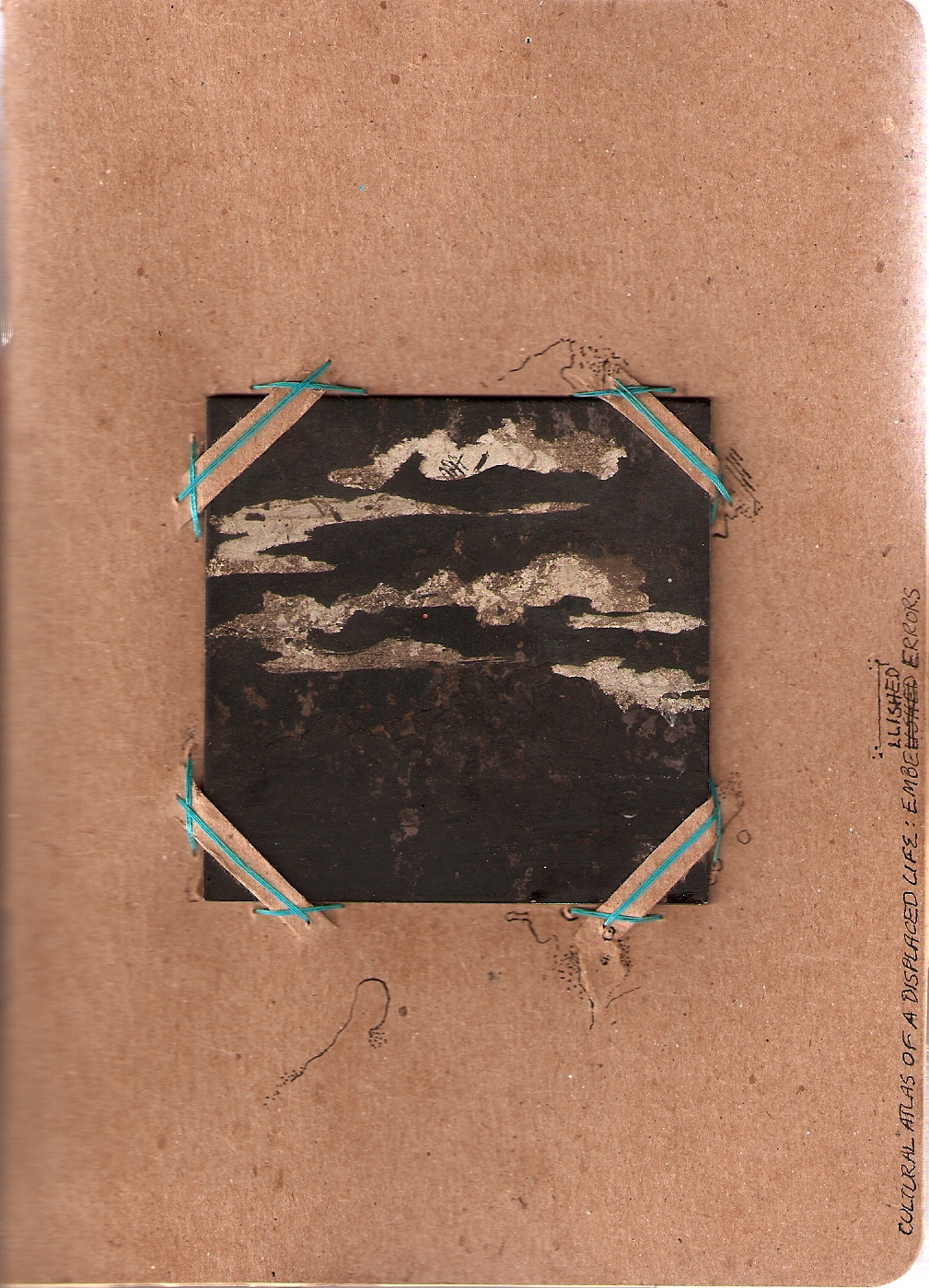
Cultural Atlas of a Displaced life: Empirical Logo(s) or Graphic Incision

Scan 2
second hand bed linens, paint, graphite and embroidery on paper. plastic bag and staples.

Cultural Atlas of a Displaced Life: Size(mic) Map of Texeuropa

copyright 2012 Bonnie McClellan - all rights reserved
Metaphorical scale map of Texas and Europe

Texas is large but the map is only metaphorically in scale. I spent 38 years in Texas and just 7 in Europe but European culture also holds the underpinnings of U.S. culture. In real terms, Texas is about equal to continental France, Belgium, Luxembourg and Switzerland all stuck together (but not nearly as densely populated).

As a Texan living in Italy, “Where are you from?” is a question I get asked a lot. It’s an easy answer; I grew up in Dallas and I have yet to meet an Italian who doesn’t know that it’s the city where either:

  1. JFK was shot, or
  2. the TV series Dallas was made.

This is where I fall on a map though few of them could tell you where the state is in the U.S. and I am often, when describing distances in Texas, constrained to superimpose a map of Europe over my internal map which results in comparisons like:

“Texas is about as big as France / Texas è più o meno la stessa grandezza della Francia.”

Or time/distance equations with multiple variables:

“It takes the same amount of time to drive from Dallas to the border with Mexico as it does to drive from Liguria to Calabria / Ci vuole lo stesso tempo di guidare da Dallas al confine con il Messico, come fa a guidare dalla Liguria alla Calabria.”

The interesting part to me is how often I need to superimpose these two maps to orient myself both internally – culturally and historically – and for others who don’t have and internal map of Texas for reference.