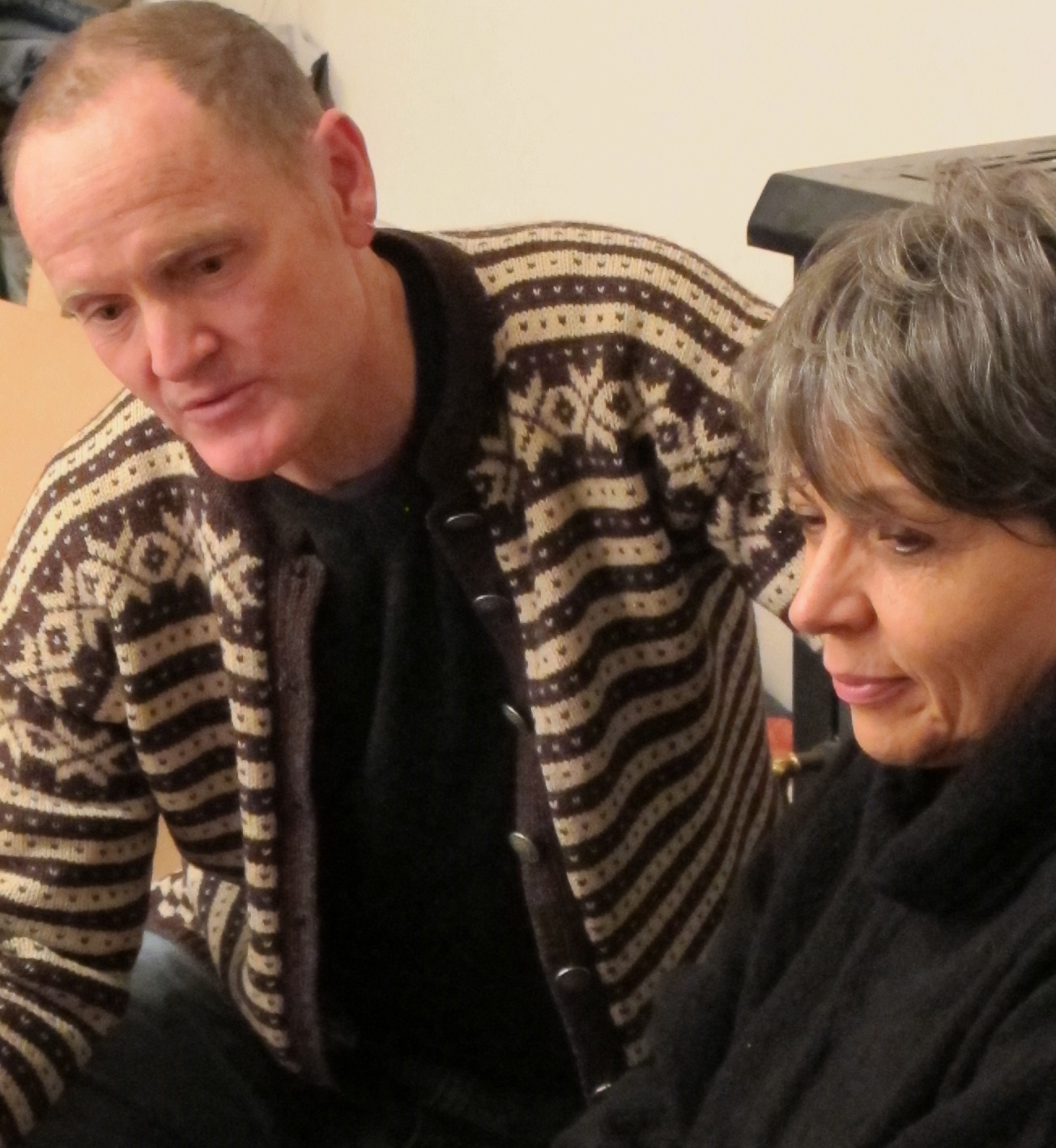
Caulonian Suite: I. Coppi in Cotto

Coppi in Cotto
Terracotta Roof Tiles with Lichen

Coppi in Cotto

Cat spelunks the canyon down
picking through lichen broidered tile.
My lover's hands diagram, inform:
           slab after slab of wet clay
           curved across the thigh to pave
           the high square meteres of the sparrows' way.

This mute arc reiterates the form
of what coulted femeur's slack desire?
Makers now in abandoned bone box stacked
Shout their names marked in black
at dull, dun, desanctified walls.

Amnesiac tiles cup together, deaf above
foxed timbers dressed in sixty years of lime.
They uphold each others' weight,

           Sweet compression.
           As distracted as August lovers
           (lost thigh to sweaty thigh)
           trying to topple not the slender wooden frame
           of a kitchen chair.

Busy, keeping the rain out.

poem and photo copyright Bonnie McClellan 2009
This is the first of a suite of 3 poems that treat 24 hours in Caulonia Superiore

Spinning Out (of Control) and Fancy Socks

Questo fine di settimana ho filato oltre 100 metri di lana…
ma sto diventando più brava (vedi la differenza tra i due prima 
alla sinistra e l’ultimi alla destra)! 
Cosa devo fare con le due qualità diverse di filato?

 So I’ve been spinning with the drop spindle this weekend and managed to meet my goal of making up at least 100  meters of plied yarn…that was more than 200 meters of singles and then andean plying all 4 skeins (whew!). My only problem now is that I’m getting better. My twist is ever smoother and more consistent and I can really see the difference between the yarn I made on Saturday and the yarn I made on Sunday. But now what do I do? The skeins are really different.

Theoretically this yarn is to make a sweater for my husband who fell in love with the roving as soon as I opened the package from the Wool Box. “It’s so smooth, it’s so shiny, it’s so soft! It’s almost as beautiful as your hair,” he says. If you read the last post you’ll know why he’s partial to Norwegian wool. He wants a close-fitting, raglan-sleeve turtleneck in slip-stitch rib so I’m thinking that I might use my ‘first’ skeins for the collar, the cuffs and the 1×1 rib that I’ll be using for the bottom edge and then hope that I can try not to get any better just yet!

“mini-trecce con merlatura” queste costa/mini-treccia
ho usato su due differente paio di calzini
e credo che il ‘merli guelfi’ ai talloni e punte
sono un modo divertente
per rendere la transizione tra i colori.

Meanwhile, the sock equilibrium is changing. I’ve been making wool socks for myself for some time now and at first my husband teased me about spending weeks on a single pair…until I made some for him. “They’re soft,” he says, “they’re comfortable,” he adds, “they’re beautiful!” So, now that he’s been converted to the joy of wearing hand-knit socks, I’m trying to make up the gap. I have more than 7 pair (one that my Mother made and sent me). He has ‘only’ three. These ‘toe-up’ grey ones with mini-cable rib and ‘crenellations’ are the latest. He’s hard on his footwear so I made a slip-stitch reinforced heel (alternating the rows to get a more delicate honeycomb effect rather than straight lines). I have done the square crenellations as a colour transition technique on several pairs of socks and find it quite nice for transitioning into a rib.
The blue and white striped ‘sailor’ socks are his favorites. Made from Lanagatta’s ‘Nuova Irlanda’ knit up on U.S. #3’s; I have to say that they have stayed soft, have not pilled at all and have not shrunk or stretched a millimeter since they came off the needles a year ago.

Questi “calzini di marinaio ”
sono i preferiti del mio marito.
His fourth pair will be the Modified Highland Hose that I posted a few weeks back made with a gorgeous and very sturdy, natural tweed Morron Bouton” that is a soft un-dyed tan with tiny fuchsia, marigold, and grass-green flecks.  I’m  knitting those top down  and on 3’s though  that needle gauge is a bit tight…I managed to snap one of my bamboo needles while cabling! However, between the snug gauge and the fully-reinforced Dutch heel, I don’t suspect he’ll be wearing through them any time soon.

Thanks for stopping by to read and Happy wool-working!

Norwegian Wool and the Magic Sweater!

This beautiful sweater was made for my husband Matthew when he was an exchange student in Norway. He was 16 then and is now edging close to 50.

It’s like a magic sweater out of a fairy tale. Matthew tells a story of how he took it off at a party when he was studying at the Maryland Institute in Baltimore and when he went to get it off the pile of coats he found it had gone missing. He thought it was gone forever. Then, three years later when he had his truck packed to move back to Texas he saw it. As he passed St. Johns University on his way out of town, he saw a woman walking the other way wearing his sweater. He stopped the car, jumped out and asked her where she’d gotten it. She said she’d found it at a thrift store. He told her the story of the sweater (then only 10 years into its history) and offered to buy it from her, offered to pay any amount she asked for. She kindly gave it back and he’s had it ever since.

Now that I think about it, this sweater has survived without a single bit of darning for more than half his lifetime. The wool is still glossy; there is not a single ‘pill’ anywhere on the inside or the outside. It has moved from Norway to Texas to Maryland back to Texas and, along with Matthew, settled in Italy. Now in it’s 35th year, I have put a few reinforcing stitches at the cuffs and have noticed that the yarn is thinning around the elbows. I wash it carefully in cold water, dry it flat; despite its age, we both wear it often. It has seen me through a few cold, Lombard days when no other thing in the house could keep me from shivering. This is the kind of sweater that a knitter aspires to.

Inspired by this sweater I recently ordered some Norwegian wool (washed, carded and combed) from a local Italian wool co-op. The box arrived and I have to say it’s beautiful. The same gloss as the wool in the magic sweater. It’s a dream to spin, the staple at least as long (if not longer) than the BLF that I tried at the spinning workshop I went to last fall. It’s also about a third again less expensive than BLF (1.50 euro/100g for the Norwegian wool vs. 2.20 euro/100g for the BLF).

TOPS WOOL NORWEGIAN MOORIT BROWN from The Wool Box

Now the challenge is for me, not only to do a decent job of spinning it, but also to make it into something as beautiful and enduring as the magic sweater.
Back to the Wool-Works!

I spent all of February putting heart and soul into International Poetry Month. Now it’s March (and still crazy cold, wet and even threatening to snow) here in Lombardy…

So I’m happily back to knitting and about to think about starting in on spinning the wonderful fluff that I ordered from The Wool Box back in January. Want to see what’s in the basket?

beautiful pink fingerless gloves requested by my daughter

new pair of ‘highland hose’ adapted for bulky yarn
here they are from the side where you can see the reinforced heel.

My new hat that I just finished yesterday! Love that SSPTBL decrease….

Where are they now?

“IPM will be presenting poems that map territories both broad and intimate, urban and rural, topographies of nations, family relationships and internal landscapes. I invite you all to come and read, bring your keys and re-map the territory of the coming 28 days of poetry…who knows what you’ll discover about your own territory…You are Here. You are This.”

That was the premise with which we began the journey of International Poetry Month. I hope that both Readers and Poets have enjoyed the trip. Today is the second of March, spring is on it’s way and the wind has come to blow through the leaves of these poems and carry them away, leaving only the voices behind. Some you will still be able to find on the web, or in a book. Some will be gone for good. Following is an alphabetical list of the participating poets; each name is also a link to the poet’s work posted at IPM. My deepest thanks to all of you who have participated in IPM 2013 by reading or writing or both.
Again, my sincere thanks to you all for your generous attention to all of these writers and their work.
All the best and Happy Reading,

Bonnie M. McCllan

If your interested in knowing why the written versions of the poems are disappearing, please read my brief post from IPM 2010 HERE.

“La Joie Venait Toujours Après la Peine” : by Liliane Richman

This poem in its written form has disappeared. If you want to know why, click HERE.

To hear a reading of this poem, click on the player below:

Copyright 2013 Liliane Richman, all rights reserved

To hear more poems by Liliane Richman, click HERE.

No Bed is an Island (for Brenda): by Adina Richman

This poem in its written form has disappeared. If you want to know why, click HERE.

copyright 2010 Adina Richman, all rights reserved

to hear a reading of this poem, click on the player below:

To read or listen to more poems by Adina Richman, click HERE.

Day of the Turtle: by Brad Frederiksen

This poem in its written form has disappeared. If you want to know why, click HERE.

This written version of this poem can be rediscovered HERE.

To hear the poet’s reading of this poem, click on the player below:

This work by Brad Frederiksen is licensed under a Creative Commons Attribution-Share Alike 2.5 Australia License.

to find more work by Brad Frederiksen on this blog, click HERE.

To read more work by Brad Frederiksen, click HERE.

How We Lived Then – The Culture of Style: by Helen Martin

This poem in its written form has disappeared. If you want to know why, click HERE.

To listen to a reading of this poem, click on the player below:

To find out more about Helen Martin, visit her professional website HERE.

To enjoy a reading of Helen Martin’s IPM 2012 entry, click HERE.

CHICKEN PAPRIKASH: By Jill K. Sayre

This poem in its written form has disappeared. If you want to know why, click HERE.

To hear a reading of this poem, click on the player below:

To find more work by Jill K. Sayre, click HERE.

Creative Commons License

Chicken Paprikash by Jill K. Sayre is licensed under a Creative Commons Attribution-NonCommercial-NoDerivs 3.0 Unported License.