La (Nuova) Fontana a Cannobio

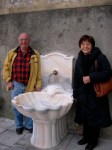
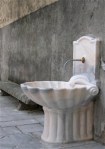
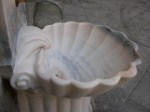
Detail of the New Fountain

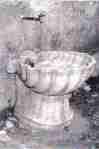
Here are the pictures  and the story of  the fountain that Matthew carved for the piazza across the lake at Cannobio. We both agree that it looks somewhat like a Baroque Bidet but it matches the Church perfectly! The story below coincides with that which we heard from the Vescovo of the church who kindly allowed us to approach the altar and view the original painting and invited us for the festival in January. The fountain that Matthew made replaces one from the 18th century that was stolen while it was dismounted for a repaving of the piazza that was done in 2004. A photo of the original fountain is below.

The only Image I could find of the original Fountain

The marble that the ‘new’ fountain was carved from is the pink ‘Candoglio’ which is reserved exclusively for the big cathedral in Milan…but, you know, Italian style, somebody knew somebody who could get a piece donated for this church.  Matthew said that it was a pleasure to work with this stone that he would otherwise never have carved.  I should have asked him for a scrap of it for the rock garden on the dashboard of my van. It is really lovely to think that he made something that, even if it’s small, should still be there in 100 years, probably more.  It certainly makes us feel invested in the community.

The story of the Church of the S.S. Pietà in Cannobio and of it’s miraculous relic is as follows:

The Sanctuary of the Most Holy Pietà

The Sanctuary of The Most Holy Pietà, that stands behind the beautiful promenade of Cannobio, was commissioned by San Carlo Borromeo in about 1578 and was built on the site of a pre-existing modest Church.

It was precisely here between the 8th of January and the 27th of February 1522 that a miraculous event took place: in a humble inn, a small painting that depicted the deposition of Christ from the Cross between the Madonna and St. John the Evangelist had “come to life”, blood and tears were coming out of the painting and a fragment of human rib was sticking out from the chest.
Today, the small painting and some blood-soaked clothes belonging to those who witnessed the events, are preserved in a niche in the high altar of the Sanctuary, whereas the Holy Rib is preserved in a reliquary in the Church of San Vittore.

The building has a single nave, with a rectangular apse and an elegant dome, which was the work of the architect Pietro Beretta. The rich internal decorations date back to the 17th and 18th centuries: there are paintings, stucco and polychrome marbles.
The most valuable work is undoubtedly the altarpiece of the high altar. This is an oil on wood, which depicts the Climb to Calvary and was executed around 1540 by the renowned artist Gaudenzio Ferrari. Beneath the presbytery there is a crypt that since 1947 has been the resting place of the deserving Don Silvio Gallotti from Cannobio.

Each year, on the evening of the 8th of January (and in a less evocative manner, also on the Monday of Pentecost), there is a traditional religious ceremony, which brings the “Holy Rib” from the Parish Church of San Vittore to the Sanctuary of the Most Holy Pietà. The holy rib is brought in a procession that is lit up by hundreds of lights placed in the windows of the houses.
The Pocket Gallery reopens with “I’m Happy To See You”

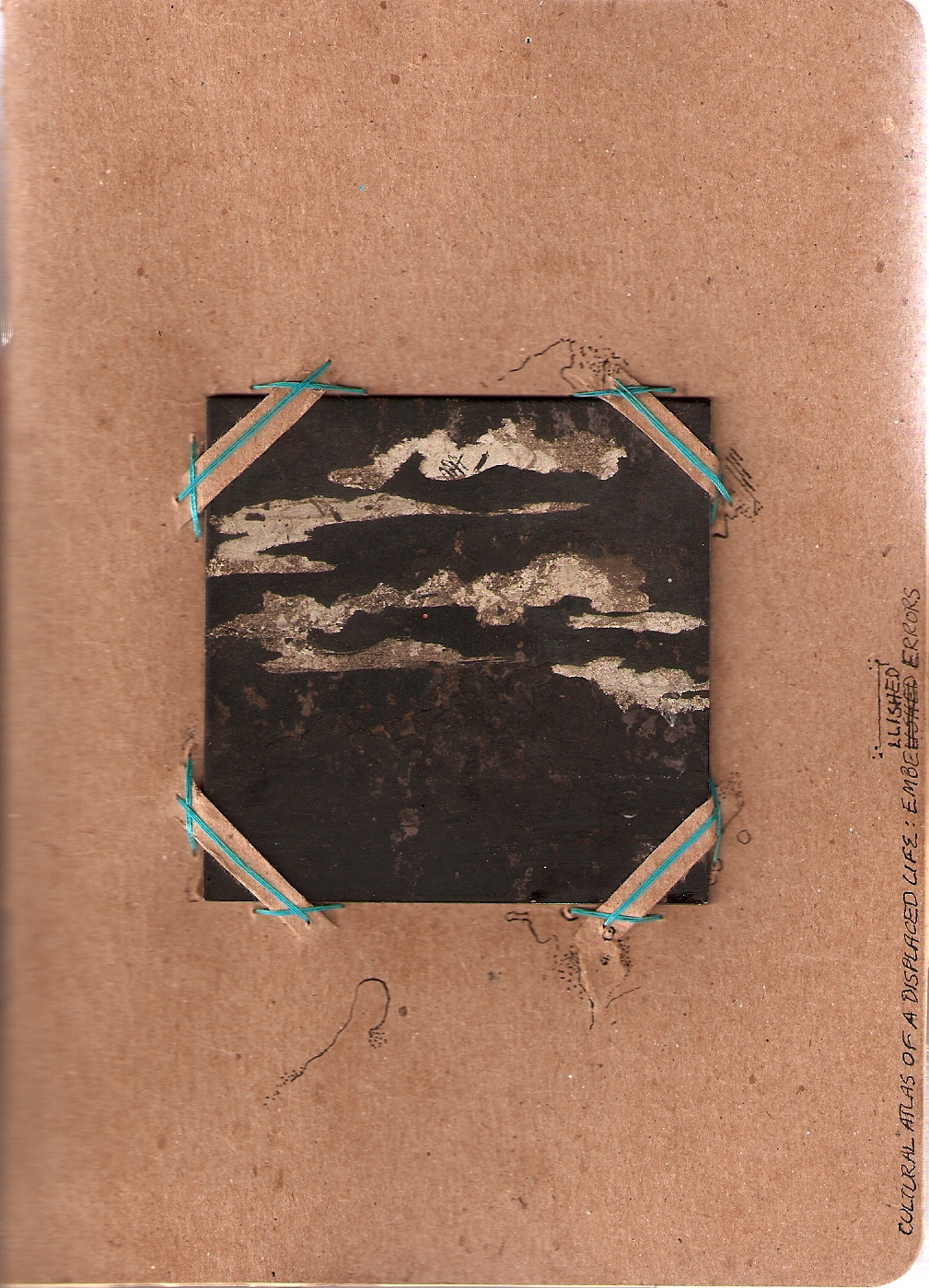
The Pocket Gallery, a contemporary artspace, has reopened with an exhibition by the Italian artist Marzia Gallinaro. This gallery, situated within the two drawers of a renovated screw-tip box, offers contemporary artists an alternative to a traditional, fixed location gallery and the complete ephemera of an internet exhibition.

Marzia’s opening was held at the popular Paduan summer night-spot, Il Chiosco (The Kiosk) on Wednesday evening. The event was well attended, and not only by the friends of the artist and gallery owner and curator, Matthew Broussard. With a sly nod to the idea of a ‘peep show’ small groups of 4 to 6 people filed in to an intimate viewing room to see the more than 100 erotic drawings that Marzia had created for the lower drawer of the gallery while many others hovered around the door craning their necks to try and see over the hunched shoulders of the chosen viewers. In the upper drawer of the gallery the ‘floor’ had been replaced with a magnifying glass marked with centimeters (never ask a carpenter how long 15 cm is). Within the span of a few hours well over 60 people had viewed the works. Four of the drawings were purchased for private collections the night of the opening.

The exhibit will be available for viewing throughout July and August both by appointment within Italy and on the Pocket Gallery website (available July 28th) which can be accessed by clicking on the link located above and to your right. Click below to watch my video of the exhibition opening…

“Is that a pistol in your pocket or are you glad to see me?” With a one-liner Sophie Tucker turns the most intimate of situations into a worldwide cultural icon. Contemporary art often plays with the tension between private and public,exhibiting as “product” the most intimate emotions: a (sometimes) refined variation on the most common marketing ploy of all. Marzia Gallinaro acknowledges this specific aspect of the Pocket Gallery and makes it her own: an art gallery is a public viewing space; but when it’s hidden…?…down there, in your pocket…? It becomes a symmetrical mirror of the tendency of contemporary are to trumpet private sentiment in public. She pokes fun at those who become voyeurs under cover of culture, and who slip into small private places (art galleries?) like pre-teens to peek at dirty pictures. Her nervous line drawing which smacks of graffiti (another public venue for private eroticism) creates a tension well suited to the paranoia (of lots of guys) at having to use a magnifying glass or a ruler… the gallery isn’t the only place where size matters.”

-Matthew Broussard owner and curator of the Pocket Gallery


What am I doing with my life? (The importance of glass cherries).

The poet, Eugino Montale says, “The ancients always said that poetry / is a stairway to God”. Montale doesn’t specify if that stairway is for the reader or for the poet…he only maintains his sense of self-irony, “perhaps not if you read mine.” The thing that I take from the poem is that Montale has found (or rediscovered) that stairway through an act of intense observation, of which the writing is only a record.

Everyone has to find their own ‘why’ in their own way for how they’ve chosen to spend their life. I wonder if it isn’t even more difficult for people who have chosen to spend their lives working a 9-5 office job? I spent a lot of time trying to answer that question myself and here are the best of the many ideas I came up with.

I think that in the contemporary world acts of intense observation and consideration are few. Our world is scanned and channel surfed, flickered but not ‘seen’ in any real sense. My idea of what the artist’s job is, is to catch people’s eye for long enough that they see below the surface flood of sound and colour and scent. Even if it is only 30 seconds instead of 15 to say to themselves, “look at how intense that red is!” at least they’ve finally seen red for a half a minute instead of it not registering at all…and I, if I’m the artist, have had the pleasure of figuring out something about red in the process.

Maybe this is a stupidly simple idea of things on my part and of course has nothing to do with the practical aspects of making a life as an artist. Perhaps also hopelessly broad as it implies that anything done with attention is art (although I have to admit that I find that idea very attractive). It reminds me of the time I visited Hawaii (Kauai); there were two kinds of flower necklaces…the ones made of orchids that smelled of nothing but looked beautiful for days and the ones made of fragipani which were fabulously fragrant but brown and falling apart by the end of the day though they still smelled like heaven…two completely different ways that I experienced what flowers are, that made me ask myself questions about the nature of permanence/impermanence and beauty. What fun to ask these questions and without worrying about how many different answers there might be.

Nature has something of the same drive as artists :

“The force that through the green fuse drives the flower / Drives my green age;” (- Dylan Thomas).

The world creates and destroys in profusion and some people find a need to transform that frantic transience through observation. Our perceived world won’t hold still so artist’s give us talismans, little (or big) anchors to hold on to…others use these moments/observations a way back to or out of themselves, or to god, as they choose.

Aristotle says, “All Art is concerned with coming into being.” though I have not read enough Aristotle to say if that coming into being is the art or the artist or why either should be important…but it sure sounds nice.

Martha Graham, an early icon in modern dance said something more direct:
“There is a vitality, a life force, an energy, a quickening, that is translated through you into action, and because there is only one of you in all time, this expression is unique. And if you block it, it will never exist through any other medium and will be lost.”

What informs our vision of past cultures of the history of the human race? Art, architecture, literature, historic chronicles, music, clothes, jewelry…all acts of observation in some sense, interior or exterior, profound or frivolous. My own experience of art is that it is more of a bridge than a stairway, and the bridge is one that is in time: from the past to me the work of other artists known and unknown speaks to me through architecture, through poetry, and yes, even through a brooch made of glass cherries…someone sat and drew, designed, that brooch in austria in the 30’s?…maybe that person is even still around? but this little piece of them has made its way into my life…it holds my shirt closed, it makes my daughter smile, it tells me something about a time when ‘beautiful’ meant something different from what i see now. Not better or more beautiful, just different. It makes me smile, it makes me think.