hands suspended: by anonymous 20th century poet

had i the resources
to create today
an image external
of the inside of my brain,
you would see before you
a juggler,
eyes cast down
at objects once suspended
patterned
blink to blink
now rendered chaotic
on static floor.


To hear more poems by anonymous 20th century poet, click HERE.
To read more poetry by anonymous 20th century poet, click HERE.

A Brief History of Babel: by Robert Okaji

Borders, windows.
Sound.

Trudging up the steps, I am winded after six flights,
my words smothered in the breathing.

The Gate of God proffers no favors.
When the spirit gives me utterance, what shall I say?

Curiously, no direct link exists between Babel and babble.

A collective aphasia could explain the disruption. One’s
inability to mouth the proper word, another’s
fluency impeded by context.

A stairway terminating in clouds.

Syllable by twisted syllable, dispersed.

Separated in symbols.
And then,
writing.

To see the sunrise from behind a tree, you must face
east: higashi, or, a discrete way of seeing
the structure of language unfold.
Two characters, layered. One
thought. Direction.
Connotation. The sun’s
ascent viewed through branches
as through the frame
of a glassless
window.

Complexity in simplicity.
Or the opposite.

I have no desire to touch heaven, but my tongues reach where they will.

Who can know what we say to God, but God?

And the breeze winding through, carrying fragments.


Listen to a reading of the poem by the poet:

You can find more poetry by Robert Okaji on this site or on his blog HERE . A collection of Robert’s poetry is available in his chapbook “If Your Matter Could Reform” which was published as part of the the National Poetry Month series by Dink Press 

Language’s Power: reading the code

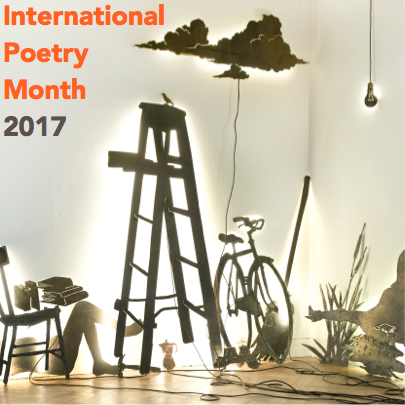
As we near the start of IPM 2017 on Feb. 1st, submissions are arriving and I’m getting excited about presenting them to our readers. I was thinking about communication networks, social networks and neural networks. While looking for images of neural-network maps, I ended up with a bit of a headache from trying to understand what is and isn’t understood about how these cells function in the brain. It turns out there are hundreds of different types of neuronal network maps. I finally settled on one that reminded me of a Gustav Klimt painting – it’s from the sound-processing area of a mouse brain.

A two-photon microscopy image showing a calcium sensor (green), the nuclei of neurons (red) and supporting cells called astrocytes (magenta). Credit: John Issa/Johns Hopkins Medicine
Credit: John Issa/Johns Hopkins Medicine

The number of neurons in the human brain is enormous, estimates vary from 86 to 100 billion, but the truly fascinating thing is that each person has an individual ‘neural map’ that develops over time, formed and annotated by personal experience and varied input. One of the many jobs these networks do from the very beginning is process language – expanding our ability to express ourselves and to understand one another. One of the tools we use to achieve this result is the word; but words must be set within a structure to be understood. Some languages are now unreadable – such as those of the ancient Indus Valley civilizations: the words and their supporting structure are there to be read but, frustratingly, we can no longer decode them. As I mentioned in my previous post, others, such as the Sumerian and Akkadian of the Gilgamesh epic, are thankfully still communicating across the millennia despite the challenges of decoding them.

collection-of-tablets

As this makes clear, despite its power, language is limited – it needs not only a transmitter but also a receiver. As Andrea Moro points out in his book I Speak, Therefore I Am: Seventeen Thoughts About Language:

“We don’t actually see light, we only see its effects on objects. We know it exists because it is partly reflected by the things it encounters, thereby making visible what would otherwise be invisible. In this way nothing, illuminated by another nothing, becomes, for us, something. Words and sentences work in the same way: they have no content of their own, but if they encounter someone who listens they become something.”

Submissions are still open, so if you’re a poet please send your work to be considered. If you’re a reader – get ready to illuminate with your gaze the upcoming 28 poems and transform them into the splendid ‘somethings’ they were meant to be.

Language’s Power: time travel

In my previous post, Language’s Power: across the universe, I mentioned the power of language to create and transmit images across time and space, a pas de deux between writer and reader. How far back can we travel through time? One of the many inspiring things I encountered in 2016 was some poetry that had its beginnings in the 21st century BCE: a new and utterly gripping translation by Andrew George of the Epic of Gilgamesh along with fragments of other Akkadian and Sumerian poems. What a flood of fascinating images! Interestingly, the ones that have stuck with me are the ones that I can’t resolve because they are are so unfamiliar; as when, in the Old Babylonian poem In those days, in those far-off days, the goddess Inanna takes an uprooted willow from the banks of the Euphrates to plant in her garden:

‘I, the woman, did not plant the tree with my hand, I planted it with my foot.
I, Inanna, did not water the tree with my hand, I watered it with my foot.’

I’m fascinated with this image of the goddess of beauty, love, lust, wisdom and war carefully planting and caring for a tree with her foot rather than her hand. Why? Like Andrea Moro’s lizards not stopping to dream from the previous post, this image was so unexpected that I’m still happily turning it over in my mind months after having encountered it.

Another inscrutable image comes from later in this same poem, after Inanna’s willow tree has matured and been converted into lumber for her ‘pure throne’ and ‘pure bed’ and the roots have been made into playthings for the king, Gilgamesh/Bilgames, that then fall into the netherworld. Bilgames’ servant, Enkidu, goes in search of the king’s toys and remains trapped in the land of the dead. His spirit temporarily returns and gives the king an account of how things are organized in the afterlife in a wonderfully rhythmic and repetitive series of questions and answers:

‘Did you see the man with one son?’
‘I saw him.’
‘How does he fare?’
‘For the peg built into his wall he bitterly laments.’
‘Did you see the man with two sons?’
‘I saw him.’
‘How does he fare?’
‘Seated on two bricks he eats a bread-loaf.’

I can get to the second image with ease but the first is like a little rock in my brain’s pockets – I keep foodling with it, trying to make sense of the peg in the wall and the lamenting man. I wonder what connections sparked to life in the neural networks of those young scribes who copied these poems as part of their lessons, being both readers and writers? Certainly the ‘peg built into his wall’ had some specific sense to them so perhaps an Akkadian scribe would just have passed over it, carefully copying out the cuneiform and looking forward to arriving at the fate of the man with seven sons so that he could stop for a barley-beer break before plowing ahead with sad fates of eunuchs and barren women. I, however, remain standing in the bare, unfurnished room with a peg in the wall, staring in fascination at a solitary, weeping man and I’m (forgive the pun) dying to ask him: ‘so, what’s with the peg?’

Even if you have zero interest in ancient poetry from the fertile crescent, it’s still amazing that we have the possibility, through the diligent work of a vast network of people from the poets who composed and recited the original works to the scribes who recorded them more than four millennia ago to ancient kings who valued culture, like Ashurbanipal, to the archeologists who found and preserved them, to scholars like Andrew George who have deciphered and meticulously translated them. Of course, without interested listeners and readers, much of that work would not have been done at all or have been about as useless as ‘a crack in the floor…filled with dust’.
Are you a poet? Make your mark and send in your ‘clay tablet’– short works and epics equally welcome – IPM 2017 is now open for submissions.
Are you a reader who is ready to take part in the creative network, doing the essential task of responding to and playing with the poets’ images? Go to the upper right of this page and you can sign up for an e-mail subscription.
"Tinker" - copyright Matthew Broussard 2016

Language’s Power: across the universe

This year I had the pleasure of an excess of inspiration, both in my work and outside of it. First and foremost I had the amazing luck and pleasure of translating a book by Andrea Moro, an Italian linguist and neuroscientist. The book was about the verb ‘to be’, its grammatical (and in some senses philosophical) history, it’s unique position in linguistic theory and a tempting little possibility of a hint about how our brains ‘react’ to language. Fortunately for me, the book was geared towards a non-specialized reader and chock-full of fascinating stuff that I never knew about language. I learned more than I could have ever imagined. Meanwhile, in preparation for translating that book, I read a few of his other books, both in Italian and in English to get a sense of his perspective and voice before I began the translation. As soon as I read the following line from “The Boundaries of Babel: The Brain and the Enigma of Impossible Languages” my mind went straight to this essay that I would be writing to introduce International Poetry Month 2017. It so clearly describes the reader’s experience while also implying the writer’s:

Even now, your eyes are following a string of black signs that conveys ideas and images that were produced by a different brain in a different place at a different time. If I wanted, I could, simply by writing, activate images in your mind that may not have been there before: A long line of lizards crossed the desert without even stopping to dream. It is quite unlikely that you have already encountered this sentence. Nevertheless, the image was created in your mind with no effort, just by your scanning that string of black symbols.            -Andrea Moro

Imagine what power poets have to create in the mind of a given reader, who exists in a completely different place and time, a never-before-encountered image. What a joy it is to write! Communicating across time and space, creating a word-map of your own images, associations and experiences waiting to be unfolded and explored. And then again, what a profound pleasure to read! The unexplored word-map awaits only your eye to be revealed and, in the reading, creates a new map of your own associations and experiences.
Over 2016 the power of language to damage and tear apart has never been more evident, from Oxford’s word of the year, post-truth, to fake news, to political rhetoric, to harsh exchanges between friends and families. In February of 2017 I would like to counterweight language’s destructive power and offer instead an opportunity for language to link people and places in a shared ‘neural network’ of creative exchange between readers and writers.

Are you ready? IPM 2017 is now open for submissions.

Next up: Poetry as Time Travel – why is the woman planting trees with her foot? Why is the man crying over the peg? Wouldn’t you like to know?

Dark Business: by Bonnie McClellan

Like cinderella’s slipper

this poem arrives

to fit your mind’s foot,

hard but comforting.

If not, blood will tell:

‘you’ve trimmed off a bit’

        –heel or toe–

the doves will call you out

even if the sky has read

the weather report and

dropped its fog to hide

your stocking’s stains.


Not like the brazen giant of Greek fame,

With conquering limbs astride from land to land;

Here at our sea-washed, sunset gates shall stand

A mighty woman with a torch, whose flame

Is the imprisoned lightning, and her name

Mother of Exiles. From her beacon-hand

Glows world-wide welcome; her mild eyes command

The air-bridged harbor that twin cities frame.


“Keep, ancient lands, your storied pomp!” cries she

With silent lips. “Give me your tired, your poor,

Your huddled masses yearning to breathe free,

The wretched refuse of your teeming shore.

Send these, the homeless, tempest-tost to me,

I lift my lamp beside the golden door!”

 – Emma Lazarus

Borrowed Words: by Bonnie McClellan

BORROWED WORDS

Adam to Eve, later in life,
after babel’s tower fell,
began his speech with borrowed words:
“Oh, my love!”
What world would I not give now
for that eternal, ancient fantasy:
“A loaf of bread, a jug of wine, and thou!”
In the shade of Kunitz’ VERY TREE,
the gentle spark released beneath
lithe pressure of your palm
above my heart
which would break
its fragile net of bone to rest
that narrow distance
closer to your flesh.
Now distracted by quick thoughts
of two french words: “chair” for flesh and “peau” for skin.
The first implying something
more animal/essential; the second softer,
more sensual than elemental:
“chair de ma chair.”
“os de mon os.”
ossature de ma vie.
bone network, calcite frame.
White
white,
like bread,
like wine;
in my bones singing:
“sang de mon sang”
with each red cell
new marrow-minted.

The Housewife’s Lament: Laundry – by Bonnie McClellan


The washing rustles its sorry story:
table stains and grey dust
leave off
hanging on
by a thread.

The Housewife’s Lament: Guest – by Bonnie McClellan

Having left my eyes ajar,
night falls in:
drunk and tired as ever,
asking me to tend
the electric altar of his current stars.

It’s been days since
you packed up the suitcase
of your kiss.
I’m here with the night,
catching the anti-meridian in my arms.

Solareclipse 2105